Eurozone inflation returns to 4%: How much downside is left for the euro?
2026-11-17 18:14:30
On Tuesday, November 17th, the euro traded in a narrow range against the US dollar around 1.1000, continuing its recent decline from higher levels. Eurozone inflation rose to 4.0% in October, with the energy component increasing by 20.8% year-on-year, indicating persistent price risks. Meanwhile, recent comments from European Central Bank Vice President Boris Vujicic have been generally dovish, emphasizing that energy price developments could push up inflation, while also highlighting AI and sovereign debt as significant stability risks. He believes that weakening confidence and rising borrowing costs will partially curb inflation by suppressing growth. 
Energy price risks continue to support inflation concerns.
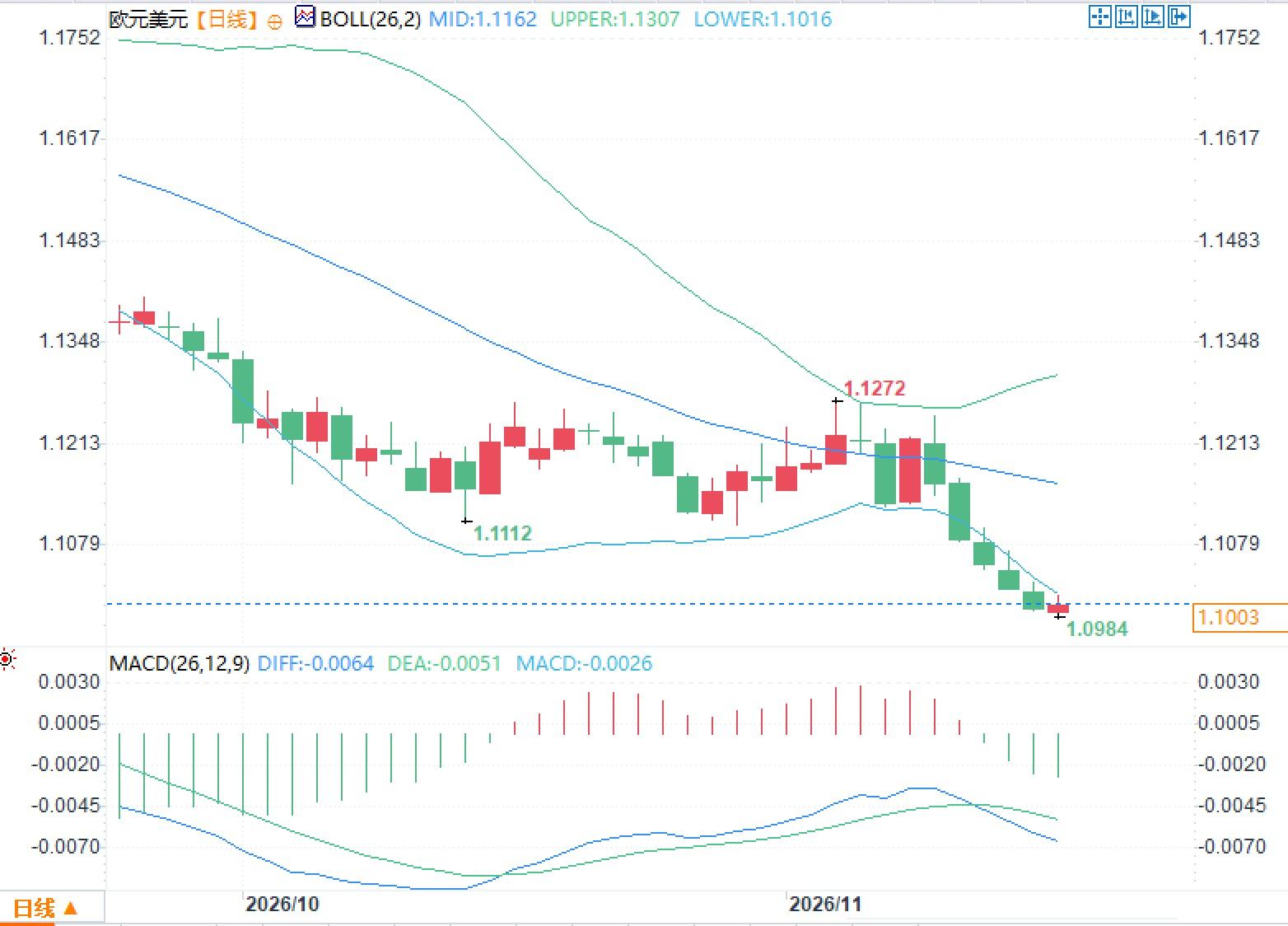
Energy prices are currently the main driver of inflation in the Eurozone. Overall inflation rose to 4.0% in October from 3.8% in September, with the year-on-year increase in energy prices widening, reflecting the continued impact of supply disruptions and shipping risks in the Middle East. This environment complicates the path of inflation decline, and policymakers tend to maintain a relatively restrictive stance to provide some support for the euro when prices fall. The market is focused on the potential transmission of energy prices to core inflation. Although the rise in overall inflation is mainly driven by energy, prices for services and non-energy industrial goods have remained relatively stable, with core inflation hovering around 2.5%. If the energy shock persists, it could affect broader price formation mechanisms through cost channels, thereby influencing the pace of policy decisions. On the daily chart, the euro/dollar exchange rate is near the lower Bollinger Band, with the middle band around 1.1162, the upper band at 1.1307, and the lower band at 1.1016. The MACD indicator shows the DIFF at -0.0064, the DEA at -0.0051, and the histogram close to the zero line.The comments from the European Central Bank Vice President were characterized by a moderately hawkish tone.
In his remarks on November 16, Boris Vujicic pointed out that recent energy price developments could push up inflation, reinforcing the rationale for maintaining a relatively restrained policy stance. He also emphasized that AI and sovereign debt risks are "very prominent" and could reinforce each other through non-bank financial channels, posing a challenge to financial stability. Vujicic further stated that weakening confidence and rising borrowing costs should be curbed by suppressing growth to contain excess inflation. This statement, while acknowledging the upside risks to inflation, also points to downward pressure on growth, making the overall tone, while hawkish, somewhat milder. Eurozone banks' capital buffers remain relatively ample, but leverage and liquidity-related risks in the non-bank sector require additional attention. Regarding sovereign debt, Vujicic noted that debt vulnerability on both sides of the Atlantic has further increased, with rising long-term yields already reflecting some concerns. AI-related financing is substantial and may compete with government bonds for funds, thus affecting borrowing costs. These factors work together to maintain a balance between inflationary constraints and growth pressures in the policy path.The overall rise in Eurozone yields reflects risk sentiment.
Eurozone benchmark government bond yields generally rose. The yield on German 10-year bonds was around 3.38%, while the yields on French and Italian 10-year bonds rose in tandem, with both the core and peripheral yield curves adjusting. This broad-based yield increase echoed the weakening risk appetite of the day, reflecting a repricing of market expectations regarding the sustainability of inflation and policy stance. The yield increase was also driven by concerns about energy prices and debt sustainability. Higher borrowing costs could further impact the fiscal space of highly indebted countries, subsequently feeding back into growth and inflation expectations.The coexistence of expectations of crude oil oversupply and geopolitical uncertainties
The International Energy Agency (IEA) indicates that the global oil market will return to a state of oversupply in the fourth quarter, with an oversupply of approximately 1.7 million barrels per day. Supply is projected to average 105 million barrels per day, primarily driven by a faster recovery in Middle Eastern exports than global demand growth. Despite ongoing disruptions to shipping in the Strait of Hormuz and attacks on related facilities, Middle Eastern exports have partially recovered through alternative routes. Currently, Brent crude oil prices are fluctuating around $92 per barrel. The oversupply expectation is putting downward pressure on prices, but shipping risks and inventory changes are still carrying a premium. The decline in crude oil prices is putting pressure on commodity currencies and, simultaneously, influencing Eurozone inflation expectations through the energy channel, creating a two-way effect on the euro.Frequently Asked Questions
Question 1: What impact will Vujicic's remarks have on policy expectations? Answer: His remarks leaned towards a moderately hawkish stance, emphasizing that energy could push up inflation, while also pointing to AI, sovereign debt risks, and downside growth factors, reducing the likelihood of a radical shift towards easing. Question 2: How do crude oil oversupply and shipping risks work together? Answer: Oversupply expectations suppress prices, but disruptions in the Strait of Hormuz and attacks on facilities maintain uncertainty, affecting inflation and related currency pricing through the energy channel.- Risk Warning and Disclaimer
- The market involves risk, and trading may not be suitable for all investors. This article is for reference only and does not constitute personal investment advice, nor does it take into account certain users’ specific investment objectives, financial situation, or other needs. Any investment decisions made based on this information are at your own risk.