Iran reiterates two-day plan to lower oil prices; will the US compromise?
2026-11-17 16:14:31
On Tuesday (November 17), during the Asian and European sessions, international oil prices consolidated weakly. The WTI main contract was down 0.58% and trading at 85.21. It had fallen nearly 4% on Monday night. The direct trigger for this round of oil price decline was the easing of expectations following the Oman mediation and Iran's announcement of a plan to open the Strait of Hormuz. The market was clearing some of the geopolitical premium. At the same time, oversupply and demand are the background conditions in the medium and long term. The IEA and many other institutions judged that the impact of shrinking demand has outweighed the supply shock caused by shipping lane disturbances. The expectation of a recovery in Middle Eastern exports continued to suppress the market. 
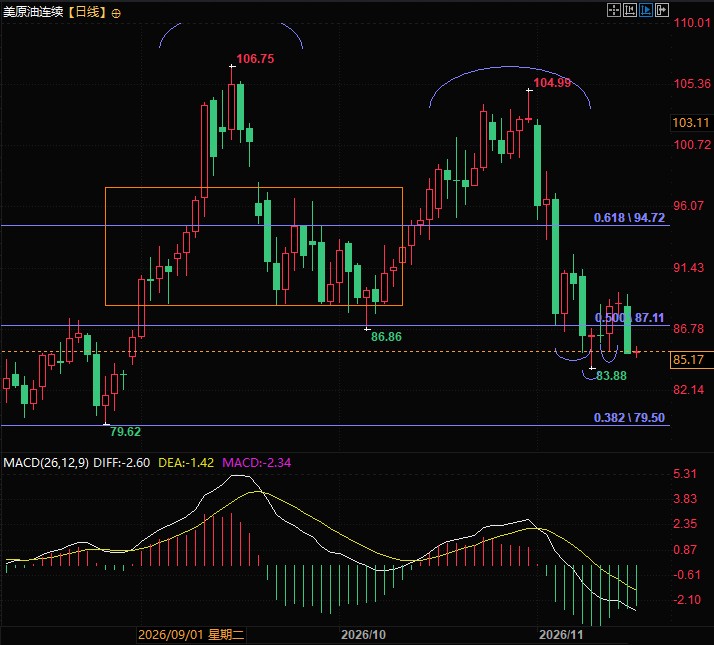 (WTI crude oil futures daily chart, source: EasyTrade) At 16:11 Beijing time, WTI crude oil futures are currently trading at $85.19 per barrel.
Oman mediates: The "two-day opening plan" for the Strait of Hormuz remains at the proposal stage.
Oman is currently the most important buffer channel for communication between the US and Iran. Iranian Foreign Minister Araqchi visited Muscat today and held a constructive meeting with Omani Foreign Minister Badr. The two sides exchanged views on de-escalating regional tensions, securing maritime routes, and ensuring the smooth flow of international shipping and trade. They agreed to maintain diplomatic communication channels and seek sustainable solutions through dialogue and respect for sovereignty. On January 1st, Araqchi stated that, at the suggestion of Qatari mediators, Iran agreed to the "two-day plan" for the Strait of Hormuz: the first day would see the US take a series of compliance measures, and the second day the Strait of Hormuz would be open, with shipping returning to normal. Subsequently, after the Central Asia and West Asia Economic Cooperation Organization (CEEC) meeting in Islamabad, Pakistan, Araqchi told the media that member states at the meeting expressed support for the "two-day plan," hoping to achieve a comprehensive ceasefire. This news is the core catalyst for recent oil market pricing: the market has begun to price in the easing of the risk of a Strait blockade, prematurely realizing the war premium previously priced into oil prices. However, it must be noted that the plan is currently only a proposal, and the core differences between the US and Iran have not yet been resolved. The US maritime blockade, sanctions, and Iran's nuclear program remain difficult points in the negotiations, and there has been no progress in implementing the plan.US-Iran military standoff escalates: shipping in the Strait of Hormuz nearly halted, three US aircraft carriers deployed to the border.
Diplomatic efforts are proceeding in tandem, while the military standoff in the Gulf remains tense. Navigation in the Strait of Hormuz has deteriorated significantly. Kpler shipping data shows a sharp decline in the number of vessels passing through the strait compared to the pre-war average of 130 vessels per day, with recent instances of only a handful of merchant ships passing through on several days, or even none at all. Iran has reported multiple incidents of oil tankers striking mines and catching fire; in the past 24 hours, a fourth oil tanker has been attacked in the waters east of the strait. The Iranian Revolutionary Guard Navy has also publicly warned that mines have been laid in the southern channel of the strait, making passage extremely risky. Bahrain has intercepted multiple Iranian drone attacks, with Iran claiming the targets were US radar facilities within Bahrain. The UAE Ministry of Foreign Affairs publicly condemned the attacks and expressed support for Bahrain's security. In terms of military deployment, the USS Theodore Roosevelt aircraft carrier has arrived in the Middle East, and the US has assembled three carrier strike groups in the region to maintain the blockade of Iranian ports. Market rumors suggest that the US and Israel are considering further attacks on Iranian energy infrastructure; Iran's Deputy Foreign Minister has explicitly stated that it does not rule out taking preemptive countermeasures before a US attack. Drone alerts have been repeatedly sounded at the Khormoor gas field in Iraq's Kurdistan region. The field, which had previously been attacked and shut down, disrupted local power supplies, highlighting the vulnerability of Middle Eastern oil and gas infrastructure. US Vice President Vance also signaled that the Trump administration has no intention of getting involved in a protracted war with Iran; its goal is to destroy Iran's nuclear program, but it will not be deeply entangled in the conflict.Russia-Ukraine peace talks: Multilateral consultations conclude, agreement still needs mutual approval
A new round of multilateral working-level consultations between Russia and Ukraine has been completed. Zelenskyy confirmed that the entire European negotiating team held online talks with representatives from Ukraine and the United States. Kushner and Witkov represented the US at the meeting, while representatives from France, Germany, the UK, Italy, Poland, the EU, and NATO also participated. Kushner revealed that the US is closely coordinating with Russia, Ukraine, and European partners to promote direct contact between Russia and the EU and to prepare for a new round of multilateral meetings in the near future. The negotiations have made phased progress on issues such as Ukraine's security guarantees, its path to EU accession, and a post-war security framework. However, he also acknowledged that a final agreement must be mutually agreed upon by both Russia and Ukraine, and reaching a consensus will require difficult trade-offs from all parties.Yemen Situation: Saudi Arabia adjusts command structure, Houthi continue counterattacks, and risks in the Red Sea rise.
The conflict in Yemen continues to escalate, with the Houthi rebels reporting over 5,183 recent Saudi airstrikes and missile strikes, resulting in damage to numerous civilian targets. Saudi Arabia recently restructured the command structure of the multinational coalition in Yemen, appointing the Saudi Chief of the General Staff as the coalition commander. This escalation is against the backdrop of the Houthi rebellion, supported by Iran, and the forced withdrawal of Saudi-backed Yemeni government forces from large areas along the Bab el-Mandeb Strait, concentrating their defenses in Aden. This has further increased shipping risks in the Red Sea, representing a significant tail risk for the crude oil market.Summary and Technical Analysis:
Geopolitical conflicts are the primary cause of fluctuations in oil prices and other asset classes, and are also the core pricing theme of the current market. Market trading focus directly follows the shifts between geopolitical easing and escalation. However, under the backdrop of geopolitical stalemate, the negative impact of geopolitical easing news on oil prices is usually short-lived and easily corrected by new risk disturbances. Both the US and Iran have accumulated significant leverage, and it remains to be seen whether they will return to the table soon. The US has a large military presence, but the congressional budget outlook is bleak. Iran has been under blockade for a long time, but it still controls shipping costs and insurance premiums in the Strait of Hormuz. Short-term diplomatic easing only leads to a temporary exodus of safe-haven funds. Trading should focus on marginal geopolitical changes, constrained by supply and demand fundamentals, and continuously monitor Oman's mediation, the opening of the Strait of Hormuz, Russia-Ukraine negotiations, and the Houthi situation in the Red Sea. Technically, the recent head and shoulders bottom pattern on the daily chart for oil prices is at risk of failure. Watch whether tonight's closing price can stay above 86.3; if it fails to do so, oil prices may weaken further. (WTI crude oil futures daily chart, source: EasyTrade) At 16:11 Beijing time, WTI crude oil futures are currently trading at $85.19 per barrel.
- Risk Warning and Disclaimer
- The market involves risk, and trading may not be suitable for all investors. This article is for reference only and does not constitute personal investment advice, nor does it take into account certain users’ specific investment objectives, financial situation, or other needs. Any investment decisions made based on this information are at your own risk.