A 20.5% increase in exports failed to translate into a stronger yen; just how heavy is the US-Japan interest rate differential?
2026-11-18 09:12:34
On Wednesday (November 18) during Asian trading hours, the US dollar rose against the Japanese yen, currently trading around 159.50, up about 0.12%. Japan's exports in October rose 20.5% year-on-year, slightly higher than expected, and significantly faster than the revised 16.5% in September. Data from the Ministry of Finance on Wednesday showed that chip shipments led the increase, ending two consecutive months of slowing export growth. 
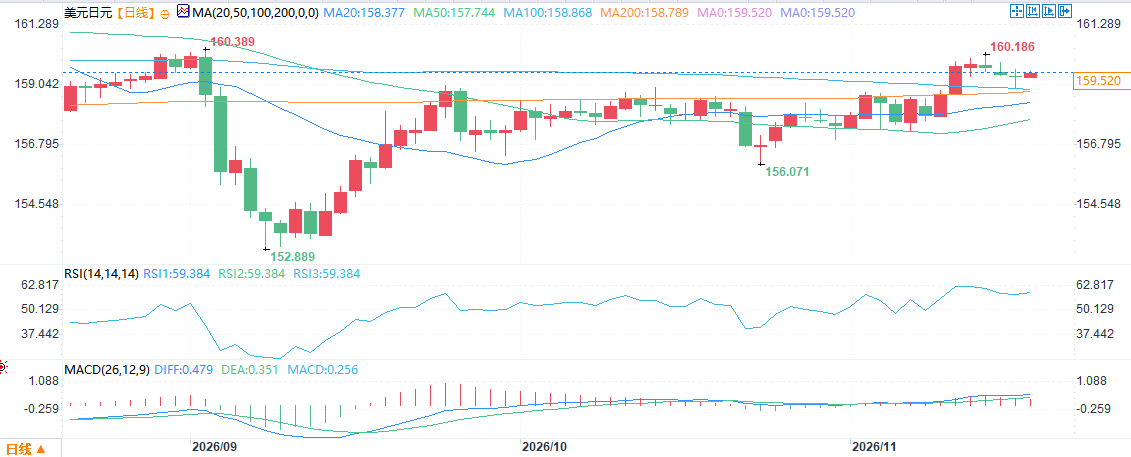 (USD/JPY daily chart, source: EasyForex) At 9:09 Beijing time, USD/JPY was trading at 159.53/54.
Trade data: Exports increased by 20.5%, imports increased by 21.6%, and the trade deficit was only half of what was expected.
Imports rose 21.6%, far below the expected 26%, compared to 18.5% in September. As a result, the trade deficit was approximately 477 billion yen—about half of analysts' expectations of 1 trillion yen, and narrower than the revised 557 billion yen in September. The seasonally adjusted deficit was approximately 767 billion yen, lower than expected but higher than the previous month. Strong exports and weak imports together compressed the deficit—exports were driven by chips, while imports were lower than forecast due to a slower-than-expected recovery in crude oil purchases.An unexpected import: Energy is Japan's main vulnerability in the conflict with Iran.
The import data was unexpected. The government had previously stated that with the arrival of oil tankers transiting the Suez Canal, crude oil purchases in October would return to the same level as last year, leading to widespread market expectations of a significant jump in import bills. Energy is Japan's main vulnerability in the conflict with Iran—the country relies on imports for nearly 90% of its energy, and high oil prices have kept its import bills high. Lower-than-expected imports may reflect a delay in the pace of procurement rather than a weakening of demand—if more oil tankers arrive, import bills could rebound, and the narrowing of the trade deficit may not be sustainable.For the Bank of Japan: This provides a mild tailwind for a December rate hike, but is insufficient to boost the yen on its own.
These data added a mild tailwind to the rationale for a December rate hike by the Bank of Japan. The BOJ kept its policy rate at 1.25% in October, but Governor Kazuo Ueda signaled a strong prospect of a rate hike at the next meeting after declaring underlying inflation had reached the 2% target; board member Takada stated this week that rates should be raised flexibly. Strong exports helped offset a slight contraction in third-quarter GDP, and a narrowing trade deficit meant less yen was available to pay for imports. However, this may not be enough to boost the yen alone—the dollar traded around 159.5 against the yen, slightly below the 160 level warned by Tokyo to strengthen intervention; with the Federal Reserve on a rate-hiking path and the 10-year Treasury yield above 5%, even a BOJ rate hike would not be favorable for the yen due to interest rate differentials. The 10-year Japanese government bond yield was near 2.9%, close to its highest level since the end of October. Trade data provided marginal support for the yen, but interest rate differentials remained dominant—the yen's direction depended on the speed at which the US-Japan interest rate differential narrowed, rather than on a single month's trade balance.Future challenges: Friday's national inflation data, with oil prices being a key factor.
The next test is Friday's national inflation data. Strong readings, coupled with today's trade data, will reinforce expectations for December action. On the other hand, rising oil prices will quickly push up import bills and the trade deficit. Friday's inflation data is the last key data point before the Bank of Japan's December decision—strong data will further solidify expectations of a December rate hike; while oil prices represent the downside risk to the positive effect of a narrowing trade deficit—if oil prices rise again due to the situation in the Middle East, today's improvement could be quickly reversed.The narrowing trade deficit supported the yen, but the Fed's rate hike path capped its potential.
There's a chain of transmission between this trade data and the USD/JPY exchange rate through the balance of payments and policy expectations. The most direct impact is that the deficit is only half of what was expected, meaning less yen is used to pay for imports, providing marginal support for the yen—from a balance of payments perspective, a narrowing import bill reduces demand for the dollar, theoretically benefiting the yen. Meanwhile, the 20.5% increase in exports, driven by chip sales, indicates that external demand remains resilient, providing a mild tailwind for the Bank of Japan's December rate hike, thus supporting the yen through policy expectations. However, this support is limited, not directional. The USD/JPY is currently trading around 159.5, slightly below the intervention warning level of 160, primarily driven by the USD/JPY interest rate differential—the Fed is on a rate hike path, and the 10-year US Treasury yield is above 5%. Even if the Bank of Japan raises rates in December, the narrowing of the interest rate differential will not be enough to reverse the dollar's interest rate advantage. The improvement in trade data provides more of a "buffer" for the yen around 160 than to push it stronger. The interplay of two forces determines the short-term pattern: trade data provides marginal support for the yen, slightly strengthening the downside resistance around 160; however, the pressure from interest rate differentials remains, making a significant decline in the exchange rate unlikely. A true directional breakout would require Friday's national inflation data to reinforce expectations of a December rate hike, or a decline in US Treasury yields, to drive a substantial narrowing of interest rate differentials.in conclusion
Japan's exports rose 20.5% in October, slightly above expectations, driven by chip sales; imports rose 21.6%, far below expectations, resulting in a trade deficit of approximately 477 billion yen, only half of analysts' forecasts. The unexpected drop in imports was the main reason for the narrowing deficit—the government had previously anticipated a resumption of crude oil purchases, but actual import figures were lower than predicted, likely reflecting a delay in the pace of purchases rather than a weakening of demand; energy is a major vulnerability for Japan in the conflict with Iran, with nearly 90% of its energy dependent on imports. The data provides a mild tailwind for the Bank of Japan's December rate hike: strong exports offset a slight contraction in third-quarter GDP, and a narrowing deficit means less yen is available to pay for imports. However, this is not enough to boost the yen alone—the dollar/yen pair is trading around 159.5, slightly below the intervention warning level of 160, and interest rate differentials remain unfavorable for the yen given the backdrop of Fed rate hikes and 10-year Treasury yields above 5%. The next test is Friday's national inflation data: strong readings will reinforce expectations of a December action; while rising oil prices will quickly push up import figures, reversing today's improvement. (USD/JPY daily chart, source: EasyForex) At 9:09 Beijing time, USD/JPY was trading at 159.53/54.
- Risk Warning and Disclaimer
- The market involves risk, and trading may not be suitable for all investors. This article is for reference only and does not constitute personal investment advice, nor does it take into account certain users’ specific investment objectives, financial situation, or other needs. Any investment decisions made based on this information are at your own risk.