Hawkish expectations from the Federal Reserve supported the dollar, but the risk of intervention kept the USD/JPY pair hovering below 160.
2026-11-18 15:08:33
Federal Reserve official Musalem's remarks were hawkish, earning him an 8.1 rating from FXS, above the historical average of 7.2. He warned of persistent inflation risks, suggesting multiple rate hikes are needed before next spring, with the real policy rate having approximately 1 percentage point of upside potential. He also mentioned that if the market questions the Fed's resolve to control inflation, Treasury yields could rise further. He added that with economic growth remaining above its trendline and financial conditions still relatively loose, continued tightening is needed to suppress inflation. Following his remarks, the FXS Fed Sentiment Index rose 0.74 points to 148.09, further solidifying hawkish expectations.  US retail sales rose 0.2% month-on-month in October, in line with market expectations, compared to 0.8% previously. Consumption did not experience a sharp decline, supporting the resilience of the economy. CME FedWatch shows a 95.7% probability of a 25bp rate hike in December and a 4.3% probability of a 50bp rate hike. BBH strategist Elias Haddad stated that the dollar's short-term gains have been excessive, and tightening by other major central banks will narrow policy divergence. However, the US economy, employment, and sticky inflation ensure the dollar's medium-term strength remains unchanged. Regarding the yen, Japan's annualized GDP declined 0.1% quarter-on-quarter in the third quarter, falling short of the expected 0.2% growth, with weaker consumption offsetting support from investment. However, MUFG analysis points out that the negative economic data has not dispelled expectations of a December rate hike by the Bank of Japan. The market still prices in an approximately 85% probability of a 25bp rate hike, with hawkish board member Naoki Takada advocating a flexible and gradual tightening path. It is precisely this combination of Bank of Japan normalization expectations and intervention deterrence that has caused USD/JPY to repeatedly struggle to hold above the 160 level. Japanese Finance Minister Satsuki Katayama had previously warned of unilateral and rapid exchange rate fluctuations, stating that Japan would coordinate with the US and intervene as needed. The market will focus on the FOMC meeting minutes tonight, gleaning members' views on the number of rate hikes and the final interest rate, which will directly drive fluctuations in US Treasury yields, the US dollar index, and USD/JPY. On the daily chart, USD/JPY maintains a bullish bias, with the price firmly above the 100-day moving average and the Bollinger middle band. The upward trend of medium- and long-term moving averages provides trend protection for this upward move. The 14-period RSI reading is 59.13, biased towards the bulls but not yet reaching the 70 overbought level, indicating that the bulls still have room to test higher levels. However, fundamental risks around 160 are significant, suggesting insufficient stability at higher levels. The first resistance level is the upper Bollinger Band at 160.30, coinciding with the psychological level of 160, making it a key watershed. If the daily chart effectively holds above 160.30, the upside potential will further expand. The first support level is the 100-day moving average at 158.90, and the second support level is the Bollinger Middle Band at 158.40. Only a deep pullback below the lower Bollinger Band at 156.50 would substantially damage the current bullish structure.
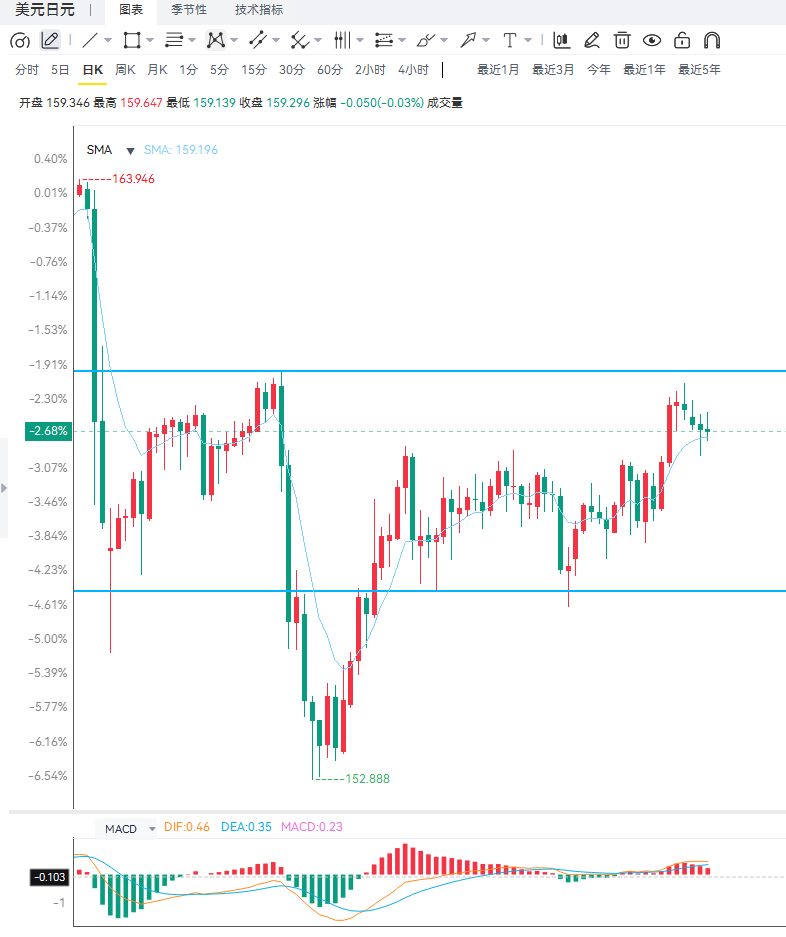 The USD/JPY pair is currently driven by bullish sentiment stemming from the USD/JPY interest rate differential, supported by hawkish comments from the Federal Reserve and resilient US consumer spending. However, expectations of a Bank of Japan rate hike and the risk of currency intervention at the 160 level pose strong resistance, creating a stalemate between bulls and bears. The pair is currently consolidating around this level, awaiting guidance from the FOMC minutes. A hawkish tone in the minutes could lead to a retest of the 160 level; a dovish tone, however, could result in a pullback to moving average support.
US retail sales rose 0.2% month-on-month in October, in line with market expectations, compared to 0.8% previously. Consumption did not experience a sharp decline, supporting the resilience of the economy. CME FedWatch shows a 95.7% probability of a 25bp rate hike in December and a 4.3% probability of a 50bp rate hike. BBH strategist Elias Haddad stated that the dollar's short-term gains have been excessive, and tightening by other major central banks will narrow policy divergence. However, the US economy, employment, and sticky inflation ensure the dollar's medium-term strength remains unchanged. Regarding the yen, Japan's annualized GDP declined 0.1% quarter-on-quarter in the third quarter, falling short of the expected 0.2% growth, with weaker consumption offsetting support from investment. However, MUFG analysis points out that the negative economic data has not dispelled expectations of a December rate hike by the Bank of Japan. The market still prices in an approximately 85% probability of a 25bp rate hike, with hawkish board member Naoki Takada advocating a flexible and gradual tightening path. It is precisely this combination of Bank of Japan normalization expectations and intervention deterrence that has caused USD/JPY to repeatedly struggle to hold above the 160 level. Japanese Finance Minister Satsuki Katayama had previously warned of unilateral and rapid exchange rate fluctuations, stating that Japan would coordinate with the US and intervene as needed. The market will focus on the FOMC meeting minutes tonight, gleaning members' views on the number of rate hikes and the final interest rate, which will directly drive fluctuations in US Treasury yields, the US dollar index, and USD/JPY. On the daily chart, USD/JPY maintains a bullish bias, with the price firmly above the 100-day moving average and the Bollinger middle band. The upward trend of medium- and long-term moving averages provides trend protection for this upward move. The 14-period RSI reading is 59.13, biased towards the bulls but not yet reaching the 70 overbought level, indicating that the bulls still have room to test higher levels. However, fundamental risks around 160 are significant, suggesting insufficient stability at higher levels. The first resistance level is the upper Bollinger Band at 160.30, coinciding with the psychological level of 160, making it a key watershed. If the daily chart effectively holds above 160.30, the upside potential will further expand. The first support level is the 100-day moving average at 158.90, and the second support level is the Bollinger Middle Band at 158.40. Only a deep pullback below the lower Bollinger Band at 156.50 would substantially damage the current bullish structure. The USD/JPY pair is currently driven by bullish sentiment stemming from the USD/JPY interest rate differential, supported by hawkish comments from the Federal Reserve and resilient US consumer spending. However, expectations of a Bank of Japan rate hike and the risk of currency intervention at the 160 level pose strong resistance, creating a stalemate between bulls and bears. The pair is currently consolidating around this level, awaiting guidance from the FOMC minutes. A hawkish tone in the minutes could lead to a retest of the 160 level; a dovish tone, however, could result in a pullback to moving average support.
- Risk Warning and Disclaimer
- The market involves risk, and trading may not be suitable for all investors. This article is for reference only and does not constitute personal investment advice, nor does it take into account certain users’ specific investment objectives, financial situation, or other needs. Any investment decisions made based on this information are at your own risk.