Despite the ongoing attacks between the US and Iran, oil prices have turned downwards. What new stable state is the market adapting to?
2026-11-18 15:58:32
On Wednesday (November 18) during the Asian session, international crude oil prices generally weakened, with Murban spot crude oil leading the decline by over 4%. WTI and Brent crude oil also closed lower, while natural gas futures declined slightly. The market showed a clear divergence: Brent crude oil's decline was relatively limited, while Murban spot crude oil, a core physical benchmark for Asian refineries, saw a significant drop. This price divergence indicates that short-term supply and demand have driven price reductions in the spot market, but continued geopolitical disturbances have resulted in a smaller decline in prices in the forward market compared to the spot market. 
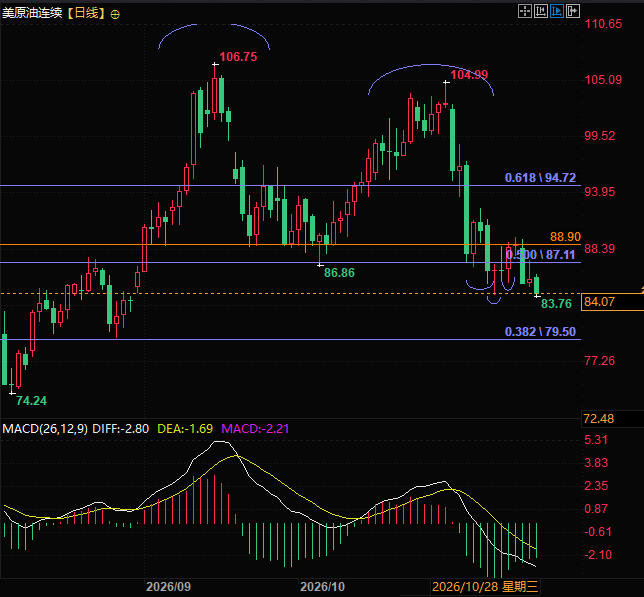 (WTI crude oil futures daily chart, source: EasyTrade) At 15:55 Beijing time, WTI crude oil futures are currently trading at $84.06 per barrel.
Despite ongoing tensions between the US and Iran, diplomatic signals have lowered expectations of a full-blown conflict.
The current standoff between the US and Iran in the Persian Gulf remains at a high level of friction, and the sequence of events needs to be clarified: On November 17, the Iranian Revolutionary Guard Corps launched a drone strike against US radar facilities at the Sheikh Issa Air Base in Bahrain, which Iran claimed was a response to the US's long-term use of the base's radar to violate Iranian airspace. Hours later, the US retaliated by attacking a Revolutionary Guard missile launch site on Qeshm Island. On November 18, the Iranian army launched another counterattack, striking US air defense and drone launch facilities at the Ali Salim Air Base in Kuwait, in response to the Qeshm Island airstrike. Both Iranian strikes explicitly targeted US assets only, excluding civilian targets in Bahrain and Kuwait. Bahrain and the US stated that all incoming drones were intercepted by air defense systems, causing no equipment damage. Meanwhile, a series of oil tanker mine-related incidents have occurred in the Strait of Hormuz, with several tankers damaged by mines in the eastern part of the strait. Near Oman, an LPG tanker was attacked, forcing its crew to evacuate. The Qatari Prime Minister stated that diplomatic consultations to push for a comprehensive agreement between the US and Iran are ongoing; diplomatic sources indicate that talks between Trump and the Qatari Foreign Minister regarding Iran were positive, and the two sides are discussing the future direction of the negotiations; the US House Minority Leader has clearly stated his intention to push for an end to the war related to Iran in the new Congress. Iranian President Peshichiyan has also indicated his willingness to break the current stalemate of "neither war nor peace" through dignified diplomatic means.Shipping model restructuring: Smaller vessels divert traffic to stabilize Gulf exports, and physical cargo premiums are quickly cleared.
Due to the risk of attack and high insurance costs, the willingness of VLCCs (Very Large Crude Carriers) to sail overseas has declined significantly, leading to the emergence of new alternative transportation solutions: large-scale use of Suezmax and Aframax tankers to transport crude oil. Vortexa data shows that the volume of these smaller vessels transporting crude oil in the Strait of Hormuz has been steadily increasing in the past two months, with daily volume exceeding 2 million barrels in October, a new high since the outbreak of the conflict. This has driven total Persian Gulf crude oil exports back to 11.4 million barrels per day, the highest point since the current conflict. These smaller vessels have smaller carrying capacities, thus mitigating the impact on the overall supply chain should an attack occur. After passing through the strait, some vessels head directly to Asian consumption ports such as India, while others undergo transshipment at sea. The agency also notes that shipping through the strait is still far from pre-war levels, with some Iraqi crude oil even needing to be transported via Syrian land-based trucks. However, this smaller vessel diversion solution has already supported the basic foundation of Gulf crude oil exports, and the market is no longer betting on a rapid supply disruption through the strait. Coupled with a significant decline in Murban spot prices, the war premium on the Middle East physical market has subsided first.Weak demand coupled with supply recovery has created a bearish fundamental outlook.
Weakening buying power in Asia further eroded support for physical prices. Key Asian buyers, such as India, adopted a more cautious purchasing strategy, putting pressure on refinery margins. Most refineries maintained only essential purchases, showing little willingness to actively stockpile. This increased bargaining power among buyers is the core reason why the Murban spot price fell far more than Brent and WTI futures. Inventory and supply data were also bearish. US API inventories accumulated significantly for two consecutive weeks, with crude oil inventories increasing by 5.28 million barrels in the week ending November 13th, while gasoline and distillate fuel inventories rose simultaneously. The IEA report showed a significant recovery in global crude oil supply in October, with global crude oil inventories increasing by 52 million barrels in a single month. Institutions predict that the oil market will enter a period of oversupply in the fourth quarter of 2026, and that the increase in supply in 2027 will significantly exceed the recovery in demand. This bearish fundamental outlook continues to suppress oil prices.Other geopolitical hotspots remain deadlocked, with risk premiums priced in tiers.
The Houthi rebels continue to pressure Saudi Arabia, launching multiple attacks on Saudi east-west oil pipelines. The Saudi-led coalition has also consistently intercepted Houthi cruise missiles and drones, escalating airstrikes within Yemen. However, beyond the intense fighting, diplomatic signals of de-escalation have directly reduced market risk premiums for a large-scale, comprehensive conflict. On the Russian-Ukrainian front, clashes continue, with Ukraine using missiles and drones to strike Russian military transport routes in the south. Russia shot down 51 Ukrainian drones in a single day. Railway transport across the Crimean Bridge has resumed. High-ranking officials in Germany and NATO have publicly supported Ukraine's deep strikes against Russian military targets. Disturbances continue in Moldova and the Asia-Pacific region, with Russian strategic bombers landing in Vietnam after patrolling near Japan and South Korea; various risk factors have not disappeared.Summary and Technical Analysis: The conflict remains at a stalemate, but the oil market is slowly adapting to a new equilibrium.
The core logic behind this round of oil price correction is clear: overt conflicts such as mutual attacks between the US and Iran, the Russia-Ukraine confrontation, and Houthi attacks persist and are unlikely to be completely resolved in the short term. This risk remains in Brent futures, limiting a deep decline in oil prices. However, the market is gradually adapting to this new stable state: shipping relies on smaller vessels to divert Gulf crude oil exports; expectations of diplomatic easing have eliminated the tail risk of a large-scale war; and coupled with continued global supply recovery and weak buying from Asian refineries, physical premiums have eased first. The key to future market trends lies in the fact that these geopolitical conflicts are likely to remain in a prolonged stalemate, but the market has gradually digested and priced in the logistics and new supply-demand balance of crude oil. Technical Analysis: Yesterday, we pointed out that if oil prices failed to close above 87, the double bottom pattern would fail. Indeed, oil prices tested 87 without success and broke down. There is a possibility of a bear trap here, i.e., a false break below to form a new double bottom. If there isn't an immediate rebound after the break, oil prices will likely continue to weaken, with the final price range around 70, which is also the measured decline of the large double top pattern above. (WTI crude oil futures daily chart, source: EasyTrade) At 15:55 Beijing time, WTI crude oil futures are currently trading at $84.06 per barrel.
- Risk Warning and Disclaimer
- The market involves risk, and trading may not be suitable for all investors. This article is for reference only and does not constitute personal investment advice, nor does it take into account certain users’ specific investment objectives, financial situation, or other needs. Any investment decisions made based on this information are at your own risk.