The US dollar fell to a recent low against the Indian rupee, but underlying variables exist behind the rupee's resilience.
2026-11-18 16:14:33
Supported by a large influx of foreign capital into stocks and a drop in oil prices, the Indian rupee continued to strengthen. On Wednesday (November 18) during the Asian session, the US dollar fell to a low of 93.23 against the Indian rupee, the lowest level since April, and is currently trading around 93.45. 
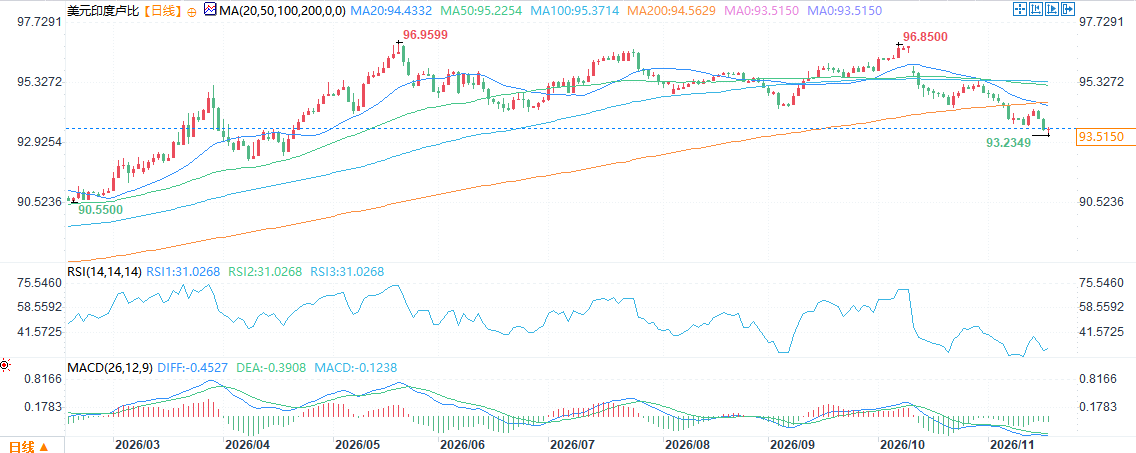 (USD/INR daily chart, source: FX678) At 16:05 Beijing time, the USD/INR exchange rate was 93.51/52.
Market Overview: The rupee rose for the third consecutive day, while the USD/RUB exchange rate fell to a recent low.
The Indian rupee continued its upward trend against the US dollar on Wednesday, marking its third consecutive day of gains. The dollar/rupee exchange rate fell further to around 93.23, its lowest level since April this year. Multiple positive factors provided support for the rupee, with the core drivers being the continued inflow of overseas funds into the Indian stock market, coupled with the benefits brought by declining international oil prices.Multiple Support Logics for the Rupee's Strength
1. Global Funds Rotate, Foreign Investors Make Large-Scale Investments in Indian Stocks Affected by the global AI trading downturn, overseas institutional investors are beginning to look for investment targets outside the AI sector, with funds continuously flowing into the Indian equity market. Since November, foreign institutional investors (FIIs) have made net purchases of Indian stocks totaling 883.6278 billion rupees, equivalent to $9 billion. Analysts at Mitsubishi UFJ noted that India's semiconductor manufacturing sector has relatively limited exposure, highlighting its investment value in the context of a global technology sector correction. At the same time, the high forward premium of the Indian rupee increases the transaction cost of shorting the rupee, further buffering the exchange rate and reducing depreciation pressure. The large-scale inflow of foreign capital not only directly boosts the stock market but also supports the rupee through foreign exchange settlement demand, forming a positive cycle. Institutions believe that India's economic growth and reform expectations remain attractive, and the logic of fund rotation is unlikely to dissipate quickly in the short term. 2. Lower Oil Prices Benefit Energy Importer India Increased supply of energy products from the Middle East has led to a continued weakening of oil prices, with MCX crude oil contracts falling to a near 11-week low. As a net energy importer, India benefits from lower oil prices, which improve its trade balance and reduce its need for foreign exchange, thus contributing significantly to the rupee's strength. Lower energy import costs help alleviate current account pressures and reduce domestic inflation expectations, providing more room for monetary policy. The market generally believes that as long as oil prices remain low, India's terms of trade will continue to improve, providing medium-term support for the rupee. The correlation between oil prices and exchange rates is particularly pronounced in the current environment, becoming one of the key external factors driving the rupee's appreciation.III. Potential Risks: Nvidia's performance may reverse, leading to a shift in cash flow.
This round of foreign capital inflows largely stems from global funds rotating out of the AI sector, a logic that is subject to change. Nvidia delivered strong earnings, with data center revenue doubling and fourth-quarter revenue guidance exceeding market consensus. Although the board has clarified that Jensen Huang will not be reinstated as CEO, the impressive performance guidance is expected to alleviate market concerns about AI capital expenditures. If the AI theme regains favor with investors, funds that previously flowed into the Indian market may flow back into AI-related assets. At that point, short-term market rotation alone will not be sufficient to maintain the rupee's strength; whether the rupee can continue to rise depends primarily on whether foreign capital can maintain a sustained inflow. Investors need to closely monitor the performance of the global technology sector and changes in capital flows, and be wary of the risk of currency correction due to a sudden reversal of the rotation logic.Summarize
The current influx of foreign equity funds, coupled with a decline in oil prices, has driven a significant appreciation of the Indian rupee. India's industry structure and relatively high forward premiums further mitigate the risk of currency depreciation. However, this market rally is highly dependent on global asset rotation. If Nvidia's performance leads to a renewed recovery in AI trading, it will divert overseas capital flowing into India, putting the rupee's upward momentum to the test. The actual situation regarding the continued inflow of foreign capital will be a key focus going forward. (USD/INR daily chart, source: FX678) At 16:05 Beijing time, the USD/INR exchange rate was 93.51/52.
- Risk Warning and Disclaimer
- The market involves risk, and trading may not be suitable for all investors. This article is for reference only and does not constitute personal investment advice, nor does it take into account certain users’ specific investment objectives, financial situation, or other needs. Any investment decisions made based on this information are at your own risk.