High US Treasury yields coupled with a stronger dollar have caused gold to continue its downward trend.
2026-11-18 15:58:30
On Wednesday (November 18) during the European session, spot gold fell by about 2% to around $3,770, a new low in more than a year. The 10-year US Treasury yield was close to 5.1%, and the dollar was at a 19-month high. The market priced in a 96% probability of a Fed rate hike in December. The Middle East conflict, pushing up oil prices, actually strengthened expectations of a rate hike. Goldman Sachs lowered its year-end 2026 gold price target to $4,150. The focus for the day is the FOMC meeting minutes, with attention on the $3,700 support level. 
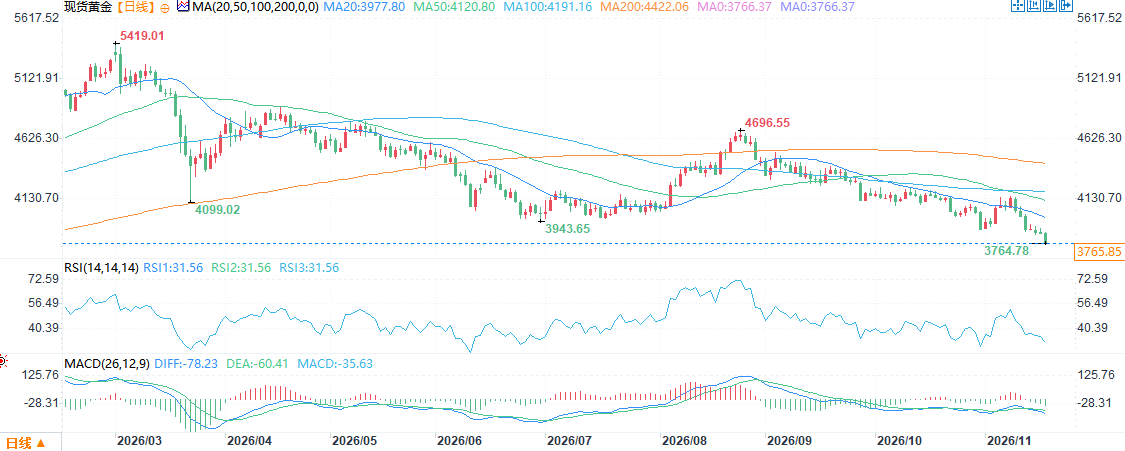 (Spot gold daily chart, source: EasyTrade) At 15:54 Beijing time, spot gold was trading at $3771.26 per ounce.
Market Overview: Gold prices fell below the psychological level of $3,800, with interest rate logic dominating pricing.
Spot gold has fallen sharply by about 2% to around $3,770 per ounce, hitting a low of $3,770.23 per ounce. Gold is currently viewed more as an interest rate trading instrument, with the influence of US Treasury yields and expectations of Federal Reserve policy outweighing safe-haven buying driven by geopolitical events. Silver and the gold mining sector are both under pressure, but silver has shown relative resilience. The market is focused on the release of the minutes from the October FOMC meeting. Technically, gold prices have been under pressure for several days, and the break below key psychological levels further confirms the short-term downtrend. Investor sentiment has turned cautious, and the safe-haven appeal has weakened significantly in the current interest rate environment, with funds flowing more into dollar assets and high-yield bonds, leading to a continued contraction in gold buying. If the meeting minutes further reinforce expectations of interest rate hikes, gold prices may accelerate their decline towards lower support levels.Key negative factors: High US Treasury yields + a strong US dollar, reversing the geopolitical logic.
The yield on 10-year US Treasury bonds hovered around 5.1%, while the US dollar was at a 19-month high. Gold, being a non-interest-bearing asset, saw its opportunity cost of holding gold rise as yields increased; a strong dollar also raised the cost of gold for overseas buyers, a double factor continuously suppressing gold prices. CME FedWatch showed the market pricing in a 96% probability of a 25bp rate hike in December, with a very low probability of a 50bp hike. Waller previously suggested that a 50bp rate hike was a possibility if core inflation remained high. Unlike previous years' safe-haven rallies, this round of Middle East conflicts did not benefit gold. Geopolitical tensions pushed up oil prices, raising inflation expectations and further solidifying expectations of a Fed rate hike, which in turn suppressed gold prices. In comparison, in November 2025, the market was still trading on expectations of a Fed rate cut, and gold prices surged; now, policy expectations have completely reversed, and gold has given back a significant portion of its previous gains. Interest rate logic completely dominates pricing, and the traditional safe-haven support from geopolitical events has clearly failed.Institutional View: Goldman Sachs Lowers Year-End Gold Price Target Again
Goldman Sachs has lowered its year-end 2026 gold price forecast from $4,650 to $4,150. The firm believes the Federal Reserve's hawkish tightening stance has suppressed the support previously provided to gold from declining yields. Even after the downward revision, this target still implies approximately a 9% upside for gold over the next six weeks, reflecting the rapid shift in market expectations. Goldman Sachs points out that the current macroeconomic environment has fully shifted from a "rate cut trade" to a "rate hike trade," significantly reducing gold's attractiveness as a non-interest-bearing asset. The firm also cautions that while short-term overselling may lead to a technical rebound, the medium-term direction remains constrained by the Fed's policy path. Other large institutions have also adjusted their positions, generally lowering their optimistic forecasts for gold, and market consensus is rapidly converging towards a rate-driven logic. Investors need to reassess the allocation value of gold in the current high-interest-rate environment.Scenario Analysis: FOMC minutes to determine short-term direction; keep a close eye on 3700 support level.
If the FOMC meeting minutes release hawkish signals, it will further solidify expectations of a December rate hike, and gold prices will continue to decline, focusing on testing the $3,700 support level. If the minutes reveal concerns about the decline in tech stocks and release dovish signals, gold may see a rebound driven by short covering. As long as the Fed maintains its rate-hiking stance, gold will find it difficult to attract sustained buying interest; the Middle East situation pushing up oil prices will indirectly amplify inflationary and rate-hiking pressures, putting downward pressure on gold prices. Short-term direction is highly dependent on the wording and details of the meeting minutes; the market will closely watch officials' latest assessments of inflation stickiness and economic resilience. If the minutes confirm a tighter policy path, the downside potential for gold prices may further open up; conversely, dovish signals may bring a phase of recovery, but in the medium term, it will still be difficult to escape the pressure of interest rates.Summarize
The biggest pressure on gold currently comes from high US Treasury yields and expectations of a Fed rate hike. Geopolitical conflicts in the Middle East no longer provide safe-haven support; instead, they amplify the negative impact through oil prices. Gold prices have fallen below the $3800 mark, and Goldman Sachs has lowered its year-end target to $4150. The FOMC meeting minutes are a short-term catalyst; hawkish content will test the $3700 support level. Only if the Fed releases dovish signals will gold have a chance to recover. (Spot gold daily chart, source: EasyTrade) At 15:54 Beijing time, spot gold was trading at $3771.26 per ounce.
- Risk Warning and Disclaimer
- The market involves risk, and trading may not be suitable for all investors. This article is for reference only and does not constitute personal investment advice, nor does it take into account certain users’ specific investment objectives, financial situation, or other needs. Any investment decisions made based on this information are at your own risk.