After gold fell to around 3780, when will the pressure from high yields ease?
2026-11-18 18:00:31
On Wednesday, November 18th, spot gold continued its correction, falling back to around $3780 per ounce, a daily drop of nearly 2%. The market lacked a single sudden catalyst, instead continuing to be pressured by a strengthening dollar and high US Treasury yields. The dollar index remained in the 103.6-103.8 range, near a 19-month high; the 10-year US Treasury yield fluctuated around 5.09%. Previously, the US October Consumer Price Index rose 0.4% month-on-month, and the core index rose 0.3%, both exceeding market expectations. Coupled with statements from several Federal Reserve officials supporting further tightening, this pushed for a repricing of the interest rate path. Currently, the target range for the US federal funds rate remains at 3.75% to 4.00%. The market has largely priced in a December rate hike, with most expectations at 25 basis points, and the possibility of a 50 basis point hike being low. Meanwhile, the US-Iran conflict remains deadlocked, with no clear breakthrough or easing path, continuing to disrupt energy and inflation expectations. 
Short-term dominance of interest rate environment and dollar pricing
As a non-interest-bearing asset, gold's price is highly sensitive to real interest rates and the relative value of the US dollar. Recently, high US Treasury yields have increased the opportunity cost of holding gold; a stronger US dollar index has suppressed demand denominated in non-dollar currencies. Following the strong October inflation data, the market has largely completed its repricing of the Federal Reserve's future path, with a rate hike at the December meeting becoming the mainstream expectation, and officials' statements favoring gradual adjustments rather than large-scale actions. The effective federal funds rate is currently around 3.88%, and policy remains in a pause-and-observation phase within the tightening cycle. On the growth front, US stock market trading is near last week's lows, and some yield curves have declined, indicating that the market is beginning to focus on the possibility of slowing growth momentum. These factors constitute the main background for the current gold price correction, with short-term momentum still dominated by macro pricing.The potential transmission of geopolitical conflicts and stagflation expectations
The US-Iran conflict has persisted for months, reaching a stalemate. Restricted passage through the Strait of Hormuz and ongoing military activity continue to exert upward pressure on energy prices and inflation expectations. If the conflict prolongs or escalates, it could create an environment where high inflation expectations coexist with a weakening growth outlook—what the market calls stagflation expectations. Historically, such environments have often altered the relative attractiveness of gold, as the upside potential for real interest rates may be limited, while safe-haven demand may be supported. Conversely, a breakthrough in negotiations could ease inflation concerns, leading the market to reassess the Federal Reserve's path and adjust interest rate expectations towards easing, which could also affect gold pricing in the short term. The current unresolved conflict, coupled with coexisting growth concerns and inflationary pressures, constitutes a crucial variable for fundamental analysis.Daily technical status
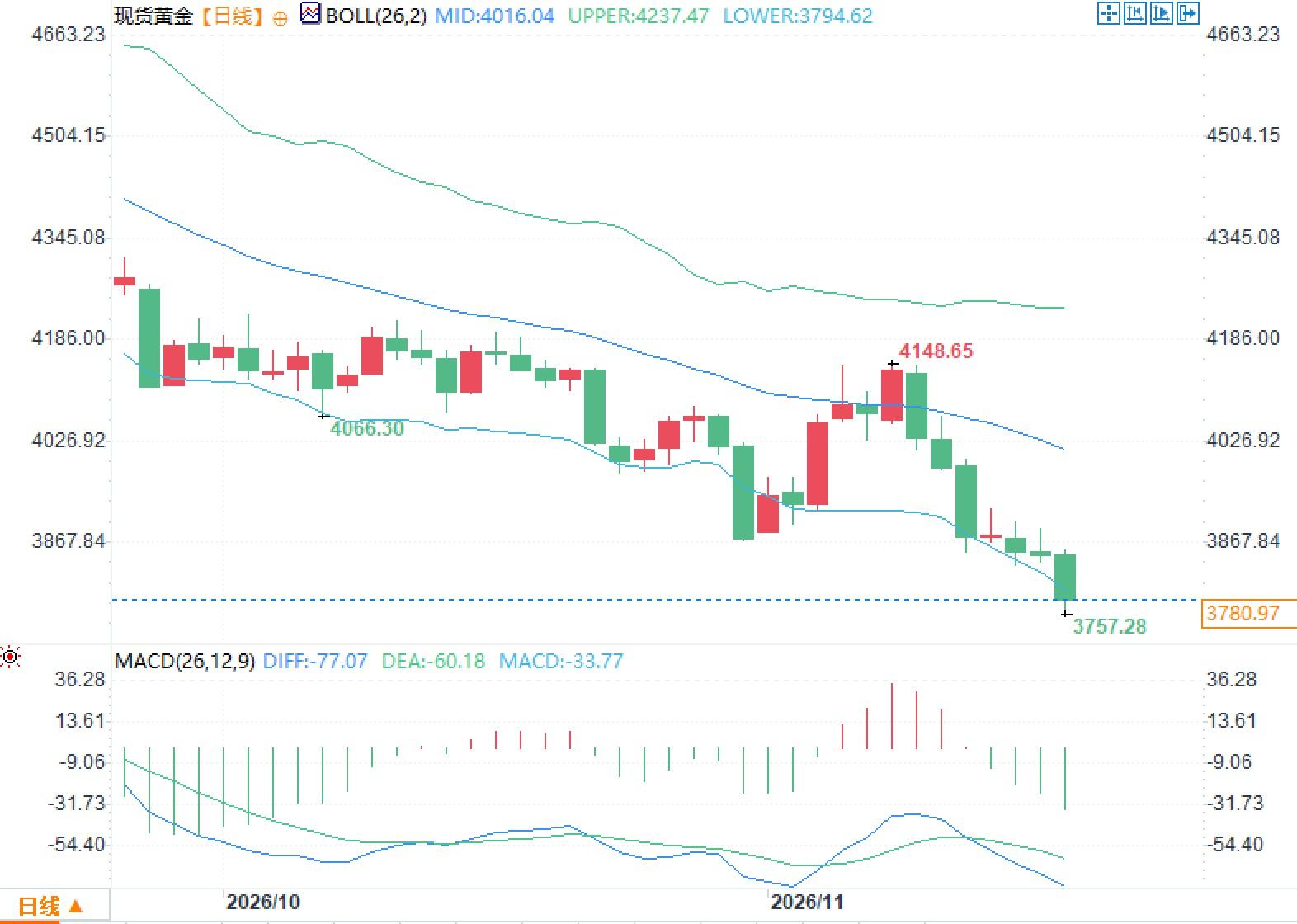
The daily chart shows that spot gold has recently seen consecutive bearish candlesticks, with the price trading near the lower Bollinger Band. The middle band is around 4016, the upper band around 4237, and the lower band around 3794. The MACD indicator shows the DIFF value at approximately -77, the DEA at approximately -60, and the histogram in negative territory. The relative position of the price to the lower Bollinger Band, as well as the negative state of the MACD lines and histogram, reflect the current volatility and momentum characteristics. No clear reversal momentum signal is seen in the short term, and market focus remains on further developments in macroeconomic variables.Rising Growth Concerns and Variable Observations
Market focus is gradually shifting from simple interest rate repricing to the interplay between growth and geopolitics. If the stock market declines further, growth concerns may dominate, potentially leading to a correction in the relative strength of US Treasury yields and the US dollar, thus impacting the opportunity cost environment for gold. If the stalemate in the US-Iran conflict persists, the path to stagflation expectations remains. Any trend change requires corresponding technical confirmation; a single fundamental narrative is insufficient to constitute a complete pricing basis. Traders are paying more attention to the interplay between data verification and policy paths, rather than isolated events.Frequently Asked Questions
Question 1: Why are high US Treasury yields and a strong dollar continuing to suppress gold prices? Answer: Gold offers no interest income, so higher yields directly increase holding costs. A stronger dollar reduces the purchasing power of non-dollar holders. These two factors combine to create short-term pricing pressure, and recent inflation data and official statements have largely priced this in. Question 2: How could the ongoing US-Iran conflict change the fundamental logic of gold? Answer: If the conflict prolongs and is accompanied by slower growth, it could create a stagflationary environment with high inflation expectations and weak growth. This would limit the potential for rising real interest rates, and gold's relative attractiveness might be reassessed.- Risk Warning and Disclaimer
- The market involves risk, and trading may not be suitable for all investors. This article is for reference only and does not constitute personal investment advice, nor does it take into account certain users’ specific investment objectives, financial situation, or other needs. Any investment decisions made based on this information are at your own risk.