US aircraft carrier rotation leaves only two ships; oil price analysis gradually returns to supply and demand.
2026-11-19 16:00:30
On Thursday (November 19th) during the Asian and European sessions, international oil prices rebounded weakly, with the WTI crude oil futures contract currently up 0.02%. Oil prices have fallen by approximately 7% this week. The most significant change in the market is a slow shift in pricing logic: shipping risks in the Strait of Hormuz continue to support prices, but a ceiling has been reached. Simultaneously, with updates to crude oil and diesel supply and demand data, expectations of oversupply are beginning to dominate, the weight of geopolitical premiums continues to decline, and supply and demand fundamentals are once again becoming the main trading driver. 
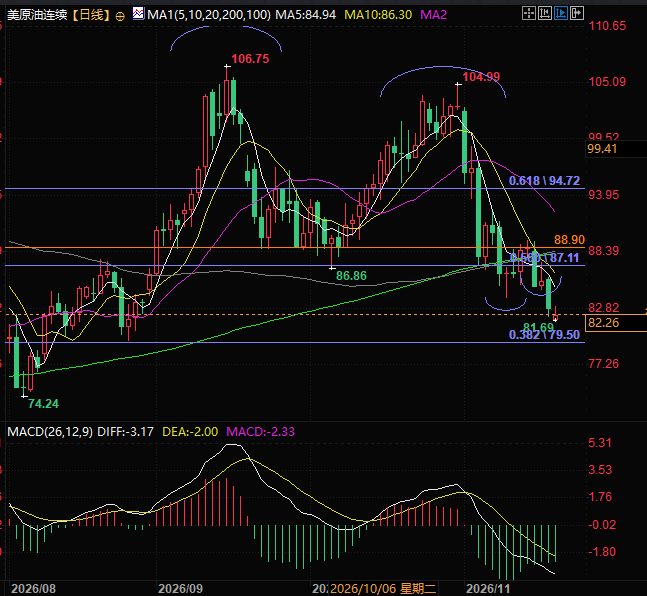 (WTI crude oil futures daily chart, source: FX678) At 15:56 Beijing time, WTI crude oil futures are currently trading at $82.27 per barrel.
Middle East standoff: Israel pushes for strikes, while the US military is primarily using carrier rotations and containment.
The US and Iran remain in a stalemate, with Israel continuing to pressure the US, urging Trump to launch a new round of large-scale airstrikes against Iran lasting four to seven days. However, details of the US military deployment indicate that the current strategic focus is on maritime deterrence and blockade rather than immediate war. The previously much-discussed three-carrier strike group in the Middle East now appears to be a normal rotation: the USS George Washington has departed for its home port of Yokosuka, Japan, and the newly arrived USS Theodore Roosevelt has taken its place. Ultimately, only two aircraft carriers remain in the Middle East to maintain a maritime blockade of Iran, retaining only military options and showing no clear signal of war. Trump has signaled his desire to reach a long-term, stable agreement with Iran, stating that the conflict will end quickly; however, there are significant disagreements within the US government regarding the reliability of relevant intelligence and the pros and cons of another strike against Iran. The new strike plan is still under consideration and has not yet been finalized. The risks in the Strait of Hormuz have not subsided. Iran has blacklisted more than half of the transshipment tankers from Gulf oil-producing countries, and another tanker was attacked near Haysaib this week. However, traders have stabilized the total volume of crude oil shipments by increasing ship-to-ship transshipment operations. Although crude oil flows in the Persian Gulf are still lower than before the war, they have recovered significantly compared to the early stages of the conflict, and the resilience of physical circulation has weakened the upward momentum of geopolitical premiums.Refineries operating at full capacity are supporting imports, easing the tight balance in the diesel market and allowing supply and demand narratives to once again dominate the market.
Previously, high diesel prices and strong crack spreads were the core drivers for the continuous increase in processing capacity by global refineries. India's crude oil imports surged to 5.58 million barrels per day in October, a record high, driven by domestic refineries operating at full capacity to meet domestic fuel demand. As global refining volumes continue to increase, the tight diesel supply situation is expected to gradually ease, and the strong support for oil prices from refined oil products will weaken marginally. Institutional views have also shifted towards a more accommodative stance: increased OPEC+ production, resilient Russian exports, and continued accumulation of US crude oil inventories will gradually rebalance the crude oil market, limiting the potential for sustained unilateral price increases. Furthermore, the Federal Reserve's signals of interest rate hikes are suppressing long-term crude oil demand, further limiting the upside potential for oil prices.Secondary risk pulse disturbances: Houthi front lines extended, Russian-Ukrainian attacks tend to have short-term impact.
Aside from the main Iranian front, the other two geopolitical fronts are more likely to generate intermittent news shocks and are unlikely to dominate oil price trends. Saudi Arabia has anticipated that the conflict with the Houthis may continue into next year and plans to wait for progress from its ground allies before initiating negotiations. Houthi missile attacks on Saudi Arabia have led to widespread and prolonged flight cancellations between Saudi Arabia and several Gulf states, with several UAE airlines extending cancellation periods. Regarding the Russia-Ukraine conflict, the Ukrainian drone attack on Russian oil storage facilities in Tatarstan is a single-point, intermittent shock that only temporarily disrupts market sentiment and is unlikely to drive significant price trends in crude oil.Summary and Technical Analysis:
Crude oil is currently in a transitional period of shifting pricing logic. The Strait of Hormuz remains a significant upward driver, with freight and insurance costs still being the most important factors influencing oil prices. Furthermore, a large-scale shipping disruption would quickly trigger a return to geopolitical premiums. However, barring any major unforeseen escalation, the market focus has shifted from "supply disruption fears" back to supply and demand observation. Expectations of ample supply, increased refinery production, and anticipated Fed policies collectively create upward pressure, while sporadic attacks in the Strait and the Middle East standoff provide downward support. In the short term, oil prices are likely to remain range-bound. Going forward, the focus will shift more towards fundamental data such as inventory levels, refinery operating rates, and OPEC+ compliance, rather than simply speculating on sudden Middle East events. Technically, after the failed double bottom, the moving averages are in a bearish alignment, and oil prices continue to fall, with a target price around $80. (WTI crude oil futures daily chart, source: FX678) At 15:56 Beijing time, WTI crude oil futures are currently trading at $82.27 per barrel.
- Risk Warning and Disclaimer
- The market involves risk, and trading may not be suitable for all investors. This article is for reference only and does not constitute personal investment advice, nor does it take into account certain users’ specific investment objectives, financial situation, or other needs. Any investment decisions made based on this information are at your own risk.