With inflationary momentum not yet abating, what is the core logic behind the movement of the US dollar index?
2026-11-19 18:14:30
On Thursday, November 19th, the US dollar index fluctuated around 103.7, near its year-to-date high. The US October Consumer Price Index (CPI) rose 0.4% month-over-month, and the core index rose 0.3%, both exceeding market expectations. This result further increased market pricing in the Federal Reserve maintaining its tightening path. TD Securities strategists pointed out that the foreign exchange market's pricing of the dollar has shifted from a relatively stock market-linked model to a mechanism dominated by the Fed's hawkish stance. The dollar is supported under this mechanism until the policy hawkishness reaches its peak. 
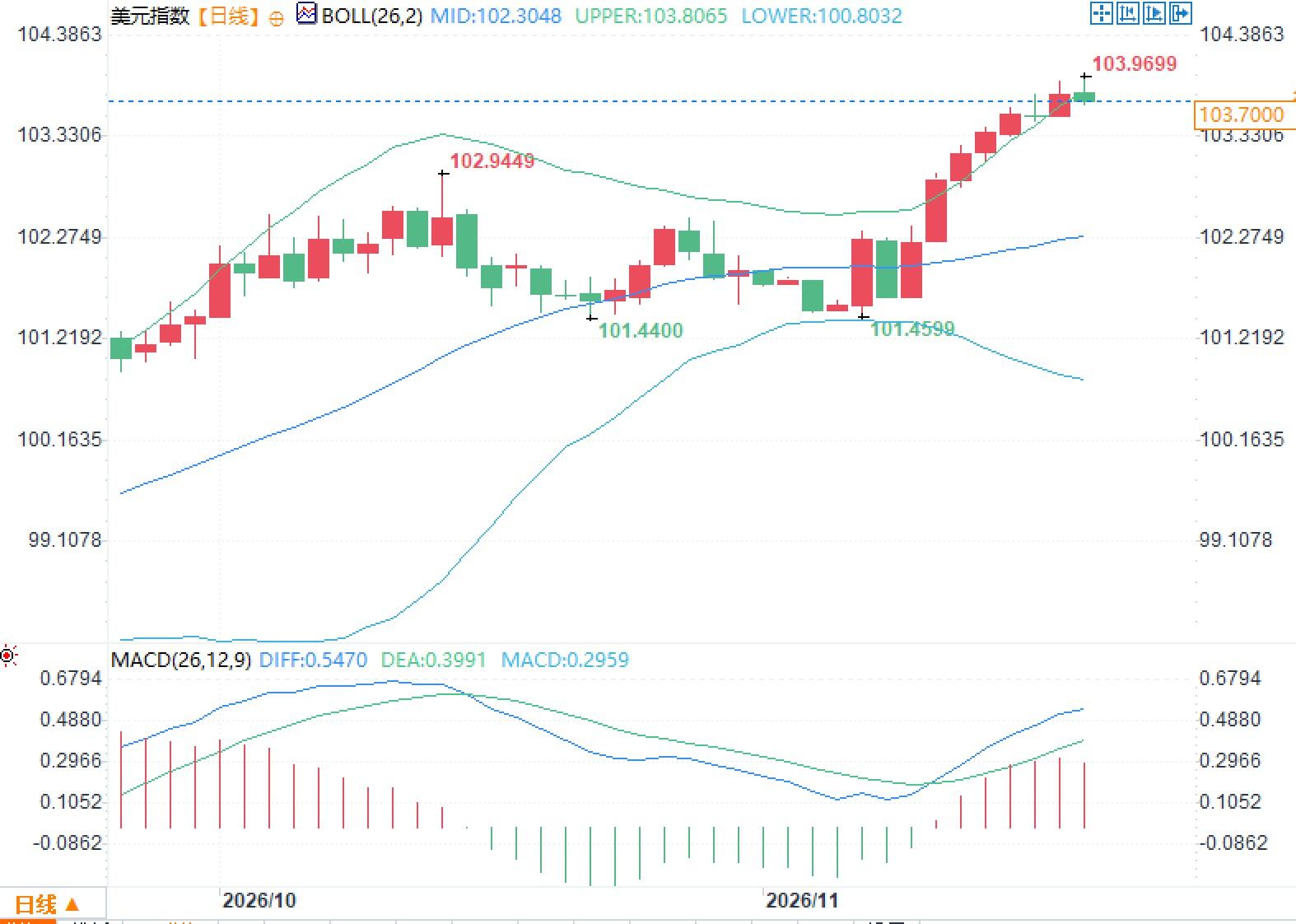
Pricing mechanisms have shifted from stock market linkages to a more hawkish policy stance.
TD Securities analysts believe that for most of 2026, the dollar's trading will reflect its performance relative to the stock market. Recent upward momentum in US inflation has changed this pattern. The market is now trading on the Fed's hawkish stance relative to other major central banks, and the bear-flattening dynamics of the US Treasury yield curve. Under this mechanism, the dollar's resilience stems from interest rate differential expectations, rather than a direct reflection of stock market risk appetite. The S&P 500 is currently about 6% to 7% lower than its previous high, a pullback that hasn't yet reached the threshold that would force the Fed to quickly adjust its stance solely due to a stock market downturn. The dominant factor in the policy path remains the relative change in inflation data and interest rate expectations.US inflation data and the observation period needed for a shift.
October inflation data confirmed upward momentum. Energy and housing sub-indices contributed significantly, with core month-on-month inflation remaining around 0.3% for the second consecutive month. TD Securities points out that to guide the Federal Reserve away from its current hawkish stance, a significant decline in inflation data over one to two quarters may be necessary. Their baseline scenario is that the Fed will pause rate hikes after March 2027. Without new supply shocks, the pressure for US rate hikes should gradually shift to other regions. St. Louis Fed President Mossul recently stated that pushing the real policy rate to the target range may require multiple rate hikes before the spring of 2027. Governor Waller mentioned that if core data remains high, a 50-basis-point adjustment could be considered at the December meeting. These statements are consistent with the market's high pricing of a December rate hike.Bear flattening of the Treasury yield curve and support from relative yield spreads
The yield on the 2-year US Treasury note has recently hovered around 4.8%, while the 10-year yield is around 5.1%, exhibiting a bearish flattening curve. Short-term yields have risen due to increased expectations of interest rate hikes, while long-term yields are influenced by both inflation and fiscal factors. TD Securities emphasizes that this dynamic provides support for the US dollar, especially when the market anticipates a more sustained rate hike path from the Federal Reserve compared to institutions like the European Central Bank and the Bank of Japan. The European Central Bank's deposit facility rate is currently maintained at 2.5%, and the market is pricing in a slight increase in December, but the absolute level and the slope of the path remain lower than those of the Federal Reserve. This relative policy difference constitutes a crucial anchor for the current pricing of the US dollar, rather than a single absolute interest rate level.Stock market pullback and policy independence
The limited pullback of the S&P 500 from its year-to-date high suggests that downside risks in the stock market have not yet provided sufficient justification for a unilateral policy shift by the Federal Reserve. TD Securities points out that the threshold for a policy shift remains high, requiring a sustained slowdown in inflation data. The December summary of economic projections will be a key observation window. If the median dot plot shows fewer rate hikes in 2027 than currently priced in by the market, and most officials share a convergent stance, it could alleviate short-term pressure on the dollar, particularly creating room for a rebound in some relatively oversold currencies. The firm's benchmark still expects the rate hike path to level off after March 2027. The key focus will be whether inflation momentum converges as expected and whether relative interest rate expectations adjust accordingly.Frequently Asked Questions
Question 1: How does TD Securities define the current changes in the dollar pricing mechanism? Answer: The institution believes that rising inflation has shifted the foreign exchange market from a model relatively linked to the stock market to a mechanism dominated by the Fed's hawkish stance and the bearish flattening of the Treasury yield curve. The dollar's resilience will continue until the hawkish policy stance peaks. Question 2: What data path might prompt the Fed to adjust its current hawkish guidance? Answer: Analysis indicates that a significant decline in inflation data may be needed within one to two quarters. In the baseline scenario, rate hikes pause after March 2027, and the pressure for US rate hikes converges to other regions. Question 3: What impact might a December summary of economic forecasts have if it shows fewer rate hikes in 2027? Answer: If the median dot plot shows fewer rate hikes and officials' stances converge, it could ease short-term dollar pressure and create room for a rebound in some relatively oversold currencies, but the subsequent inflation path needs to be verified.- Risk Warning and Disclaimer
- The market involves risk, and trading may not be suitable for all investors. This article is for reference only and does not constitute personal investment advice, nor does it take into account certain users’ specific investment objectives, financial situation, or other needs. Any investment decisions made based on this information are at your own risk.