The plunge in copper prices may impact AI infrastructure development.
2026-11-19 18:40:30
Copper is arguably the lifeblood of the booming artificial intelligence industry. It is responsible for supplying power to data centers, connecting power grids across the country, and is a core material in this unprecedented AI infrastructure construction. Whether it's the power supply busbars inside server racks, the power interconnection cables between server rooms, or the newly built power transmission networks, high-purity copper is an irreplaceable conductor, and it will be difficult to find alternative materials with the same cost-effectiveness in the short term.  However, with the sudden drop in copper prices, the next phase of the AI boom has become significantly more difficult. Whether it's tech giants heavily borrowing and continuously increasing investment in data center construction, or the metal supply chain providing core cables for these projects, both will face a more complex operating environment. The market easily interprets low copper prices as a positive sign, ignoring the fact that low prices can conversely suppress upstream capital expenditure, creating a potential for future supply contraction. Over the past month, copper prices have weakened in tandem with the semiconductor and other technology sectors, leading many investors to worry that the market's enthusiasm for AI-related trading is waning. This coordinated decline also reflects how trading funds view copper as a leading indicator of AI demand; once copper prices weaken, funds directly lower their expectations for AI capital expenditure, creating a negative feedback loop across sectors. According to FactSet data, copper prices plummeted 5.4% on Wednesday alone, closing at $5.6595 per pound, a seven-month low. “A large amount of capital is leaving the AI trading market,” said Steve Sosnick, chief strategist at Interactive Brokerage, on Wednesday. “Previously, funds would buy all upstream and downstream assets related to AI infrastructure, but now these peripheral assets are also being sold off.” The market’s speculative logic is consistent: when confidence in the main theme weakens, the first to be abandoned are cyclical assets with high elasticity and no direct AI revenue. A major market concern is that if the momentum of the AI boom weakens, global copper demand will decline accordingly. However, the reality is quite the opposite. The underlying constraint on the industry in the medium to long term is not that demand is lower than expected, but that the release speed of copper mine supply cannot keep up with the incremental demand brought about by the combination of AI and new energy. The hard constraint on the supply side has always existed. It is very likely that the world will be unable to produce enough copper to match demand from the source, and the long-term supply shock may actually push up copper prices. Since November, copper prices have fallen by 12.6% cumulatively, which means that copper prices are likely to have the worst monthly performance since July 2025. As copper prices fell, the Nasdaq Composite Index, dominated by technology stocks, and other AI-related indices weakened in tandem. Investors began to question the source of revenue to support the massive infrastructure investments and high capital expenditures. Many institutions' calculations show that current AI business revenue is far from sufficient to cover the continued expansion of data center investments, which is one of the core reasons for the recent valuation correction in the technology sector. FactSet data shows that the Nasdaq Composite Index, heavily weighted with technology stocks, fell by more than 4% in November, while the Philadelphia Semiconductor Index (SOX) fell by 10.4% this month. The simultaneous sell-off of copper and chip stocks created a chain reaction. Jacob White, Director of ETF Product Management at Sprott Asset Management, noted, "Investors selling chip stocks and reducing their portfolio holdings also spread to the commodity market, dragging down copper prices." Many macro multi-asset portfolios allocate to both technology growth and industrial metals; during periods of declining risk appetite, they simultaneously reduce their holdings in both asset classes, amplifying price volatility. Following the US midterm elections, market sentiment towards data center construction has become more cautious; however, the actual demand for data center deployment has not yet shown signs of cooling. Goldman Sachs analysts predicted on Wednesday that hyperscale cloud providers will continue to borrow to finance AI projects, with related debt financing potentially reaching $1 trillion by 2027. In a high-interest-rate environment, continued debt financing will increase the financial burden on companies, and coupled with fluctuations in upstream raw material prices, it will further compress profit margins. Coppernico Metals, a mining company focusing on copper and gold exploration in South America, stated through its CEO Ivan Bebek that by 2030, the data center sector alone will account for approximately 3% of global copper demand; if the supporting power grids, substations, and other infrastructure are included, the copper demand share in this sector will likely rise to 16%–18% over the next decade. This does not yet account for the increased copper demand from energy storage, new energy power plants, and electric vehicles; with multiple demands converging, the pressure on copper mines will continue to amplify.
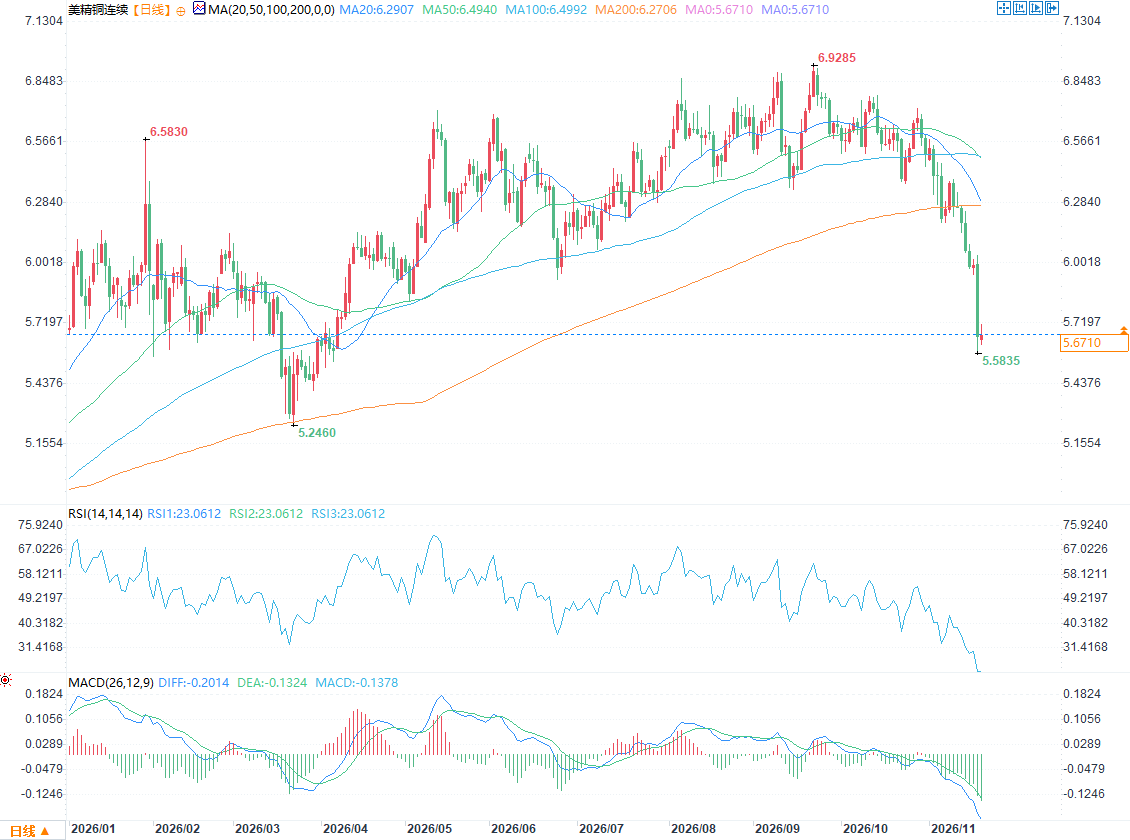 (COMEX copper futures daily chart source: EasyTrade) "I think everyone needs to understand one thing: the decline in copper prices does not mean that the demand for copper driven by AI has disappeared," said Bebek. "AI data centers will continue to be built, and we are still transforming towards a low-carbon, intelligent future, and this entire transformation process will consume a huge amount of copper." However, he added that the decline in copper prices will actually amplify the already pressing supply gap, and the limited supply will ultimately become a bottleneck for the advancement of AI infrastructure. Copper mine exploration and construction cycles generally last for several years and are very sensitive to prices. Low copper prices will directly cause many marginal projects to be shelved, and when subsequent demand is realized again, supply will be difficult to catch up quickly. Since 2015, the number of newly discovered large copper resources globally has declined significantly, the grading of existing mines has continued to decline, and the difficulty and cost of development have increased simultaneously. Bebek said that the copper mining industry needs stable capital investment to support exploration work and mine capacity expansion; the decline in copper prices coupled with violent fluctuations will directly dampen the enthusiasm for mine development projects. Capital will prioritize avoiding mining projects with high uncertainty and long payback periods, shifting towards assets with better liquidity. He believes that while long-term copper demand has strong certainty, the ability to deliver on short-term and long-term supply presents a growing risk. This supply-demand mismatch is a slow-moving variable and won't immediately reflect in prices, but if demand remains resilient and supply can't keep up, a sustained price correction will occur. In the current environment of rising interest rates, a subsequent rebound in copper prices will further increase the construction costs of data centers.
However, with the sudden drop in copper prices, the next phase of the AI boom has become significantly more difficult. Whether it's tech giants heavily borrowing and continuously increasing investment in data center construction, or the metal supply chain providing core cables for these projects, both will face a more complex operating environment. The market easily interprets low copper prices as a positive sign, ignoring the fact that low prices can conversely suppress upstream capital expenditure, creating a potential for future supply contraction. Over the past month, copper prices have weakened in tandem with the semiconductor and other technology sectors, leading many investors to worry that the market's enthusiasm for AI-related trading is waning. This coordinated decline also reflects how trading funds view copper as a leading indicator of AI demand; once copper prices weaken, funds directly lower their expectations for AI capital expenditure, creating a negative feedback loop across sectors. According to FactSet data, copper prices plummeted 5.4% on Wednesday alone, closing at $5.6595 per pound, a seven-month low. “A large amount of capital is leaving the AI trading market,” said Steve Sosnick, chief strategist at Interactive Brokerage, on Wednesday. “Previously, funds would buy all upstream and downstream assets related to AI infrastructure, but now these peripheral assets are also being sold off.” The market’s speculative logic is consistent: when confidence in the main theme weakens, the first to be abandoned are cyclical assets with high elasticity and no direct AI revenue. A major market concern is that if the momentum of the AI boom weakens, global copper demand will decline accordingly. However, the reality is quite the opposite. The underlying constraint on the industry in the medium to long term is not that demand is lower than expected, but that the release speed of copper mine supply cannot keep up with the incremental demand brought about by the combination of AI and new energy. The hard constraint on the supply side has always existed. It is very likely that the world will be unable to produce enough copper to match demand from the source, and the long-term supply shock may actually push up copper prices. Since November, copper prices have fallen by 12.6% cumulatively, which means that copper prices are likely to have the worst monthly performance since July 2025. As copper prices fell, the Nasdaq Composite Index, dominated by technology stocks, and other AI-related indices weakened in tandem. Investors began to question the source of revenue to support the massive infrastructure investments and high capital expenditures. Many institutions' calculations show that current AI business revenue is far from sufficient to cover the continued expansion of data center investments, which is one of the core reasons for the recent valuation correction in the technology sector. FactSet data shows that the Nasdaq Composite Index, heavily weighted with technology stocks, fell by more than 4% in November, while the Philadelphia Semiconductor Index (SOX) fell by 10.4% this month. The simultaneous sell-off of copper and chip stocks created a chain reaction. Jacob White, Director of ETF Product Management at Sprott Asset Management, noted, "Investors selling chip stocks and reducing their portfolio holdings also spread to the commodity market, dragging down copper prices." Many macro multi-asset portfolios allocate to both technology growth and industrial metals; during periods of declining risk appetite, they simultaneously reduce their holdings in both asset classes, amplifying price volatility. Following the US midterm elections, market sentiment towards data center construction has become more cautious; however, the actual demand for data center deployment has not yet shown signs of cooling. Goldman Sachs analysts predicted on Wednesday that hyperscale cloud providers will continue to borrow to finance AI projects, with related debt financing potentially reaching $1 trillion by 2027. In a high-interest-rate environment, continued debt financing will increase the financial burden on companies, and coupled with fluctuations in upstream raw material prices, it will further compress profit margins. Coppernico Metals, a mining company focusing on copper and gold exploration in South America, stated through its CEO Ivan Bebek that by 2030, the data center sector alone will account for approximately 3% of global copper demand; if the supporting power grids, substations, and other infrastructure are included, the copper demand share in this sector will likely rise to 16%–18% over the next decade. This does not yet account for the increased copper demand from energy storage, new energy power plants, and electric vehicles; with multiple demands converging, the pressure on copper mines will continue to amplify. (COMEX copper futures daily chart source: EasyTrade) "I think everyone needs to understand one thing: the decline in copper prices does not mean that the demand for copper driven by AI has disappeared," said Bebek. "AI data centers will continue to be built, and we are still transforming towards a low-carbon, intelligent future, and this entire transformation process will consume a huge amount of copper." However, he added that the decline in copper prices will actually amplify the already pressing supply gap, and the limited supply will ultimately become a bottleneck for the advancement of AI infrastructure. Copper mine exploration and construction cycles generally last for several years and are very sensitive to prices. Low copper prices will directly cause many marginal projects to be shelved, and when subsequent demand is realized again, supply will be difficult to catch up quickly. Since 2015, the number of newly discovered large copper resources globally has declined significantly, the grading of existing mines has continued to decline, and the difficulty and cost of development have increased simultaneously. Bebek said that the copper mining industry needs stable capital investment to support exploration work and mine capacity expansion; the decline in copper prices coupled with violent fluctuations will directly dampen the enthusiasm for mine development projects. Capital will prioritize avoiding mining projects with high uncertainty and long payback periods, shifting towards assets with better liquidity. He believes that while long-term copper demand has strong certainty, the ability to deliver on short-term and long-term supply presents a growing risk. This supply-demand mismatch is a slow-moving variable and won't immediately reflect in prices, but if demand remains resilient and supply can't keep up, a sustained price correction will occur. In the current environment of rising interest rates, a subsequent rebound in copper prices will further increase the construction costs of data centers.
- Risk Warning and Disclaimer
- The market involves risk, and trading may not be suitable for all investors. This article is for reference only and does not constitute personal investment advice, nor does it take into account certain users’ specific investment objectives, financial situation, or other needs. Any investment decisions made based on this information are at your own risk.