A chart shows that the Baltic Dry Index declined slightly due to weaker freight rates for Capesize and Supramax vessels.
2026-11-20 00:04:31
The latest data shows that the Baltic Dry Index (BDI) was 2901 points on November 19, 2026, a decrease of 0.45% compared to the previous week, marking the largest drop since November 17, 2026. Looking at the short-term charts, the BDI has seen positive growth 7 times, negative growth 4 times, and zero growth in the last 11 BDI readings. Specifically, the Panamax Freight Index (BPI) was 2132 points, up 0.14% from the previous week; the Capesize Freight Index (BCI) was 4514 points, down 0.77%; and the Supramax Freight Index (BSI) was 1814 points, down 0.17%. For detailed charts of the Baltic Dry Index and its three main sub-indices, including the latest 720-day and 10-year trends, please refer to the charts specially created by FX678. 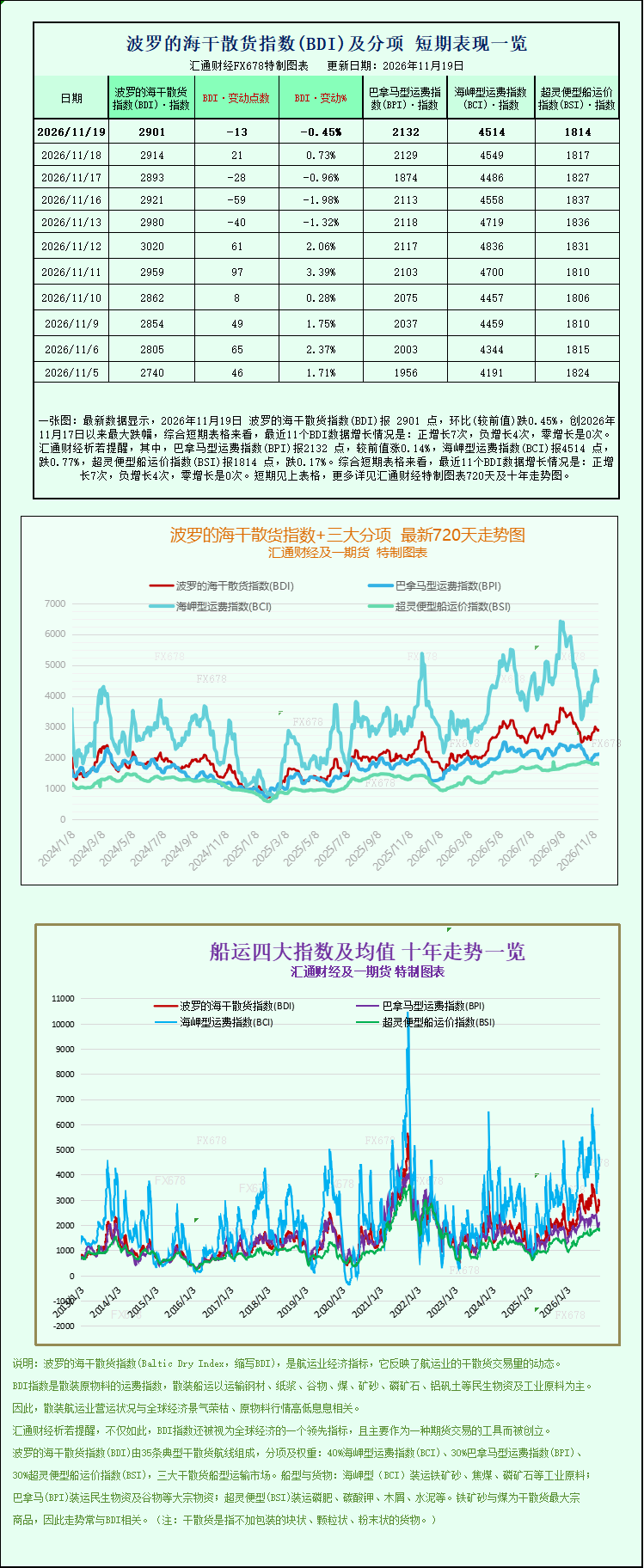 The Baltic Dry Index (BDI), the core freight rate index for dry bulk shipping, saw a slight decline on Thursday, dragged down by falling rates for Capesize and Supramax vessels. The overall dry bulk shipping market showed a divergent pattern, with significant differences in profitability across different vessel types, reflecting the uneven global demand for dry bulk trade. The Baltic Dry Index (BDI), which tracks freight rates for Capesize, Panamax, and Supramax vessels, closed at 2901 points, down 13 points, or 0.5%, from the previous trading day. This slight pullback indicates a cooling in the overall dry bulk shipping market; however, the index remains relatively high and has not experienced a sharp drop, suggesting that the market has not yet entered a phase of widespread weakness, with structural differentiation being the most prominent characteristic. As the vessel type with a very high weighting in the index, the Capesize Index (BCI) fell 35 points, or 0.8%, to close at 4514 points. Capesize vessels primarily transport ultra-large industrial raw materials such as iron ore and coal, with a typical deadweight tonnage of up to 150,000 tons per vessel, making them the core carriers for transoceanic bulk commodity shipping. Although the sector index declined, the average daily earnings of this vessel type increased by $315 to $37,438. The index level and actual daily vessel earnings are not entirely synchronized, mainly due to differences in route structure, the proportion of long- and short-term charter orders, and freight rates for different voyages. Some long-distance ocean routes maintained strong profitability, while freight rates on some short-haul round-trip routes were under pressure. After offsetting these factors, the index recorded a decline, but the actual average vessel earnings still increased. The closely related iron ore market also exhibited a game-theoretic dynamic. Iron ore futures prices rose on Thursday, and a decrease in iron ore arrivals at domestic ports provided some support for prices. Reduced port arrivals indicate a contraction in short-term spot market supply, providing a floor for ore prices. However, the upside potential is limited by multiple real-world factors. On the one hand, hot metal production by steel companies continues to decline, and downstream steel mills are slowing down their production pace, directly weakening the actual demand for iron ore. On the other hand, steel mill profits continue to deteriorate, and marginal losses are further widening, resulting in a severe lack of willingness to actively replenish inventory. Weak downstream demand suppresses the upward movement of raw material prices, and iron ore can only show a volatile but slightly upward trend, making it difficult to achieve a sustained surge. Iron ore is also the main cargo for Capesize vessels, and this situation of "supported but difficult to surge" in the mining market is also transmitted to the shipping market, limiting the upward momentum of Capesize freight rates and making them prone to a rise followed by a fall. The market is not entirely weak; the Panamax sector has become one of the few positive driving forces. The Panamax Index (BPI) rose slightly by 3 points, closing at 2132 points. These vessels have a deadweight tonnage in the 60,000-70,000 tonne range and are mainly responsible for the transoceanic transportation of goods such as coal and grain, playing a key role in the grain export season and coal transportation trade in the Asia-Pacific region. As the index rose, the average daily earnings of Panamax vessels also increased by $27 to $19,188. The slight upward trend in Panamax vessels reflects the continued resilience of demand in the food and coal trade in some regions. Atlantic food shipments and transshipment of thermal coal in the Asia-Pacific region brought some freight orders, supporting the firm freight rates for this vessel type and offsetting some of the downward pressure on the index from other vessel types. The Supramax sector, however, continued its weak performance, with the Supramax Index (BSI) falling 3 points, or 0.2%, to 1814 points. This vessel type consists of small to medium-sized dry bulk carriers with a more dispersed route network, actively engaged in short-haul regional trade and small-volume bulk cargo transportation, making them more susceptible to fluctuations in localized regional trade. The weakness in this sector reflects sluggish demand for small to medium-sized bulk cargo transportation, with a decrease in the activity of inter-regional freight of small-volume ores, building materials, and food. In summary, the current dry bulk shipping market exhibits a typical structural divergence: while large Capesize vessels have seen a correction in the index, their earnings remain high, supported by iron ore and long-distance coal shipping. Panamax vessels are resilient due to grain and some coal trade, while Supramax vessels are under significant pressure. This is driven by a divergence in global commodity demand: iron ore is constrained by steel mill production cuts, grain trade remains rigid, and regional short-haul bulk cargo flows are cooling. Looking ahead, the iron ore market will depend on the pace of steel mill production recovery. If steel mills improve their losses and resume production, it will drive up iron ore purchases, benefiting Capesize vessels. Regarding grain, changes in the export window for grain in the Northern and Southern Hemispheres will continue to influence Panamax freight rates. Supramax vessels, on the other hand, need to wait for a recovery in regional trade activity. In the short term, the dry bulk market is likely to continue its divergent pattern, with little chance of a unilateral surge or plunge. The price movements of each vessel type will fluctuate in accordance with the demand for their respective cargoes.
- Risk Warning and Disclaimer
- The market involves risk, and trading may not be suitable for all investors. This article is for reference only and does not constitute personal investment advice, nor does it take into account certain users’ specific investment objectives, financial situation, or other needs. Any investment decisions made based on this information are at your own risk.