A pause does not mean a halt; how will the Fed's December rate hike pace unfold?
2026-11-20 08:26:32
On Friday (November 20) during the Asian session, the US dollar index traded around 103.90. Overnight, the dollar index surged to 103.96, reaching a new high since early April 2025. Philadelphia Fed President and FOMC voting member Anna Paulson spoke in New York, offering no clear interest rate guidance for the December meeting. She suggested that the market's understanding of the Fed's policy response function is more important than straightforward forward guidance; she emphasized that the unchanged interest rate in October was merely a pause in the pace, not the end of tightening. The speech did not change market pricing; a 25 basis point rate hike in December remains the market benchmark expectation. However, if inflation and wage data exceed expectations, a faster pace of tightening cannot be ruled out. 
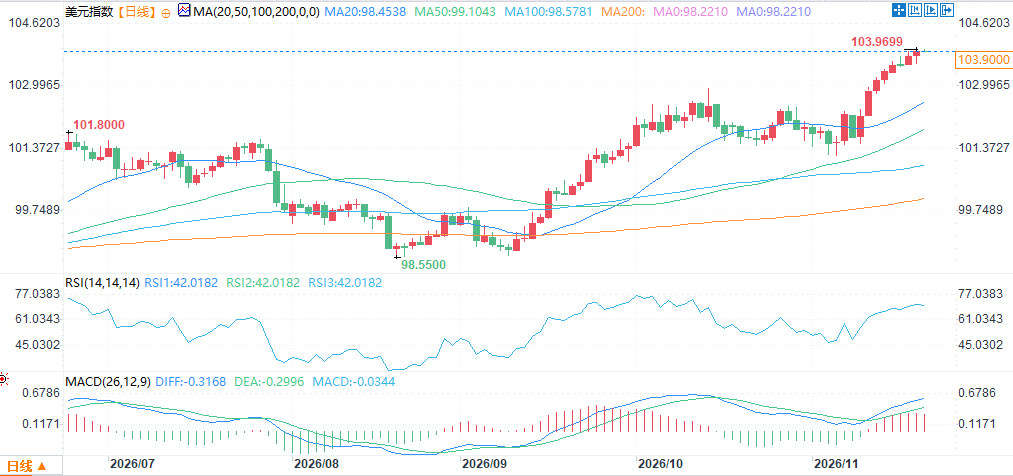 (US Dollar Index Daily Chart, Source: EasyForex) At 8:20 Beijing time, the US Dollar Index was at 103.89.
De-emphasizing direct forward guidance: Focusing on helping the market understand the policy logic
At an event hosted by the New York University Money Market Association, Paulson explicitly stated that in a normal policy environment, the practical value of officials' direct forward guidance on the interest rate path is limited. She emphasized that the real key is not officials verbally predicting whether the next meeting will raise rates or remain unchanged, but rather ensuring the market fully understands the Fed's policy response function—that is, how the Fed will adjust its policy stance in response to different economic data. As long as the market grasps this logic, even if officials reduce specific statements, monetary policy can remain stable and predictable. This view aligns closely with the current direction of reforms to the Fed's internal communication mechanisms, particularly with Chairman Warsh's inclination to reduce interest rate guidance. Paulson believes that over-reliance on specific guidance can lead to path dependence in the market, thus weakening policy flexibility; conversely, when the market can independently deduce the policy path based on data such as inflation, employment, and wages, communication efficiency is higher, and unexpected policy shocks are reduced. She illustrated this by stating that in past communications, the market's understanding of the Fed's intentions has become increasingly sophisticated, thus officials no longer need to repeatedly provide a "clear path." This shift in communication philosophy means that future public speeches by FOMC members will focus more on explaining economic judgments and policy logic, rather than giving specific interest rate hints for specific meetings. For the market, this means that the focus of interpreting officials' speeches should shift from "whether interest rates will be raised" to "under what data combinations interest rates will be raised," thereby improving the overall predictability of policy.Clearly define the October pause: a respite, not the end of the policy.
She cited the October policy meeting as an example to clearly define the decision made at the time. After raising rates in September, the decision was made to maintain rates unchanged in October. The market generally expected further tightening, so this pause would not cause a policy lag. Paulson pointed out, "A shared market understanding allows policy to proceed cautiously, without misinterpreting a pause as a halt to rate hikes." She reiterated her previous position that current policy needs to maintain a restrictive level, and she personally prefers a gradual rate hike path. At the same time, she specifically warned that stock market volatility and oil price changes could weaken the resilience of consumer spending, which is also an important consideration in her preference for a gradual pace. Paulson believes that a pause in a meeting is more like a breather in the policy rhythm, giving the economy and data a window for observation, rather than a signal of a policy shift. She emphasized that as long as the path of inflation decline is not fully solidified and the labor market remains relatively active, the restrictive stance must continue. This statement that "a pause is not the end" helps prevent the market from over-interpreting it as a signal of easing, thereby avoiding premature easing of financial conditions. For investors, this means that holding rates steady in October does not change the overall direction of the tightening cycle. Subsequent meetings will still determine whether to continue raising rates based on data; the pace may slow, but the direction remains unchanged. Paulson's statement further solidified market expectations for policy continuity.Three triggering conditions have been identified, and a watch list has been drawn up to accelerate interest rate hikes.
Paulson explicitly listed three signals that would prompt her to support faster rate hikes: a significant rise in inflation expectations, persistently rising wage pressures, and a renewed increase in underlying core inflation. She pointed out that these indicators will be key clues for the market to observe the December policy meeting, with particular focus on the non-farm payroll report released on December 4th. If wage growth or inflation expectations strengthen beyond expectations, it will provide a realistic basis for the 50-basis-point rate hike option proposed by Waller and other officials. Currently, underlying inflation is still hovering in the 2.5%-3% range, far from the long-term target of 2%, so policy cannot declare victory prematurely. Paulson emphasized that these triggering conditions are not abstract concepts, but rather a quantifiable list of observations: if inflation expectations rise significantly from current levels, average hourly wage growth continues to exceed levels consistent with the 2% inflation target, or core inflation shows signs of renewed acceleration, she will be more inclined to support a greater tightening. This statement effectively provides the market with clear "acceleration conditions," and also means that the data window before the December meeting is crucial. The wage data in the non-farm payroll report, the subsequent inflation expectations survey, and the core inflation reading will directly determine whether the Federal Reserve maintains its gradual 25-basis-point pace or considers more significant action. Paulson's list makes the policy response function more transparent and provides the market with a clearer anchor when trading the December decision.Market trading implications: The interest rate hike cycle may continue until 2027.
This speech did not signal any new policy shift, thus unlikely to significantly disrupt interest rate futures pricing. The market still overwhelmingly bets on a 25 basis point rate hike in December, raising the interest rate range to 4.00%–4.25%. The statement that "a pause does not mean a stop" further reinforced market expectations that this rate hike cycle is likely to continue into 2027, thus supporting short-term Treasury yields and the dollar exchange rate. Subsequent non-farm payroll, inflation, and inflation expectations data will determine whether the Fed continues its gradual pace of 25 basis points or shifts to a larger rate hike if the data exceeds expectations. From a trading perspective, Paulson's speech reduced market illusions of an "early end to tightening," thus supporting short-term interest rates and the dollar; at the same time, since she clearly outlined the conditions for acceleration, if the non-farm payroll or subsequent inflation data on December 4 are strong, the probability of a 50 basis point option will increase rapidly. Investors need to closely monitor the interaction between data and officials' speeches to avoid misinterpreting a single pause as the end of the cycle. Overall, the Federal Reserve remains in a phase of "data dependence + maintaining restraint," and the end of the rate hike cycle is far from over. Market pricing will continue to revolve around the theme of "gradual but sustained" until inflation truly returns to near the 2% target. (US Dollar Index Daily Chart, Source: EasyForex) At 8:20 Beijing time, the US Dollar Index was at 103.89.
- Risk Warning and Disclaimer
- The market involves risk, and trading may not be suitable for all investors. This article is for reference only and does not constitute personal investment advice, nor does it take into account certain users’ specific investment objectives, financial situation, or other needs. Any investment decisions made based on this information are at your own risk.