After the euro fell below 1.10 against the dollar, will 1.08 be the end of this round of decline?
2026-11-20 08:32:30
On Friday (November 20) during the Asian session, the euro continued to trade below 1.1000 against the US dollar, near an 18-month low, having fallen by about 6% since the end of August. Speculative short positions have climbed to their highest level in over six years. Morgan Stanley, Deutsche Bank, and another major European bank are all targeting the next level at 1.0800. The euro is simultaneously facing internal turmoil from the French election and fiscal impasse, as well as external pressure from the Federal Reserve's continued tightening; however, the crowded short-covering structure also means that a strong short-covering rally could easily erupt should a positive signal emerge. 
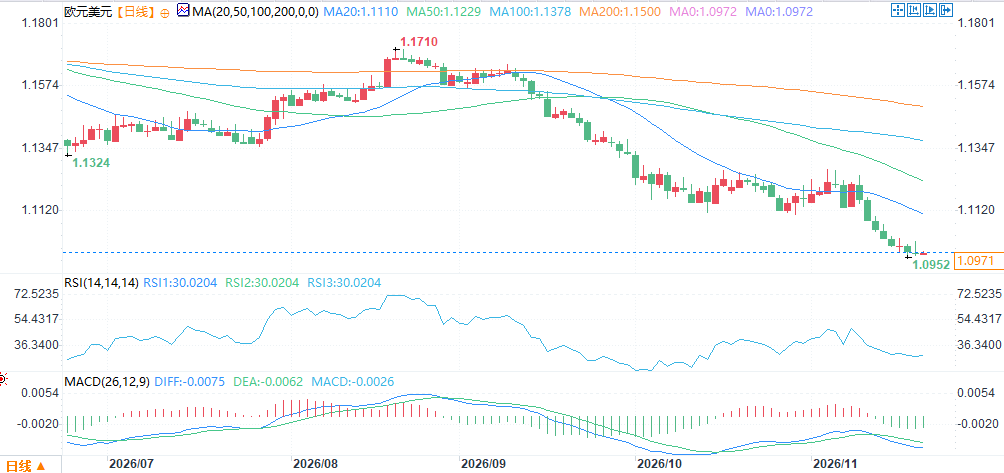 (Euro/USD daily chart, source: EasyForex) At 8:30 Beijing time, the euro/dollar exchange rate was 1.0970/71.
Currency breakout: Short positions are extremely crowded, with 1.08-1.09 becoming the market focus.
The euro fell to its first 18-month low against the dollar, with speculative short selling reaching a six-year high. Three major institutions have given a target price of 1.08 for next year, and the options market risk level is also concentrated in the 1.08-1.09 range. It is worth noting that although the medium-term downtrend has not reversed, the overcrowded short positions pose a risk of a sharp rebound. If France can release a credible fiscal budget, or if US inflation data weakens significantly, it will trigger a large number of short positions to be closed, leading to a rapid recovery. At the same time, the strong dollar is pushing the USD/JPY pair close to the potential intervention threshold for Japan around 160. Current market sentiment is extremely bearish, and any catalyst positive for the euro could quickly push up the exchange rate due to short covering, resulting in sharp short-term fluctuations. Traders need to closely monitor changes in position data to avoid being caught in a stampede in crowded trades.Double pressure: French election risks and Fed tightening resonate together
Domestically, France has been embroiled in political turmoil for weeks, with markets questioning the feasibility of the government's budget bill. The first round of the presidential election in April next year, and the potential second round in May, will gradually price in political risk premiums. Externally, the Federal Reserve's rate hike cycle continues, with multiple institutions expecting further rate hikes in December, January, and March of the following year. Morgan Stanley predicts that Fed rate hikes will continue until early 2027, with rate cuts not expected until 2028 at the earliest. The resilience of the US economy supports higher US Treasury yields, and the widening interest rate differential between the US and Europe provides strong support for the US dollar, even leading to a unique situation where stocks and the dollar strengthen simultaneously, making the euro a major asset under pressure. The combined pressure from both internal and external factors makes it difficult for the euro to find effective support in the short term, and the market's repricing of the overall risk premium in the Eurozone is still underway.Market Divergence: Is the Decline Due to a Strong Dollar or French Sovereign Risk?
There is a clear divergence of opinion in the market regarding the driving logic behind the current euro decline. Some analysts believe that the essence of this decline is the strengthening of the US dollar, evidenced by the fact that the euro has not weakened against all currencies. If the market is primarily driven by the US dollar, the spread between French and German 10-year bond yields will remain relatively stable; however, if the Franco-German yield spread widens significantly, it indicates that French sovereign fiscal risk has become the dominant factor, and the euro will face greater downward pressure. Currently, the options market has not seen large-scale purchases of deep put protection, and some strategists judge that the downside risk is only moderately biased towards the area above 1.08. This divergence directly affects the choice of trading strategies: if the US dollar is confirmed to be dominant, it is more appropriate to position based on the strength of the US dollar; if sovereign risk intensifies, additional caution is needed regarding the spread of systemic pressure within the Eurozone.Key areas of focus for future observation: Closely monitor the Franco-German interest rate differential and key US data.
Going forward, trading requires observing two parallel threads. Externally, the December Fed meeting is approaching, and a series of US inflation and employment data will directly determine the Fed's interest rate hike pace, thus affecting the strength of the US dollar. Internally, the progress of the French budget and changes in pre-election polls can be verified in real-time through the Franco-German bond yield spread. Even if the overall trend is downward, positive fiscal progress or a cooling of US inflation will quickly unwind short positions, triggering a short-term rebound. Investors should simultaneously track the Franco-German yield spread and the release of core US data to promptly determine whether the dominant driver has shifted, thereby seizing potential trading windows for rebounds or further breakdowns. (Euro/USD daily chart, source: EasyForex) At 8:30 Beijing time, the euro/dollar exchange rate was 1.0970/71.
- Risk Warning and Disclaimer
- The market involves risk, and trading may not be suitable for all investors. This article is for reference only and does not constitute personal investment advice, nor does it take into account certain users’ specific investment objectives, financial situation, or other needs. Any investment decisions made based on this information are at your own risk.