CBOT Commodity Analysis: Corn rebounded after hitting its lowest level since June 30, while soybeans fell for the fourth consecutive day, breaking below the 200-day moving average.
2026-11-20 09:08:36
On Thursday (November 19), the CBOT grain market showed a clear divergence. December corn settled at $4.39 per bushel, up 3.5 cents, after hitting a low of $4.322, its lowest since June 30, before rebounding. December wheat settled at $5.782 per bushel, up 8.25 cents, after hitting a low since January 12 before recovering. January soybeans settled at $12.075 per bushel, down 9.25 cents, marking their fourth consecutive day of decline, breaking below the 200-day moving average after hitting resistance above the 20-day moving average. December soybean meal settled at $332.40 per short ton, down $3.60. Kansas City December hard red winter wheat settled at $6.257 per bushel, up 16.5 cents. The rebound in corn and wheat was attributed to "short covering after overselling," while the decline in soybeans was a continuation of a trend driven by exchange rates and weather. One chief strategist bluntly stated, "Today's rebound is simply profit-taking after corn hit a new low. As for wheat, there's a fundamental discussion, as Putin has essentially closed the door to a ceasefire in Ukraine." This statement highlights the different nature of the rebounds in the two commodities: corn is technical, while wheat is driven by both fundamentals and geopolitics. The decline in soybeans stemmed from two sources: a weaker Brazilian real—which typically triggers more sales from Brazilian farmers; and favorable weather in Brazil—following a record US harvest, the prospect of a bumper crop in South America further suppressed prices. Currently, CBOT grains are in a three-way split: "geopolitically driven wheat, currency-driven soybeans, and technically driven corn," and the basis performance reveals the true temperature of the spot market. Midwestern corn basis is mixed—a grain depot in Cincinnati lowered its spot basis by 4 cents but raised its December delivery basis to a 5-cent premium over the December contract. This detail suggests that buyers are trying to persuade farmers to slow spot deliveries and postpone some deliveries to December due to unusually tight supplies in the eastern corn belt. Soybean basis remained stable to rise as processors in the Midwest, East and Central regions struggled to procure soybeans while farmers were busy harvesting corn.  As of 09:01 AM today (November 20th) in the Asian morning session, here is a summary of the price changes for related commodities.
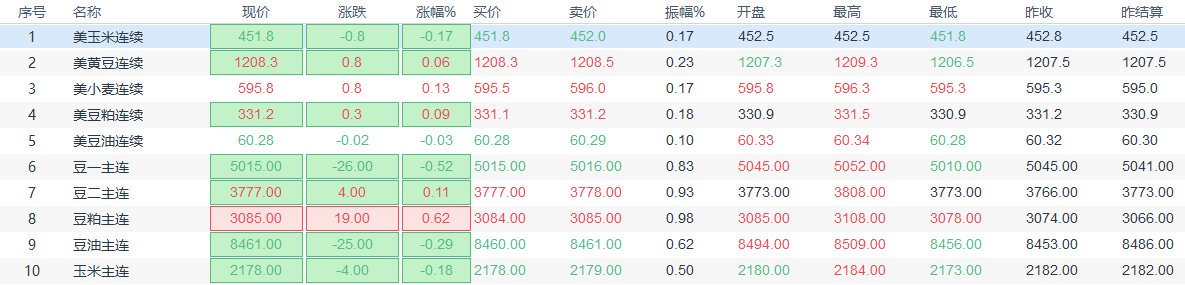 According to FX678's observations, estimates from overseas traders show that on Thursday (November 19th), the speculative positions of commodity funds on corn futures, soybean futures, wheat futures, soybean meal futures, and soybean oil futures at the Chicago Board of Trade (CBOT), specifically the net positions and average net positions of CBOT commodity funds, are shown in the chart below created by FX678.
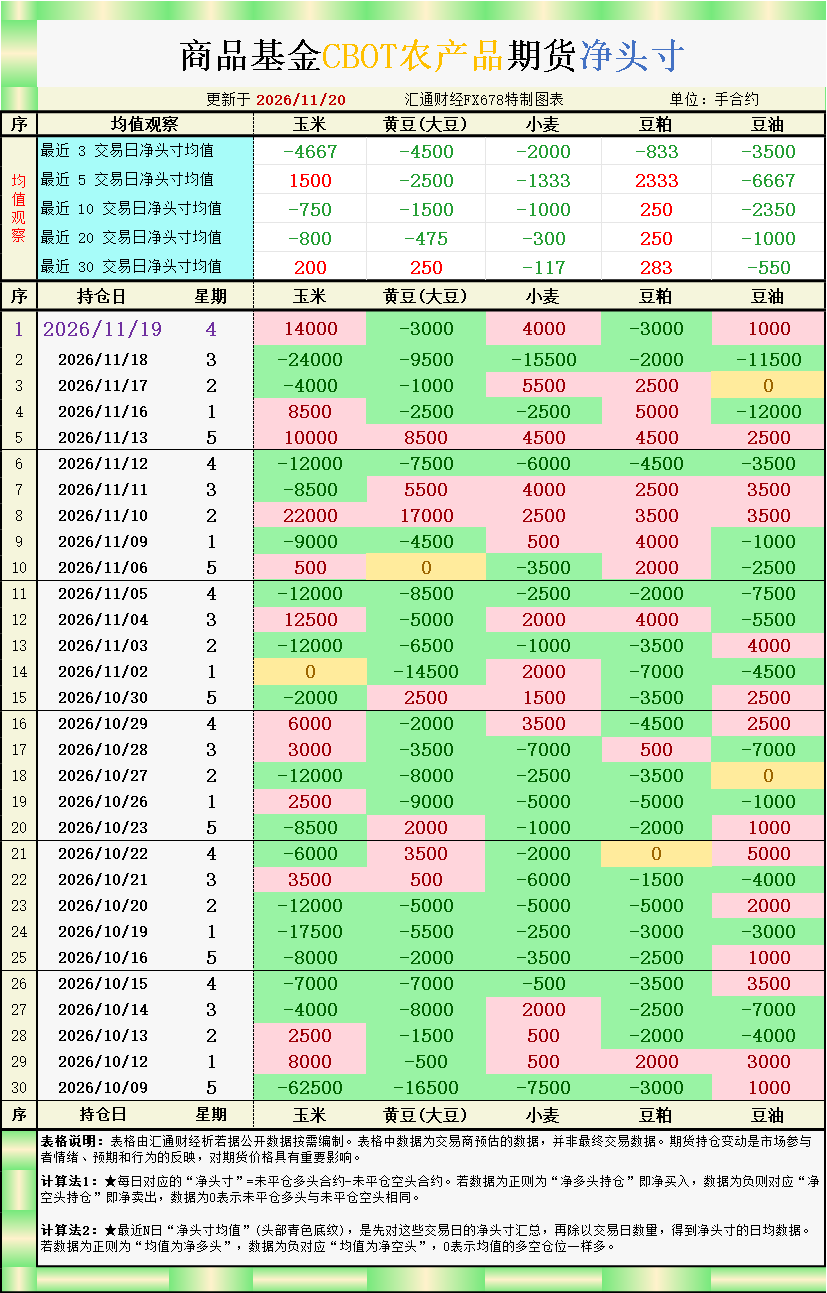 The following is an interpretation of the net positions and averages in the above position charts: [CBOT corn speculative positions: net buying of 14,000 contracts; average net selling of 4,667 contracts over the past 3 trading days; average net buying of 1,500 contracts over the past 5 trading days; average net selling of 750 contracts over the past 10 trading days; average net selling of 800 contracts over the past 20 trading days; average net buying of 200 contracts over the past 30 trading days.] [CBOT soybean speculative positions: net selling of 3,000 contracts; average net selling of 4,500 contracts over the past 3 trading days; average net selling of 2,500 contracts over the past 5 trading days; average net selling of 1,500 contracts over the past 10 trading days; average net selling of 475 contracts over the past 20 trading days; average net buying of 250 contracts over the past 30 trading days.] [CBOT wheat speculative positions are net buys of 4,000 contracts; the average net position over the past 3 trading days is net sells of 2,000 contracts; the average net position over the past 5 trading days is net sells of 1,333 contracts; the average net position over the past 10 trading days is net sells of 1,000 contracts; the average net position over the past 20 trading days is net sells of 300 contracts; and the average net position over the past 30 trading days is net sells of 117 contracts.] [CBOT soybean meal speculative positions are net sells of 3,000 contracts; the average net position over the past 3 trading days is net sells of 833 contracts; the average net position over the past 5 trading days is net buys of 2,333 contracts; the average net position over the past 10 trading days is net buys of 250 contracts; the average net position over the past 20 trading days is net buys of 250 contracts; and the average net position over the past 30 trading days is net buys of 283 contracts.] [CBOT soybean oil speculative positions are net buys of 1,000 contracts; the average net position over the past 3 trading days is net sells of 3,500 contracts; the average net position over the past 5 trading days is net sells of 6,667 contracts; the average net position over the past 10 trading days is net sells of 2,350 contracts; the average net position over the past 20 trading days is net sells of 1,000 contracts; and the average net position over the past 30 trading days is net sells of 550 contracts.] CBOT grain positions, basis, and international supply and demand reveal new market trends. Detailed analysis of each commodity is provided below.
As of 09:01 AM today (November 20th) in the Asian morning session, here is a summary of the price changes for related commodities. According to FX678's observations, estimates from overseas traders show that on Thursday (November 19th), the speculative positions of commodity funds on corn futures, soybean futures, wheat futures, soybean meal futures, and soybean oil futures at the Chicago Board of Trade (CBOT), specifically the net positions and average net positions of CBOT commodity funds, are shown in the chart below created by FX678. The following is an interpretation of the net positions and averages in the above position charts: [CBOT corn speculative positions: net buying of 14,000 contracts; average net selling of 4,667 contracts over the past 3 trading days; average net buying of 1,500 contracts over the past 5 trading days; average net selling of 750 contracts over the past 10 trading days; average net selling of 800 contracts over the past 20 trading days; average net buying of 200 contracts over the past 30 trading days.] [CBOT soybean speculative positions: net selling of 3,000 contracts; average net selling of 4,500 contracts over the past 3 trading days; average net selling of 2,500 contracts over the past 5 trading days; average net selling of 1,500 contracts over the past 10 trading days; average net selling of 475 contracts over the past 20 trading days; average net buying of 250 contracts over the past 30 trading days.] [CBOT wheat speculative positions are net buys of 4,000 contracts; the average net position over the past 3 trading days is net sells of 2,000 contracts; the average net position over the past 5 trading days is net sells of 1,333 contracts; the average net position over the past 10 trading days is net sells of 1,000 contracts; the average net position over the past 20 trading days is net sells of 300 contracts; and the average net position over the past 30 trading days is net sells of 117 contracts.] [CBOT soybean meal speculative positions are net sells of 3,000 contracts; the average net position over the past 3 trading days is net sells of 833 contracts; the average net position over the past 5 trading days is net buys of 2,333 contracts; the average net position over the past 10 trading days is net buys of 250 contracts; the average net position over the past 20 trading days is net buys of 250 contracts; and the average net position over the past 30 trading days is net buys of 283 contracts.] [CBOT soybean oil speculative positions are net buys of 1,000 contracts; the average net position over the past 3 trading days is net sells of 3,500 contracts; the average net position over the past 5 trading days is net sells of 6,667 contracts; the average net position over the past 10 trading days is net sells of 2,350 contracts; the average net position over the past 20 trading days is net sells of 1,000 contracts; and the average net position over the past 30 trading days is net sells of 550 contracts.] CBOT grain positions, basis, and international supply and demand reveal new market trends. Detailed analysis of each commodity is provided below.Corn: Net buying of 14,000 lots reversed the 3-day moving average, driven by both oversold correction and tight spot supply.
Corn commodity funds saw net buying of 14,000 contracts on Thursday, compared to a 3-day average of net selling of 4,667 contracts—a significant reversal in daily flows, indicating concentrated and directional buying by funds. The December contract touched a low of $4.322, its lowest since June 30, before rebounding to close at $4.39, up 3.5 cents. The drivers were twofold. First, profit-taking after overselling—one institutional chief strategist bluntly stated, "Today was simply profit-taking after corn hit new lows." Second, tightness in the spot market—corn basis in the Midwest was mixed, with a Cincinnati grain depot lowering its spot basis by 4 cents but raising its December delivery basis to a 5-cent premium over the December contract, suggesting buyers are trying to persuade farmers to slow spot deliveries and postpone some to December due to "exceptionally tight" supplies in the Eastern Corn Belt. On the export front, net sales of old-crop corn for the week ending November 12 totaled 1.5881 million tons, within trade expectations; the Busan Feed Association in South Korea purchased up to 63,000 tons of corn; international institutions lowered their 2026/27 global corn production forecast by 6 million tons to 1.301 billion tons. Net fund purchases of 14,000 lots echoed the assessment of "oversold correction + tight spot supply." The closing price was $4.39, with upside targets at $4.45 to $4.50. The sustainability of the rebound depends on whether the spot supply tightness continues and whether export sales can take over from technical buying.Soybeans: Net selling of 3,000 contracts continued, pressured by exchange rate and weather factors after breaking below the 200-day moving average.
On Thursday, commodity funds net sold 3,000 soybean contracts, close to the 3-day average of 4,500 contracts and higher than the 5-day average of 2,500 contracts—a consistent net selling direction, indicating that the funds' bearish stance continues. The January contract closed at $12.075, down 9.25 cents, marking its fourth consecutive day of decline. It touched resistance above the 20-day moving average before breaking below support at the 200-day moving average. Two key factors weighed on prices: firstly, the weakening Brazilian real—which typically triggers more sales from Brazilian farmers; and secondly, favorable weather in Brazil—following a record US harvest, the prospect of a bumper crop in South America further suppressed prices. On the export side, the USDA reported sales of 200,844 tons of soybeans to Mexico; net sales for the week ending November 12 were 1,501,000 tons, within expectations. Regarding basis, the Midwest soybean basis remained stable, while the Gulf CIF soybean premium for December shipment was 113 cents, up 1 cent. Some traders pointed out that purchasing soybeans is currently difficult for some processors as farmers are focused on harvesting corn—a detail that suggests there is no oversupply of soybeans in the spot market, and the basis support comes from "farmers having no time to sell" rather than "strong demand." Net selling of 3,000 contracts by funds echoes the downward pressure from "currency + weather." The closing price was $12.075, with a downside target of $12.00. A rebound would require the Brazilian real to stabilize or unforeseen weather problems in South America.Wheat: Net buying of 4,000 contracts reverses three-day net selling; short covering triggered by Putin closing the ceasefire.
Wheat commodity funds saw net buying of 4,000 contracts on Thursday, compared to a 3-day average of net selling of 2,000 contracts—a shift in daily flows from bearish to bullish, reversing the short-term net selling trend. The December contract rebounded after hitting its lowest level since January 12, closing at $5.78-1/4, up 8-1/4 cents; the Kansas City December hard red winter contract closed at $6.257, up 16.5 cents. The driver was geopolitical. Putin ruled out negotiations for a ceasefire in the Black Sea after Ukraine destroyed part of a bridge connecting Russia and Crimea—one chief strategist bluntly stated that the wheat rebound "has a fundamental discussion, because Putin has essentially closed the door on a ceasefire in Ukraine." This statement weakened hopes for easing tensions from previous trilateral talks, and geopolitical premiums were re-incorporated. In terms of basis, the basis for hard red winter wheat in the US Plains remained stable, with limited buyer interest. The protein premium rose by 7 cents for wheat with 13.00% to 13.40% protein and by 8 cents for wheat with 14.00% protein, indicating continued tight demand for high-quality wheat. In international transactions, South Korean flour mills tendered for approximately 100,000 tons of milled wheat, exclusively from the US; the Taiwan Flour Mills Association tendered for approximately 89,000 tons of Grade 1 milled wheat, also from the US; Jordan issued a tender for 120,000 tons—Asian buyers explicitly requested US origin, supporting US wheat exports. Net fund purchases of 4,000 contracts echoed the combination of "net short positions + escalating geopolitical tensions." The closing price was $5.78-1/4, with upside targets at $5.85-$5.90. The sustainability of geopolitical events will be the dominant variable in the next phase.Soybean meal: Net selling of 3,000 lots reversed the 5-day net buying trend; basis remained firm but exports were slightly lower than expected.
Soybean meal futures saw a net sell of 3,000 contracts on Thursday, compared to a 3-day average of 833 net sales and a 5-day average of 2,333 net purchases – a shift from long to short positions, reversing the short-term net buying trend. The December contract closed at $332.40, down $3.60. The cash basis held steady to slightly higher, but buyer interest fluctuated ahead of the Thanksgiving holiday – a processing plant in Iowa Falls switched its basis to a "call option" quote, indicating that cash supply and demand were causing excessively rapid basis price volatility. The basis has remained firm in recent days as some plants prepare to temporarily shut down or slow crushing during Thanksgiving – but most plants are still operating around the clock. On the export front, net soybean meal sales for the week ending November 12 were 198,100 tonnes, slightly below trade expectations of 200,000 to 400,000 tonnes. The net sell of 3,000 contracts by funds echoes the assessment that the firm basis stems from a short-term supply tightening due to holiday shutdowns, rather than a substantial improvement in demand. The price of $332.40 corresponds to the marginal pricing of new crop crushing supply, and it is likely to fluctuate in the range of $328 to $338 per short ton in the short term.Soybean oil: Net buying of 1,000 lots reverses short-term net selling, with support emerging from the energy sector.
On Thursday, commodity funds saw a net inflow of 1,000 contracts into soybean oil, while the 3-day average was a net outflow of 3,500 contracts and the 5-day average was a net outflow of 6,667 contracts—a shift from short to long positions in a single day, reversing the short-term net selling trend. As a feedstock for biodiesel, soybean oil's pricing logic is tied to both soybeans (cost side) and crude oil (energy side). On Thursday, soybeans fell 9.25 cents, dragging down costs; on the energy side, crude oil rose on Thursday, increasing the production cost of polyester, a cotton substitute—this detail, while specifically targeting cotton, also illustrates that the strengthening of the energy side provides marginal support for vegetable oils. Looking at the crushing chain, the decline in soybeans lowered crushing costs, soybean meal followed suit, and the basis remained stable; changes in crushing profits depend on the difference in the decline rates of the two. The net inflow of 1,000 contracts by funds echoes the "energy-side support," indicating that the drag from costs was partially offset by the support from the energy side. Soybean oil currently lacks independent upward momentum, and short-term fluctuations are likely, but the decline may be limited by energy-side support.Summary: Short covering in corn and wheat, and continued bearish sentiment in soybeans and soybean meal.
A clear divergence is emerging based on the combined open interest data of the five major commodities: corn saw net buying of 14,000 contracts (reversing the 3-day average net selling of 4,667 contracts), wheat saw net buying of 4,000 contracts (reversing the 3-day average net selling of 2,000 contracts), and soybean oil saw net buying of 1,000 contracts (reversing short-term net selling), while soybeans saw net selling of 3,000 contracts (continuing) and soybean meal saw net selling of 3,000 contracts (reversing 5-day net buying). This divergence means that fund buying is concentrated in oversold recovery commodities (corn) and geopolitically driven commodities (wheat), while selling is concentrated in commodities suppressed by exchange rates and weather (soybeans) and commodities with slightly lower-than-expected exports (soybean meal). The reversal in corn and wheat flows directly reflects the "technical recovery + geopolitical escalation" at the position level; the net selling of soybeans and soybean meal indicates that pressure from exchange rates and demand remains. The divergence between basis and futures is a consistent signal. The divergence in corn basis—a downward adjustment in the spot basis and an upward adjustment in the December delivery basis—indicates that buyers expect tight supply to continue into December. The stable soybean basis and rising Gulf Coast premium suggest that export demand is slightly stronger than domestic circulation. The firm soybean meal basis stems from short-term supply tightening due to crushing plant shutdowns for the holidays. This pattern implies that the spot market has not followed the pessimistic pricing of futures, and the resilience of the basis provides a downside buffer for the market. Looking ahead, whether corn can hold above $4.32 and continue net buying momentum, whether wheat can break through $5.85 to $5.90, and whether soybeans can find support above $12.00 are three key indicators to watch to see if this divergence in positioning can continue. The key points to watch in the next one to two weeks are: the evolution of the situation in the Black Sea (if attacks continue after Putin closed the ceasefire door, there is still room for short covering in wheat), the Brazilian Real and South American weather (if the Real continues to weaken, downward pressure on soybeans will persist), and trade relations between the United States and major Asian countries (if agricultural purchases increase significantly, soybeans will receive substantial support). Given the divergence between geopolitical, exchange rate, and technical factors, coupled with increased positions on both ends of the spectrum and the basis providing a buffer, the short-term direction of the market will vary depending on the commodity—wheat will be slightly stronger, corn will be slightly stronger with fluctuations, soybeans will be slightly weaker, and soybean meal will fluctuate. Whether these three factors can resonate depends on whether there are new changes in the three exogenous variables: the Black Sea, Brazil, and major Asian countries.- Risk Warning and Disclaimer
- The market involves risk, and trading may not be suitable for all investors. This article is for reference only and does not constitute personal investment advice, nor does it take into account certain users’ specific investment objectives, financial situation, or other needs. Any investment decisions made based on this information are at your own risk.