Will the weaker-than-expected CPI data change the Bank of Japan's December interest rate hike plans?
2026-11-20 09:50:32
On Friday (November 20) during Asian trading hours, the USD/JPY pair edged lower, currently trading around 159.65, down about 0.2%. Japan's three inflation indicators for October all fell short of market expectations, although core CPI remained above the Bank of Japan's 2% inflation target for the second consecutive month. Despite the cooling inflation data, Kazuo Ueda's recent hawkish signals have led the market to still bet on a rate hike to 1.50% at the December policy meeting. The slightly weaker data has slightly reduced support for yen interest rates, with the USD/JPY pair hovering below the 160 intervention level, and the exchange rate relying more on intervention warnings for support. High producer prices and volatile oil prices remain important variables for future inflation. 
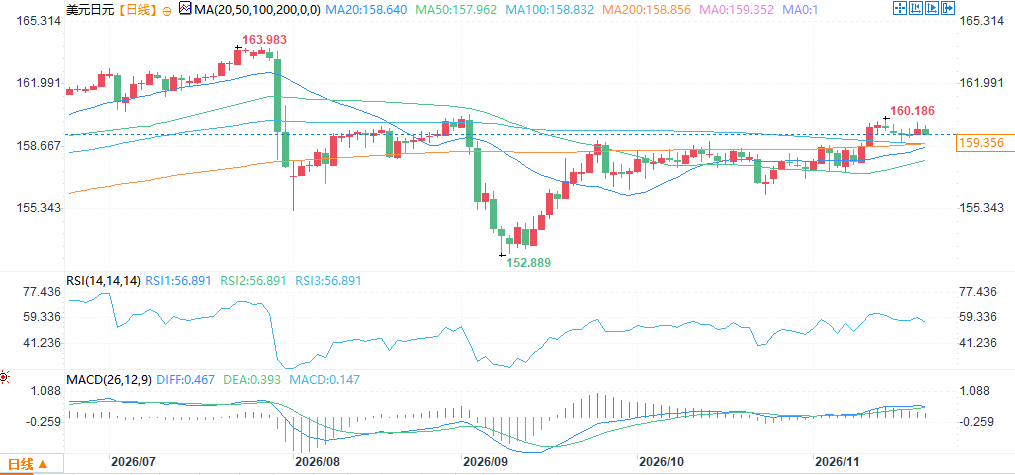 (USD/JPY daily chart, source: FX678) At 9:44 Beijing time, USD/JPY was trading at 159.37/38.
Inflation data overview: Readings generally lower than expected, core inflation holds above 2%.
Japan's October inflation figures all fell short of economists' expectations. Core CPI, excluding fresh food, rose 2.2% year-on-year, below the expected 2.3%, but slightly higher than September's 2.1%. Overall CPI rose 2.3% year-on-year, below the expected 2.5%. Core-core CPI, excluding fresh food and energy, fell to 2.2%, down from 2.4% previously, also below the market expectation of 2.3%. While underlying inflation showed signs of a marginal decline, the two key indicators, core and core-core, remained firmly above the 2% target. The decline in core-core inflation provides room for discussion among dovish voices, but overall price pressures have not been completely eliminated. Cost pressures on businesses remain high; Japan's Producer Price Index (PPI) rose as high as 7.1% year-on-year in October, driven by rising prices in oil, chemicals, steel, and utilities. Coupled with a weaker yen increasing import costs, upstream costs will gradually be passed on to downstream consumer goods. Fluctuations in oil prices due to the Middle East situation will be a key variable determining whether inflation will rise again or continue to cool. While the cooling of data provided a brief respite, it was insufficient to reverse the market's fundamental assessment of sticky inflation.Central Bank Policy Stance: Weak Data Does Not Change the Benchmark Scenario of a December Rate Hike
The Bank of Japan's current policy rate is 1.25%. It has already raised rates twice this year, in June and September, and chose to hold steady in October. A media survey shows that 86% of economists expect another 25 basis point hike to 1.50% at the December 17-18 meeting, marking the third rate hike this year. Even though the CPI fell short of expectations, Kazuo Ueda publicly stated on Thursday that the current monetary environment remains loose, and the central bank needs to continue raising rates, while also warning of the potential risk of overshooting inflation. The lower-than-expected monthly inflation only slightly lowered market pricing for a rate hike, but it was not enough to overturn the benchmark expectation for a December rate hike. Some institutions are even more aggressive, predicting that the policy rate may rise to 2.5% by mid-2027, significantly higher than the current market consensus. It is worth noting that Japan's third-quarter GDP unexpectedly contracted, raising concerns about the economic fundamentals, which is a real constraint on the pace of the Bank of Japan's rate hikes. The coexistence of hawkish signals and cooling data suggests that the policy path still leans towards gradual tightening.The Japanese Yen's Dilemma: Interest Rate Hikes Fails to Close the US-Japan Interest Rate Differential; Intervention Relies on the 160 Level as a Deterrent
Inflation data has cooled marginally, weakening the yen's support from interest rates. The USD/JPY exchange rate continues to hover around 160, a level considered a potential red line for Japanese intervention. Even if the Bank of Japan raises interest rates as expected in December, the Federal Reserve is also in a rate-hiking cycle, making it difficult for the interest rate differential between the US and Japan to narrow significantly. Therefore, the yen's appreciation effect solely from a Japanese rate hike is limited. This means that in the short term, the yen relies more on verbal warnings from the Ministry of Finance to suppress depreciation, with interest rate expectations providing relatively limited protection. Short-term Japanese government bond yields may decline slightly due to lower-than-expected inflation. However, if the US continues to push up US Treasury yields, the yen will still face significant depreciation pressure. Intervention and deterrence have become the main means of supporting the exchange rate, and market vigilance regarding actual market intervention continues to rise.The main focus for future observation: the triple interplay between inflation, oil prices, and the US central bank's policies.
The market needs to monitor three key factors: First, Japan's CPI and wage data to determine whether domestic demand-driven inflation can sustainably remain above 2%; second, international oil prices, as energy is a major driver of this round of Japanese inflation, and geopolitical conflicts in the Middle East causing oil price fluctuations will directly alter the Bank of Japan's policy balance; and third, the Federal Reserve's December interest rate hike strategy. If the Fed maintains a hawkish stance, even if Japan raises rates, the US-Japan interest rate differential will remain high, making it difficult to alleviate the pressure on the yen to depreciate. Conversely, if US inflation declines and the Fed shifts towards a slower pace of tightening, the yen will have a genuine window for recovery. These three intertwined factors will jointly determine the yen's trajectory and the Bank of Japan's policy space before the end of the year. (USD/JPY daily chart, source: FX678) At 9:44 Beijing time, USD/JPY was trading at 159.37/38.
- Risk Warning and Disclaimer
- The market involves risk, and trading may not be suitable for all investors. This article is for reference only and does not constitute personal investment advice, nor does it take into account certain users’ specific investment objectives, financial situation, or other needs. Any investment decisions made based on this information are at your own risk.