After the attack on oil tankers in the Taiwan Strait, can geopolitical premiums reverse the downward pressure on crude oil prices?
2026-11-20 10:32:30
On Friday (November 20) during Asian trading hours, US crude oil futures rebounded slightly, currently trading below $83. Overnight, US crude oil futures fell to $81.66 per barrel, a low since the end of August. Geopolitical risks such as the attack on oil tankers in the Strait of Hormuz and the Houthi attack on the Saudi capital have brought geopolitical premiums; however, the unexpectedly large accumulation of US crude oil inventories and the continued downward pressure from the fundamental oversupply of global crude oil have offset each other, keeping oil prices range-bound in the short term. 
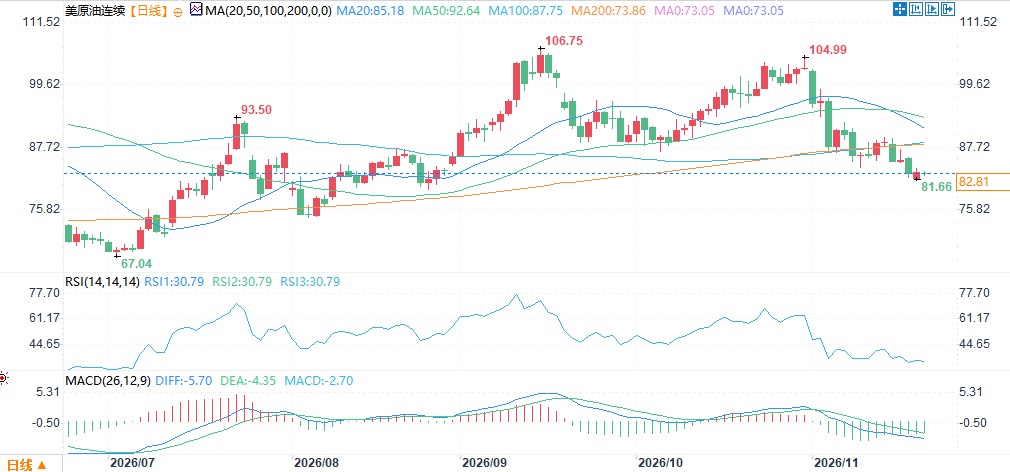 (US crude oil futures daily chart, source: FX678) At 10:21 Beijing time, US crude oil futures were trading at $82.80 per barrel.
Renewed tensions in the Middle East and shipping risks in the Taiwan Strait are providing a floor for oil prices.
Multiple regional conflicts have become a significant bullish factor for crude oil. The Iranian Navy announced that two oil tankers struck mines and exploded in the Strait of Hormuz on Thursday, raising market concerns about potential shipping disruptions. Simultaneously, the Iranian-backed Houthi rebels launched missiles at Riyadh, the Saudi capital, damaging multiple floors of the city's tallest landmark building, the headquarters of the Saudi sovereign wealth fund, and surrounding buildings. Fortunately, there were no casualties. Western officials revealed that Saudi Arabia anticipates the confrontation with the Houthis may continue into next year. Additionally, media reports indicate that the Trump administration is assessing a new round of military strikes against Iran, although no final orders have been issued. However, the market reaction was relatively limited, with Brent crude oil rising only slightly by 0.21%. These geopolitical events are providing more of a temporary boost than a substantial disruption to crude oil supply.The unexpected surge in US inventories highlights the negative reality of global oversupply.
The latest inventory data from the U.S. Energy Information Administration (EIA) has become a core fundamental factor suppressing oil prices. As of the week ending November 13, U.S. crude oil inventories increased by 3.38 million barrels, compared to a decrease of 4.657 million barrels the previous week; the market consensus was for a decrease of 400,000 barrels, meaning the actual inventory buildup significantly exceeded market expectations. This larger-than-expected inventory increase further confirms the assessment that global crude oil supply exceeds demand. With no significant recovery in demand, the continued rise in inventories indicates a weak fundamental oil market, putting downward pressure on oil prices in the medium to long term. Even with repeated geopolitical risks, the oversupply environment limits the significant upside potential for oil prices.Institutional Views
In its latest report, Goldman Sachs points out that the global crude oil market will experience a significant oversupply in 2027, with an average daily surplus of approximately 2 million barrels, even after factoring in some supply disruption risks. Based on this, the firm forecasts an average Brent crude price of $88 per barrel in 2027, falling further to $78 per barrel by the end of the year; West Texas Intermediate (WTI) crude is expected to average around $78 per barrel, potentially dropping to around $70 per barrel by the end of the year. The report emphasizes that Middle Eastern supply will gradually recover and exceed 2025 levels through ship-to-ship transshipment and new pipeline construction, while continued weak demand for road fuels in China will drag down overall demand by approximately 400,000 barrels per day. In the short term, shipping attacks and infrastructure damage may still push up risk premiums, but in the medium term, a shift towards oversupply will dominate price declines. Goldman Sachs also provides a scenario analysis: if Middle Eastern supply continues to be significantly disrupted, the average Brent price could rise above $120; if supply is stronger, it could fall into the $60 range. Morgan Stanley has slightly lowered its full-year 2026 average price forecast for WTI crude oil to $85.80 per barrel, while raising it to $80.50 per barrel for 2027. Specifically, its Q4 2026 target has been lowered to $92 per barrel from $95, while its Q1 2027 target has been raised to $93 per barrel from $90. These adjustments reflect near-term inventory accumulation and increased expectations of supply recovery, but geopolitical risks continue to support a certain premium. Morgan Stanley believes the market is shifting from high tension to gradual easing, and WTI will face greater downward pressure in 2027, although quarterly volatility may increase due to recurring tensions in the Middle East.Market Outlook: Geopolitical risks and inventory fundamentals continue to tug at each other.
In the short term, oil prices will continue to oscillate between geopolitical risks and oversupply. Traders need to closely monitor the status of tanker traffic in the Strait of Hormuz. If there is a large-scale disruption to shipping, oil prices will rise rapidly; conversely, if shipping in the strait remains unimpeded, the logic of high US inventories and global oversupply will regain dominance, and oil prices will come under downward pressure again. (US crude oil futures daily chart, source: FX678) At 10:21 Beijing time, US crude oil futures were trading at $82.80 per barrel.
- Risk Warning and Disclaimer
- The market involves risk, and trading may not be suitable for all investors. This article is for reference only and does not constitute personal investment advice, nor does it take into account certain users’ specific investment objectives, financial situation, or other needs. Any investment decisions made based on this information are at your own risk.