Strategist: Market wary of deleveraging wave; panic is the core factor causing gold price plunge.
2026-11-20 10:48:33
Robin J. Brooks, former chief economist at the Institute of International Finance and chief foreign exchange strategist at Goldman Sachs, points out that the Federal Reserve's ill-timed rate hike cycle is amplifying market panic and could trigger widespread deleveraging. The previous abnormal strength of the US dollar against emerging market currencies was a typical signal of the start of deleveraging, and the recent decline in gold and precious metals should also be understood within this framework. Meanwhile, high real interest rates, volatile oil prices, and geopolitical risks further increase uncertainty about the market outlook.
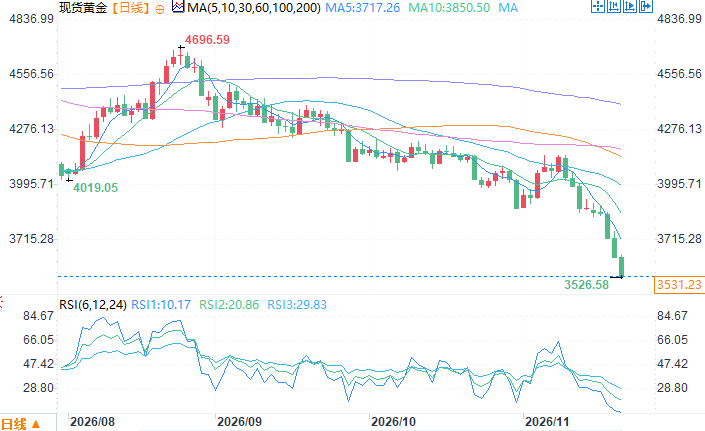 Spot gold daily chart source: FX678. At 10:35 AM Beijing time on November 20th, spot gold was trading at $3531.23 per ounce.
The Fed's hawkish policy is unlikely to be sustainable, and market disagreements have emerged.
Robin J. Brooks argues that the Federal Reserve's persistently hawkish stance is not sustainable in the long term. The decline in oil prices has driven real interest rates rapidly, with current real yields on 10-year and 30-year Treasury bonds reaching their highest levels in over two decades. While the market initially expected the Fed to soften its hawkish stance after the midterm elections, the current market is fiercely divided on the monetary policy path led by Kevin Warsh, and this policy wrangling is putting the US economy at risk. Analysts believe Warsh should provide clear policy guidance to dispel market speculation and stabilize expectations.Multiple drivers of the gold price decline, with the influence of panic factors continuing to amplify.
The traditional logic behind the downward pressure on gold stems from rising real interest rates, with the market pricing in continued tightening by the Federal Reserve, which further suppresses the attractiveness of gold as a non-interest-bearing asset. While the decline in oil prices should have provided some support for gold, this positive factor has gradually faded. The core variable driving the recent decline in gold prices is the panic factor accompanying rising expectations of deleveraging. Even with a long-term bullish outlook on currency devaluation in the context of fiscal instability, this analysis acknowledges that the deleveraging cycle is a short-term negative factor, and that if the conflict related to Iran escalates again, the evolution of the deleveraging trend will become even more unpredictable.Multiple assets are sending unusual signals, and price movements are deviating from fundamental constraints.
This analysis tracks the interconnected movements of gold, Brent crude oil, the broad US dollar index, the 2-year US Treasury real yield, and copper prices, as well as key time points related to Iran. It's noteworthy that while real interest rates and oil prices have generally stabilized recently, the dollar, gold, and copper prices have exhibited non-linear fluctuations. Such price movements, detached from fundamentals, often foreshadow liquidity pressures and the onset of asset deleveraging. Particularly noteworthy is that even after the rise in real interest rates stalled, gold prices continued to decline, demonstrating that panic has become an independent suppressive force.Regression model analysis of gold price drivers reveals that fear factors are the biggest drag.
By analyzing the five-day rolling return of gold prices using a regression model, we can see that gold price fluctuations are driven by a combination of factors, including the real two-year yield, Brent crude oil, US stocks, volatility indicators, and the fear residual factor. The decline in oil prices briefly supported gold prices, but this support faded as Brent crude oil stabilized around $90. While rising real interest rates did bring a negative impact, the effect was limited. The real driver of gold price declines this month was the fear factor, which accumulated continuously after Waller's comments about a 50 basis point rate hike and the release of CPI data.The risks of deleveraging have not yet been confirmed, and the Federal Reserve may trigger unexpected market shocks.
Brooks emphasized that it is too early to conclude that large-scale deleveraging has been fully implemented, but risk signals have emerged, and subsequent trends need to be closely monitored. The Fed's hawkish policy itself has a self-defeating characteristic; after a significant rise in real interest rates, it will be difficult for the Fed to deliver on its full rate hike plan. Once deleveraging officially takes effect, various asset prices will experience unpredictable fluctuations, and the Fed's aggressive tightening path could potentially lead to a market liquidity crisis.Conclusion
This round of gold price decline can no longer be simply explained by real interest rates; panic and a potential deleveraging wave are becoming the new main themes. With the Federal Reserve's hawkish stance, internal policy disagreements, and geopolitical variables intertwined, the market is in a sensitive observation window. Once liquidity pressures spread, precious metals, commodities, and the foreign exchange market will all experience significant volatility. Spot gold daily chart source: FX678. At 10:35 AM Beijing time on November 20th, spot gold was trading at $3531.23 per ounce.
- Risk Warning and Disclaimer
- The market involves risk, and trading may not be suitable for all investors. This article is for reference only and does not constitute personal investment advice, nor does it take into account certain users’ specific investment objectives, financial situation, or other needs. Any investment decisions made based on this information are at your own risk.