Gold prices are accelerating their decline; is a rebound unlikely?
2026-11-20 10:10:30
Gold prices fell to around $3,570 in early Asian trading on Friday. The precious metal continued its decline as market expectations for further interest rate hikes by the Federal Reserve intensified. It should be noted that the current level is approximately $60 lower than the previously reported $3,630, and a short-term bearish acceleration pattern has formed – the price is not only below the Bollinger Band middle line and the 100-day moving average, but also well above the lower band (around $3,705), indicating deep "outside the bands."  The minutes of the October FOMC meeting showed that almost all Federal Reserve officials expected interest rates to need to rise . The minutes also indicated that policymakers believed inflation risks were rising and a more tightening policy response might be necessary, reinforcing comments from several policymakers this week—including Governor Christopher Waller, who stated that the Fed might need to respond more aggressively to rising prices. Chris Gaffney, head of world markets at EverBank, said, “Interest rate expectations and a strong dollar are the two factors weighing on gold prices today. The minutes from last month’s FOMC meeting showed that almost all officials expected interest rates to need to rise, and inflation data released since that meeting supports further US rate hikes.” According to the CME FedWatch tool, the market is currently pricing in a nearly 97.3% probability of a 25 basis point rate hike in December, and a 2.7% probability of a 50 basis point hike. Higher interest rates are generally unfavorable for gold, which does not pay interest. OCBC analysts noted that "concerns about AI spending, a hawkish shift in expectations from the Federal Reserve, and hopes for a de-escalation in the Middle East have triggered sharp market volatility," with "industrial metals, particularly copper, leading the sell-off, followed by weakness in gold." They added that "concerns about excessive Fed tightening and slowing AI-related demand have weighed on metals," reinforcing downward pressure across the sector. "Weaker commodity prices added pressure by worsening trade prospects for the South African rand, Mexican peso, and Brazilian real, prompting carry trade unwinding," as investors reassessed the attractiveness of high-yielding emerging market currencies. The bank believes that "this move continues a broader pattern of market misalignment in recent weeks—US yields rose sharply last week, while the tech sector and oil prices fell after the Democrats swept the US midterm elections." In the energy market, OCBC noted that "lower oil prices should continue to provide some relief to India's import bills and dollar demand, although the sustainability of this decline remains questionable amid geopolitical tensions." Fed Chair Goolsby's performance was slightly below baseline, with an FXS speech tracking score of 7.1/10 , compared to the established average of 7.2/10, but the tone remained firmly focused on inflation risks. He emphasized a stable job market and inflation "well above" the 2% target, highlighting the continued effects of tariffs and potential AI-driven overheating. These remarks leaned hawkish on inflation forecasts, although he acknowledged robust consumer demand. His repeated framing of the Fed's "failure" on inflation and the need to prevent the AI wave from overheating the economy reinforced the tendency to maintain a tight policy, providing broad support for the dollar. The FXS Fed Sentiment Index fell 0.06 points to 150.56 . Technically, the daily MACD has not yet stopped falling, meaning that bearish momentum is still being released, and a short-term acceleration of the downtrend has occurred—accelerated declines are usually accompanied by increased volatility, consistent with the assessment that "volatility is expected to increase further." The 3630 level is a short-term resistance level for any rebound; failure to recover this level will maintain the bearish structure. Further above this is the lower Bollinger Band at approximately 3705 , a difference of $75, forming a double resistance level in the short term. The next key level to watch is 3500 ; a break below this level could lead to further declines. On the 4-hour chart, the price has fallen from 3735 on November 19th to 3570, a cumulative drop of approximately $165 over two days. The downward slope is significantly steeper than the previous drop from 3985 to 3735, consistent with the "accelerated bearish" pattern. In such an accelerated structure, technical rebounds are often short-lived and limited in magnitude; 3630 serves as a significant reference point as the recent resistance level. In summary, the key now lies in whether 3500 can hold: holding it could lead to an oversold correction, while a break below it could open up deeper downside potential.
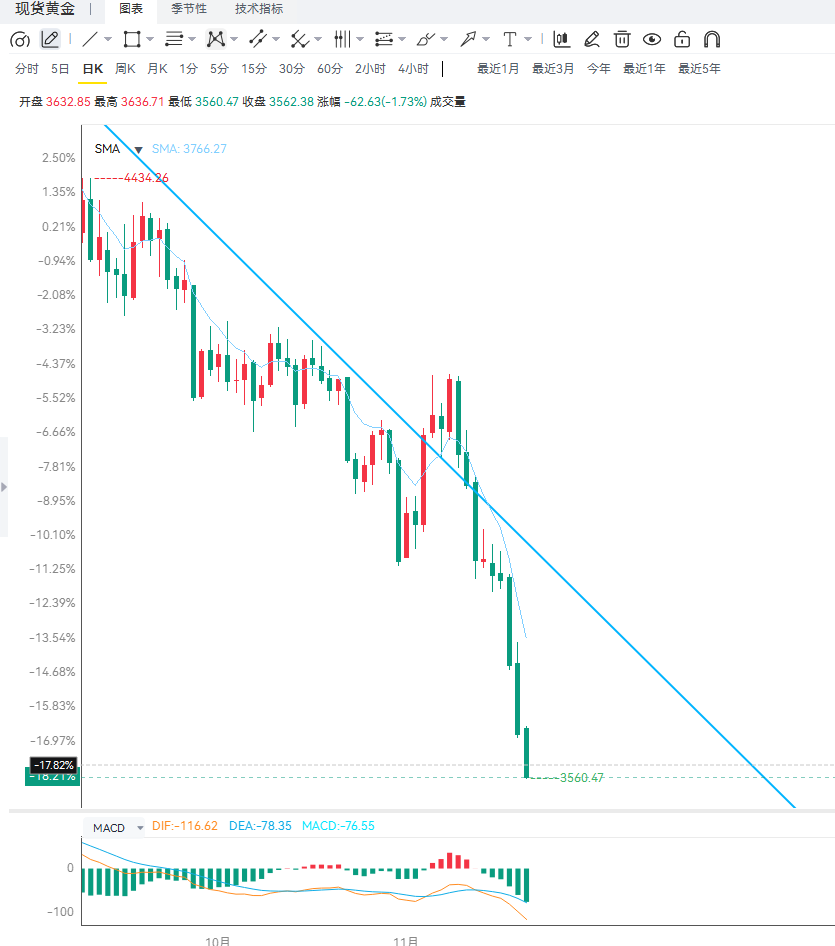 Editor's Summary: The current decline in gold is driven by two converging factors: "policy" and "demand." On the policy side: The October minutes showed that almost all officials anticipated rising interest rates, increased inflation risks, and a potential need for a tighter response. A 25 basis point rate hike in December is already priced in by 97.3%, with a 2.7% tail remaining for a 50 basis point hike. On the demand side: OCBC Bank's explicit concerns about "AI spending" and "excessive tightening by the Fed" are jointly pressuring metals, with copper leading the decline. Carry trades are being unwound due to deteriorating trade conditions—this is no longer an isolated drop in gold, but a systemic revaluation of the entire metals and commodities sector. 3630 is a short-term resistance level, 3500 is the next key level to watch, and the lower Bollinger Band at 3705 provides further resistance. In the medium term, if the daily MACD continues downward and the narrative of "AI concerns → demand worries" persists, the probability of gold prices falling to 3500 or even lower is high. If the Fed's stance shifts or the Middle East situation escalates again, a recovery after overselling may occur, but confirmation requires a recovery above 3630. Key factors to watch include whether the daily MACD can stop falling, the battle for the 3500 level, further convergence in pricing of a December rate hike, AI capital expenditure-related signals, and the recurring tensions in the Middle East.
The minutes of the October FOMC meeting showed that almost all Federal Reserve officials expected interest rates to need to rise . The minutes also indicated that policymakers believed inflation risks were rising and a more tightening policy response might be necessary, reinforcing comments from several policymakers this week—including Governor Christopher Waller, who stated that the Fed might need to respond more aggressively to rising prices. Chris Gaffney, head of world markets at EverBank, said, “Interest rate expectations and a strong dollar are the two factors weighing on gold prices today. The minutes from last month’s FOMC meeting showed that almost all officials expected interest rates to need to rise, and inflation data released since that meeting supports further US rate hikes.” According to the CME FedWatch tool, the market is currently pricing in a nearly 97.3% probability of a 25 basis point rate hike in December, and a 2.7% probability of a 50 basis point hike. Higher interest rates are generally unfavorable for gold, which does not pay interest. OCBC analysts noted that "concerns about AI spending, a hawkish shift in expectations from the Federal Reserve, and hopes for a de-escalation in the Middle East have triggered sharp market volatility," with "industrial metals, particularly copper, leading the sell-off, followed by weakness in gold." They added that "concerns about excessive Fed tightening and slowing AI-related demand have weighed on metals," reinforcing downward pressure across the sector. "Weaker commodity prices added pressure by worsening trade prospects for the South African rand, Mexican peso, and Brazilian real, prompting carry trade unwinding," as investors reassessed the attractiveness of high-yielding emerging market currencies. The bank believes that "this move continues a broader pattern of market misalignment in recent weeks—US yields rose sharply last week, while the tech sector and oil prices fell after the Democrats swept the US midterm elections." In the energy market, OCBC noted that "lower oil prices should continue to provide some relief to India's import bills and dollar demand, although the sustainability of this decline remains questionable amid geopolitical tensions." Fed Chair Goolsby's performance was slightly below baseline, with an FXS speech tracking score of 7.1/10 , compared to the established average of 7.2/10, but the tone remained firmly focused on inflation risks. He emphasized a stable job market and inflation "well above" the 2% target, highlighting the continued effects of tariffs and potential AI-driven overheating. These remarks leaned hawkish on inflation forecasts, although he acknowledged robust consumer demand. His repeated framing of the Fed's "failure" on inflation and the need to prevent the AI wave from overheating the economy reinforced the tendency to maintain a tight policy, providing broad support for the dollar. The FXS Fed Sentiment Index fell 0.06 points to 150.56 . Technically, the daily MACD has not yet stopped falling, meaning that bearish momentum is still being released, and a short-term acceleration of the downtrend has occurred—accelerated declines are usually accompanied by increased volatility, consistent with the assessment that "volatility is expected to increase further." The 3630 level is a short-term resistance level for any rebound; failure to recover this level will maintain the bearish structure. Further above this is the lower Bollinger Band at approximately 3705 , a difference of $75, forming a double resistance level in the short term. The next key level to watch is 3500 ; a break below this level could lead to further declines. On the 4-hour chart, the price has fallen from 3735 on November 19th to 3570, a cumulative drop of approximately $165 over two days. The downward slope is significantly steeper than the previous drop from 3985 to 3735, consistent with the "accelerated bearish" pattern. In such an accelerated structure, technical rebounds are often short-lived and limited in magnitude; 3630 serves as a significant reference point as the recent resistance level. In summary, the key now lies in whether 3500 can hold: holding it could lead to an oversold correction, while a break below it could open up deeper downside potential. Editor's Summary: The current decline in gold is driven by two converging factors: "policy" and "demand." On the policy side: The October minutes showed that almost all officials anticipated rising interest rates, increased inflation risks, and a potential need for a tighter response. A 25 basis point rate hike in December is already priced in by 97.3%, with a 2.7% tail remaining for a 50 basis point hike. On the demand side: OCBC Bank's explicit concerns about "AI spending" and "excessive tightening by the Fed" are jointly pressuring metals, with copper leading the decline. Carry trades are being unwound due to deteriorating trade conditions—this is no longer an isolated drop in gold, but a systemic revaluation of the entire metals and commodities sector. 3630 is a short-term resistance level, 3500 is the next key level to watch, and the lower Bollinger Band at 3705 provides further resistance. In the medium term, if the daily MACD continues downward and the narrative of "AI concerns → demand worries" persists, the probability of gold prices falling to 3500 or even lower is high. If the Fed's stance shifts or the Middle East situation escalates again, a recovery after overselling may occur, but confirmation requires a recovery above 3630. Key factors to watch include whether the daily MACD can stop falling, the battle for the 3500 level, further convergence in pricing of a December rate hike, AI capital expenditure-related signals, and the recurring tensions in the Middle East.
- Risk Warning and Disclaimer
- The market involves risk, and trading may not be suitable for all investors. This article is for reference only and does not constitute personal investment advice, nor does it take into account certain users’ specific investment objectives, financial situation, or other needs. Any investment decisions made based on this information are at your own risk.