The IEA and Goldman Sachs hold divergent views: How will the Hormuz crisis define the future of the oil market?
2026-11-20 11:02:33
On Friday (November 20) during Asian trading hours, Brent crude oil futures fluctuated slightly higher, currently trading around $92.70, up about 0.07%. The International Energy Agency (IEA) and Goldman Sachs have offered drastically different medium- to long-term assessments of the Strait of Hormuz crisis. IEA Executive Director Fatih Birol stated that the Strait crisis has brought about a historic energy shock, permanently altering the global energy system and making a return to the pre-war state difficult. However, Goldman Sachs believes that with the completion of bypass pipelines, a large-scale oversupply in the crude oil market will emerge by 2027, with Brent crude prices falling back to $78 by the end of the year. The two views are not entirely contradictory: the energy market structure is undergoing a long-term reshaping, but the short-term geopolitical risk premium will gradually diminish. 
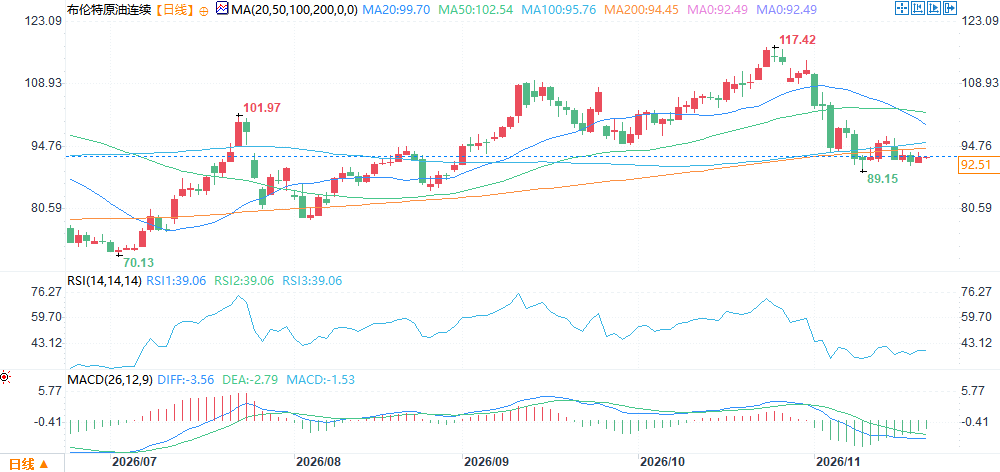 (Brent crude oil futures daily chart, source: EasyTrade) At 10:53 Beijing time, Brent crude oil futures were trading at $92.71 per barrel.
IEA: The Hormuz earthquake caused the biggest energy shock in history, permanently rewriting the global energy landscape.
The IEA released its "World Energy Outlook 2026," characterizing the disruption of the Strait of Hormuz as the largest energy supply shock in history. At the peak of the crisis, global crude oil supply plummeted by 16 million barrels per day, and natural gas supply declined by 320 million cubic meters per day; as of November, the Gulf region had suffered a cumulative loss of 2.8 billion barrels of crude oil and 60 billion cubic meters of natural gas. By releasing strategic reserves, opening alternative routes, increasing production in the Atlantic Basin, and reducing crude oil imports in Asia, the global economy buffered the impact, but the costs were ultimately passed on to end consumers. Global oil and gas import spending will reach $1.6 trillion this year, a 25% increase from 2025, with diesel and jet fuel being the most severely affected. Birol believes that market confidence in the safety of the Strait of Hormuz has been destroyed, and there is no viable path back to the pre-war market environment. Countries will accelerate energy diversification, building new alternative pipelines and broadening supply sources. According to calculations, with the detour pipeline and demand regulation, crude oil transport volume via the Hormuz will decrease from 20 million barrels per day before the war to 8.5 million barrels per day in 2030, and further decrease to below 2 million barrels per day in 2035.Goldman Sachs: Bypassing capacity releases, oversupply in 2027 will suppress oil prices.
Unlike the IEA, which focuses on structural reforms, Goldman Sachs prioritizes adaptive adjustments on the supply side. The bank projects an additional 3.8 million barrels per day (bpd) of capacity in the Gulf bypass pipeline over the next year, allowing crude oil to bypass the Strait of Hormuz and be transported to the Gulf of Oman, the Red Sea, and the Mediterranean. Gulf exports have recovered to 2025 average levels, and the crude oil market has been in surplus since October, with the surplus projected to reach 2 million bpd by 2027. Goldman Sachs forecasts an average Brent crude price of $88 per barrel for 2027, falling to $78 per bpd by the end of the year. This market logic is already being reflected; recent reports of tanker mine strikes in the Strait of Hormuz have had a muted price reaction, indicating a decreasing market sensitivity to unforeseen events in the Strait. Even with ongoing geopolitical risks, the new bypass capacity will continue to dilute the price premium resulting from Strait disruptions.Market divergence: Crude oil prices declined, but refined oil prices remained in a tight balance.
A clear divergence has emerged between the crude oil and refined oil markets. Even with international crude oil prices pressured by expectations of oversupply, diesel and jet fuel remain the most strained commodities in the entire energy sector, and refining margins are expected to remain high. Asian importing countries are the most affected, as their economies are highly dependent on Gulf crude oil exports, and the benefits of the bypass pipeline have been relatively slow to materialize in Asia. Two perspectives can coexist: the Hormuz crisis has permanently reshaped the global energy trade structure, and long-term risk premiums will not completely disappear; however, as bypass capacity comes online, the geopolitical premium of near-month contracts will gradually be absorbed, and crude oil spot prices will face downward pressure.Key themes for market outlook: Progress of bypass pipeline commissioning and supply and demand of refined oil products.
Going forward, two key variables need to be monitored. First, the actual production and output capacity of the Middle East bypass pipeline is crucial to whether Goldman Sachs' $78 oil price scenario can materialize. Second, changes in the inventory of refined oil products such as diesel and jet fuel. Continued shortages of refined oil products will support the bottom line for crude oil prices, limiting their downside potential. Simultaneously, the purchasing strategies of major Asian importing countries need to be considered. Asian economies' high dependence on Gulf oil will directly impact their actual demand capacity for crude oil. Although the long-term energy landscape has changed, the short- to medium-term trend of oil prices depends more on physical supply and demand and the pace of pipeline capacity completion. (Brent crude oil futures daily chart, source: EasyTrade) At 10:53 Beijing time, Brent crude oil futures were trading at $92.71 per barrel.
- Risk Warning and Disclaimer
- The market involves risk, and trading may not be suitable for all investors. This article is for reference only and does not constitute personal investment advice, nor does it take into account certain users’ specific investment objectives, financial situation, or other needs. Any investment decisions made based on this information are at your own risk.