With consumption recovering and inflation surging, which will dominate the trends of the pound and the euro?
2026-11-20 15:40:32
On Friday (November 20th) during the European session, the euro/pound (EUR/GBP) pair ended a two-day rebound and fell slightly, trading around 0.8370. Stronger-than-expected UK retail sales in October confirmed the resilience of domestic consumption, providing support for the pound. Meanwhile, Eurozone inflation surged to a three-year high, fueling market expectations of a December rate hike by the ECB. These two forces offset each other, leaving the cross-currency pair caught in a tug-of-war between bulls and bears. Lagarde did not commit to a December rate hike, and the widening spread between the US and European two-year swap rates further amplified the uncertainty surrounding policy decisions. 
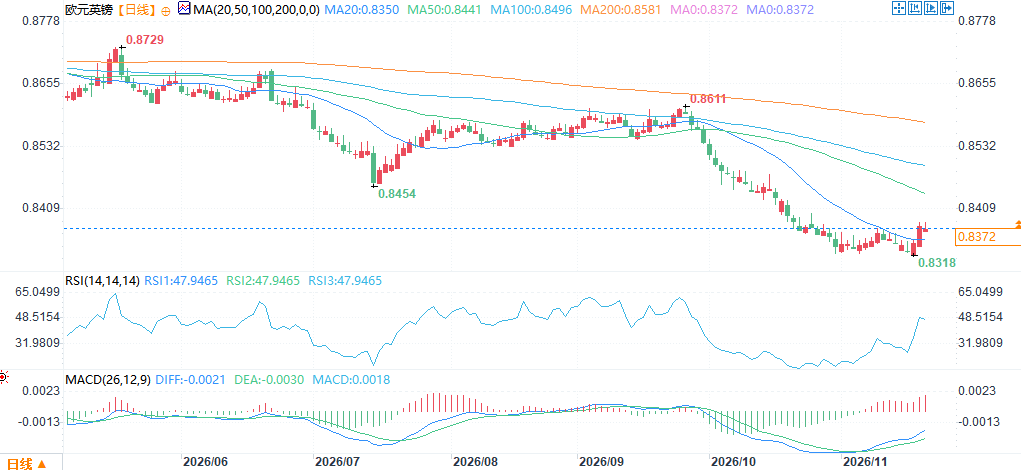 (Euro/Pound Sterling daily chart, source: EasyTrade) At 15:22 Beijing time, the euro was trading at 0.8372/73 against the pound sterling.
A stronger-than-expected rebound in UK consumption strengthens the short-term fundamentals of the pound.
The UK Office for National Statistics (ONS) released retail sales data, showing a 0.7% month-on-month increase in October, significantly higher than the market expectation of 0%, compared to a -0.4% decline in September. Year-on-year growth rose to 2.3%, also higher than the consensus expectation of 1.7%. Retail sales are a core indicator of UK household consumption, and the rebound in data suggests resilience in domestic demand, implying that the decline in UK inflation stickiness may be slower than previously expected. This provides a basis for the Bank of England to maintain a tight policy and serves as important support for the pound's short-term stability. Following the release of the consumption data, the pound received buying support, suppressing the euro's rise against the pound. However, the market is also weighing the internal disagreements within the Bank of England regarding future interest rate hikes and fiscal pressures, which will limit the pound's upside potential. The strong retail sales figures do not directly open a channel for a sustained strengthening of the pound.Eurozone inflation surges, raising expectations for ECB rate hikes, but uncertainties remain.
Eurostat data confirmed that Eurozone overall inflation rose to 4.0% year-on-year in October, a three-year high; core inflation was revised upward from 2.5% to 2.6%, still significantly below the 2% inflation target. The rebound in inflation has prompted traders to repric the possibility of a December rate hike by the ECB, providing potential support for the euro. However, ECB President Lagarde remained cautious, offering no definitive commitment to a December rate hike and failing to lock in a tightening path. This contradiction between rising inflation and restrained central bank statements makes it difficult for bullish expectations for the euro to materialize quickly. ING's observations show that the two-year US-EU swap spread has widened again, reaching its largest level since September 2025, and the policy divergence between the Fed and the ECB will continue to influence euro valuations.The main theme of cross-currency trading: a race between the Bank of England and the European Central Bank.
The pricing of EUR/GBP essentially reflects the relative strength of the monetary policy paths of the Bank of England and the European Central Bank. Currently, a hedging pattern exists: strong UK consumption supports a hawkish stance from the Bank of England; rebounding Eurozone inflation supports expectations of an ECB rate hike. On one hand, resilient UK domestic demand underpins the pound; on the other hand, rising Eurozone inflation fuels expectations of a Eurozone rate hike. These two forces offset each other, making it difficult for EUR/GBP to break out of a one-sided trend, and it is highly likely to remain range-bound. Only if UK inflation continues to decline, or if the ECB clearly signals a rate hike in December, will this equilibrium be broken.Main observation line for the future market
The next key areas to watch are: first, UK inflation and employment data, which will determine the Bank of England's policy direction in December and early next year; and second, speeches by ECB officials and the December policy meeting, with a focus on whether Lagarde releases a clear signal of an interest rate hike. In the short term, the 0.8380 level is a key support/resistance level. If UK consumption continues to be stronger than expected, the pound will outperform, and EUR/GBP will decline. If the ECB clearly tightens, the euro is expected to recover, driving the exchange rate upward. (Euro/Pound Sterling daily chart, source: EasyTrade) At 15:22 Beijing time, the euro was trading at 0.8372/73 against the pound sterling.
- Risk Warning and Disclaimer
- The market involves risk, and trading may not be suitable for all investors. This article is for reference only and does not constitute personal investment advice, nor does it take into account certain users’ specific investment objectives, financial situation, or other needs. Any investment decisions made based on this information are at your own risk.