Gold breaks through key support! Are funds really flowing into the US dollar? Where is the consensus on the bottom?
2026-11-20 17:34:30
On Friday (November 20), spot gold continued its downward trend, falling back to around $3,500, a multi-month low. A strong dollar, rising real yields, and significant market pricing in a December Fed rate hike were the main factors suppressing the price. Meanwhile, most global risk assets weakened, with the dollar performing relatively well. Precious metal traders are generally concerned about: Is the current decline nearing a bottom? Is there a large-scale flow of funds into dollar assets? Given the widespread market decline, has the medium- to long-term logic for gold fundamentally changed? This article will analyze the core questions most relevant to traders, considering recent market discussions and the macroeconomic background. 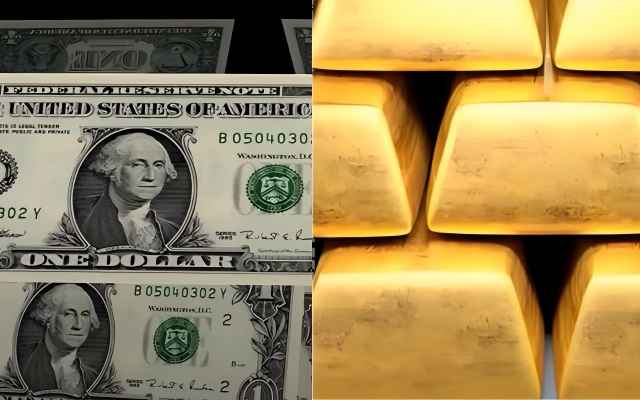
The most immediate background to the current market is the dominance of a strong US dollar and interest rate expectations.
The recent correction in spot gold is not driven by a single event, but rather by a resonance of the macroeconomic environment. Market pricing in a December Fed rate hike has intensified significantly, leading to a stronger dollar and rising real yields, directly increasing the opportunity cost of holding non-interest-bearing assets. As a typical non-interest-bearing asset, gold is more susceptible to suppression in this environment. Simultaneously, several major global markets have shown signs of declining risk appetite. US technology stocks are under pressure, major Asian stock indices are weakening, and other precious metals are also adjusting, exhibiting a clear pattern of widespread declines in risk assets. The US dollar has been relatively resilient during this process, becoming a key target for safe-haven and asset allocation. Many traders have observed that when real interest rates and the dollar strengthen simultaneously, precious metals often face temporary outflow pressure, which aligns closely with the current trend. From a capital flow perspective, high-yield dollar assets (especially government bond-related instruments) are highly attractive to institutional funds. In an environment of rising liquidity appetite and declining risk appetite, funds tend to flow to dollar-denominated assets that offer certain returns and high liquidity, rather than assets like gold that primarily rely on safe-haven or long-term value preservation logic. This does not mean that long-term demand for gold has disappeared, but rather that the priority of short-term capital allocation has changed significantly.The question traders care about most: Is there a consensus that gold has bottomed out?
Traders and analysts are divided on the short-term trend of gold, but consensus on the "bottom" is relatively limited. Some believe that the current price has entered a noteworthy long-term accumulation range, with the maximum downside relatively controllable; others point out that gold may continue to be under pressure until the Fed's policy path is fully clear and the dollar's strength shows a clear reversal. A more common observation is that market judgments on short-term direction are highly dependent on subsequent Fed statements and the dollar's performance, rather than simply the price itself. Many experienced observers emphasize that the true bottom often appears after marginal changes in macroeconomic drivers, such as a peak and decline in real yields, weakening dollar index momentum, or a correction in market expectations for interest rate hikes. Currently, these conditions have not yet formed a clear resonance, so the consensus that the "bottom has been confirmed" is not strong. It is worth noting that from a medium- to long-term perspective, the targets given by several international institutions for around 2027 are still significantly higher than the current price level. This indicates that despite short-term pressure, the market has not completely denied gold's strategic role in central bank gold purchases, geopolitical uncertainty, and long-term monetary environment changes. Traders are more focused on distinguishing between "short-term funding pressures" and "medium- to long-term allocation logic."Has all the money really flowed into the US dollar? What does the market-wide decline mean?
Recent market performance shows that the US dollar has indeed become a relatively strong asset. A strong dollar not only suppresses gold but also affects other risk assets through tightening financial conditions. When the dollar strengthens and US Treasury yields rise, the global liquidity environment tends to tighten, putting pressure on emerging market assets, commodities, and some stock sectors. This doesn't mean "all funds are absolutely flowing to the dollar," but rather that allocation priorities have shifted in stages. When risk appetite declines, institutions tend to increase the proportion of dollar cash, short-duration Treasury bonds, or hedging instruments to cope with uncertainty and potential volatility. In this environment, gold faces pressure from rising opportunity costs and may become a target for some funds to reallocate later—especially when the dollar strengthens or interest rate expectations ease. The widespread market decline reflects the commonalities of macroeconomic drivers: high interest rate expectations, a strong dollar, and contracting risk appetite. For precious metal traders, this means that gold's price movement is currently highly tied to the dollar and interest rates, rather than operating independently of the overall market. Understanding this linkage is more helpful in grasping the phased rhythm than simply focusing on gold's own price.Key observation points from a trader's perspective
In the current discussion, traders are not most concerned with short-term price fluctuations, but rather with when macroeconomic variables will show marginal changes. Statements from Federal Reserve officials, the subsequent evolution of US inflation and employment data, the momentum of the US dollar index, and the trend of real yields are all key areas of observation repeatedly mentioned by the market. Meanwhile, the long-term demand logic for gold has not disappeared due to the short-term adjustment. Central bank gold purchases, geopolitical uncertainties, and the long-term evolution of the global debt and monetary environment are still considered by many analysts as important factors supporting medium- to long-term allocation value. The tension between short-term capital flows and medium- to long-term demand is the core of the current market discussion. Against the backdrop of widespread pressure on risk assets and a relatively strong US dollar, gold's adjustment reflects more the phased characteristics of the macroeconomic environment. What traders need to continuously track is whether the driving factors themselves have changed, rather than whether the price is "low enough." Market judgments about the bottom are still evolving dynamically, and the formation of consensus often lags behind the confirmation of macroeconomic signals.- Risk Warning and Disclaimer
- The market involves risk, and trading may not be suitable for all investors. This article is for reference only and does not constitute personal investment advice, nor does it take into account certain users’ specific investment objectives, financial situation, or other needs. Any investment decisions made based on this information are at your own risk.