Canadian retail sales rose to C$75.3 billion in September. What does the consolidation of USD/CAD around 1.43 signify?
2026-11-20 21:46:30
On Friday, November 20th, Statistics Canada released September retail sales data. Total retail sales rose 0.8% month-over-month, higher than the previous estimate of 0.7%, reaching C$75.3 billion. August's figure was revised upward from 1.2% to 1.4%. Core retail sales rose 0.1% month-over-month, and sales volume also rose 0.1%. Third-quarter retail sales rose 1.2%, and sales volume rose 1.0%. October's estimate was a 1.5% month-over-month decline, based on 58.1% of survey responses. During the same period, the US dollar fluctuated around 1.43 against the Canadian dollar. The October Consumer Price Index remained at 3.1% year-over-year, and the unemployment rate rose to 6.7%. The Bank of Canada's policy rate remained at 2.5%, with the next decision scheduled for December 9th. 
Detailed Analysis of Canadian Retail Sales Data in September
Total retail sales rose to C$75.3 billion in September, a 0.8% increase month-over-month, 0.1 percentage points higher than the forecast. August's figure was revised upward to 1.4%, indicating slightly stronger previous momentum. Sales volume rose only 0.1% month-over-month, suggesting that price factors accounted for a large proportion of nominal growth. Cumulative retail sales rose 1.2% in the third quarter, while sales volume rose 1.0%, showing overall stable quarterly performance. October's forecast is for a 1.5% month-over-month decline, based on a low recovery rate, and may be revised later. Bank of Canada Governor Tiff Macklem recently pointed out that consumer spending remains robust despite slowing population growth, but there is excess supply in the economy.Sub-components and their contribution to price factors
Of the nine sub-categories, five saw growth. Gasoline stations and fuel suppliers saw a 6.9% month-over-month increase in sales, with volume rising 1.6%, significantly driven by price increases. Motor vehicle and parts dealers saw a 0.2% month-over-month increase in sales, a slowdown from August's 1.2%. General merchandise retailers saw a 1.5% month-over-month increase in sales. Food and beverage retailers saw a 0.4% month-over-month decrease in sales, erasing some of August's gains. Fuel-related sub-categories contributed to the nominal total, but core and volume growth were limited, reflecting relatively moderate basic consumer demand. The continued high energy prices corroborate the 8.9% year-over-year increase in the transportation sub-category of the October Consumer Price Index.The Relationship Between Consumer Demand and the Canadian Economic Background
Nominal retail sales exceeded expectations, but core and volume sales rose only slightly, indicating limited demand momentum. October forecasts fell sharply, and if the final data confirms this, it will contrast with the stable performance of the third quarter. The unemployment rate rose to 6.7%, with an even higher youth unemployment rate, indicating signs of easing in the labor market. The Bank of Canada raised its global growth forecast to 3.1% in its October monetary policy report, but emphasized the inflationary risks posed by high energy prices, and the policy rate has risen to 2.5%. The retail data provides a mixed picture of consumption and assessments of excess supply, offering a mixed reference for the December policy decision.Technical Structure Observation of USD/CAD
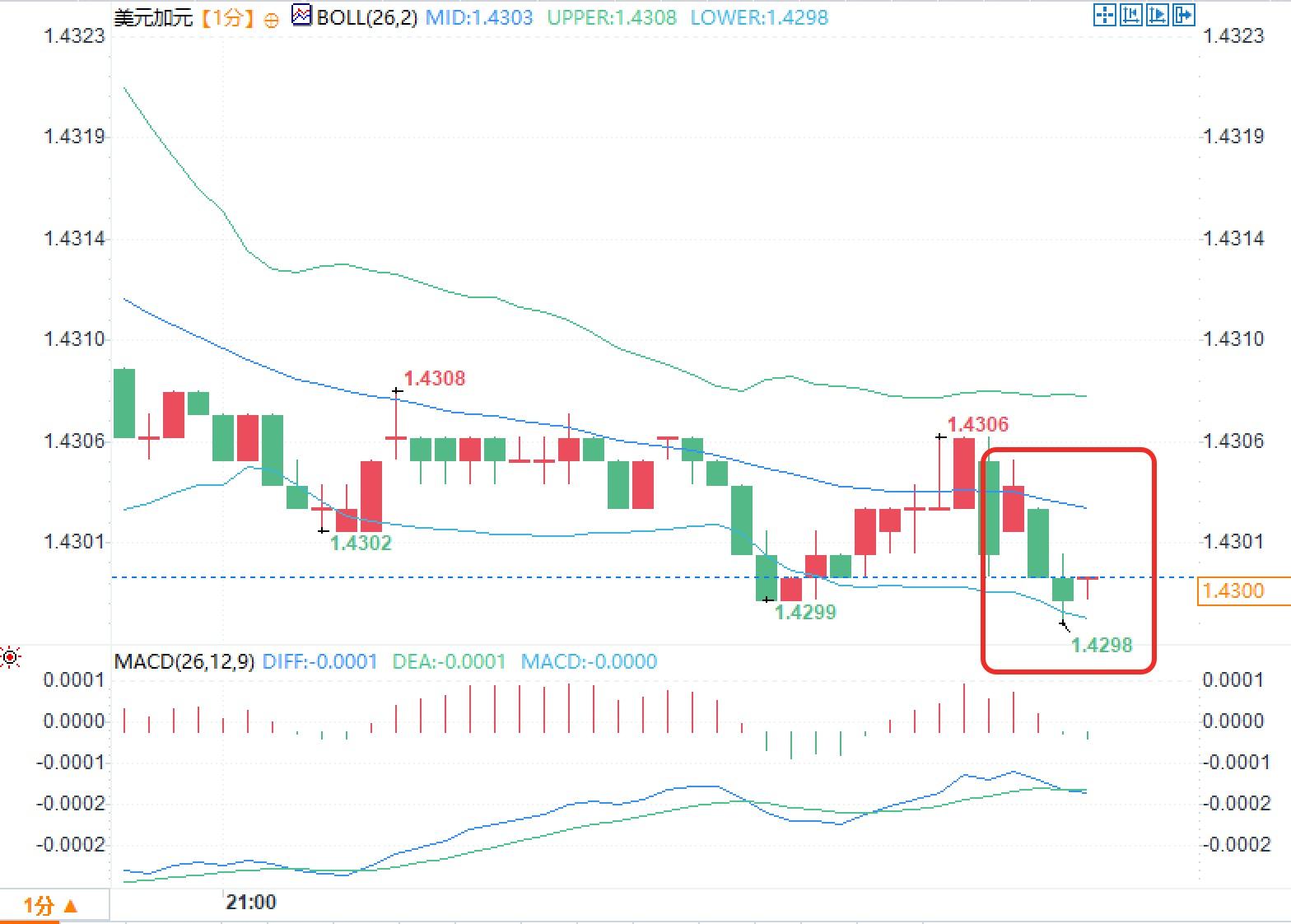
The USD/CAD 1-minute chart shows the price fluctuating around 1.4300. The Bollinger Bands middle band is at 1.4303, the upper band at 1.4308, and the lower band at 1.4298, with the band narrowing. The price is trading near the middle band, and recent candlestick bodies have been small. The MACD indicator shows the DIFF and DEA at -0.0001, with the histogram close to the zero line, indicating weak short-term momentum. The chart shows consolidation characteristics with limited volatility. The technical structure reflects the current market's digestion of fundamental information, without any clear unidirectional trend.Frequently Asked Questions
Question 1: What were the main sources of Canada's September retail sales exceeding expectations? Answer: The main driver was a 6.9% month-on-month increase in sales at gasoline stations and fuel suppliers, largely due to price factors. Core retail sales and sales volume only increased by 0.1% each, indicating relatively limited underlying demand. Question 2: What is the significance of the 1.5% decline forecast for October for the overall assessment? Answer: The forecast is based on a 58.1% response rate and may be revised later. If confirmed, it will contrast with September and the third quarter performance, showing fluctuations in consumption patterns and providing a reference for assessing the sustainability of demand. Question 3: What are the current technical characteristics of the USD/CAD exchange rate? Answer: The price is consolidating around the Bollinger Band middle line at 1.4303, with narrowing bandwidth. The MACD is close to the zero line, indicating weak short-term momentum. The chart shows consolidation characteristics with limited volatility.- Risk Warning and Disclaimer
- The market involves risk, and trading may not be suitable for all investors. This article is for reference only and does not constitute personal investment advice, nor does it take into account certain users’ specific investment objectives, financial situation, or other needs. Any investment decisions made based on this information are at your own risk.