A chart shows the Baltic Dry Index (BDI) declining slightly, influenced by lower freight rates for Capesize and Supramax vessels.
2026-11-20 22:40:32
The latest data shows that on November 20, 2026, the Baltic Dry Index (BDI) was 2898 points, a three-day low, down 0.10% from the previous day, marking the second consecutive day of decline (including zero growth). Looking at the short-term charts, the BDI has seen positive growth 6 times, negative growth 5 times, and zero growth in the last 11 BDI data points. Specifically, the Panamax Freight Index (BPI) was 2140 points, up 0.38% from the previous day; the Capesize Freight Index (BCI) was 4502 points, down 0.27%; and the Supramax Freight Index (BSI) was 1810 points, down 0.22%. For detailed charts of the latest 720-day and 10-year trends of the Baltic Dry Index and its three main sub-indices, please refer to the charts specially created by FX678. 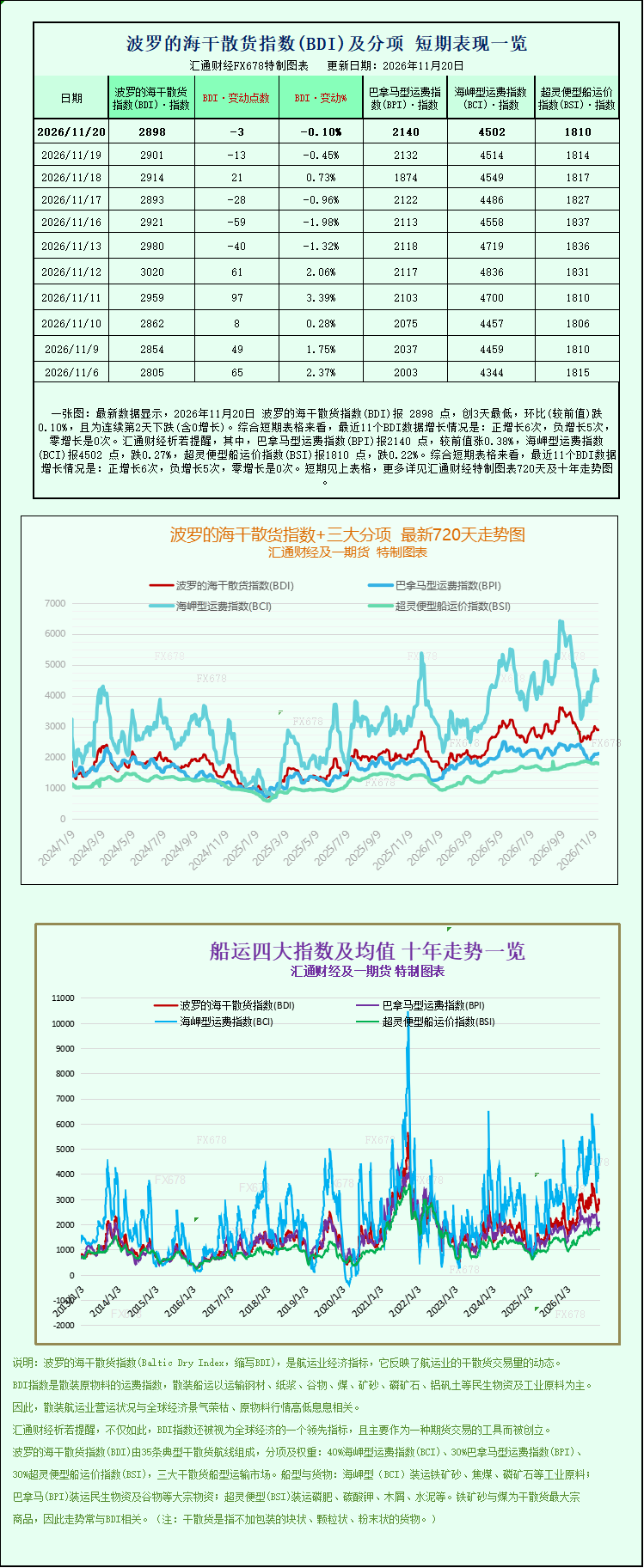 The Baltic Dry Index, the core shipping index tracking dry bulk vessel freight rates on the Baltic Exchange, fell slightly on Friday, closing lower for the week. Weaker freight rates for Capesize and Supramax vessels offset support from a modest rise in Panamax rates, dragging down the overall index. The Baltic Dry Index (BDI), which reflects freight rates for Capesize, Panamax, and Supramax vessels, fell slightly by 3 points, or 0.1%, to 2898 points. On a weekly basis, the index fell 2.8% this week, ending its previous oscillating upward trend, indicating a weakening of overall sentiment in the dry bulk shipping market. The sub-segments of vessels showed a clear divergence, with Capesize vessels, the largest category, performing the weakest. The Capesize freight rate index fell 12 points, or 0.3%, to 4502 points, a weekly decline of 4.6%, making it the main force dragging down the Baltic Dry Index. Capesize vessels saw their average daily earnings decline by $114 to $37,324. These vessels, typically with a deadweight tonnage of 150,000 tons, are the mainstays of transoceanic transport of bulk raw materials like iron ore and thermal coal. Their routes are concentrated on Australian and Brazilian iron ore shipments to East Asian steel mills, as well as Oceania coal export routes. Freight rates are highly correlated with the trade flows of iron ore and coal. Iron ore futures rebounded somewhat on Friday, with market participants betting on domestic steel companies starting year-end restocking, driving the price recovery. However, iron ore futures still closed lower overall this week. Earlier in the week, contract prices briefly broke through previous lows. The core issue behind this was weak end-user demand coupled with persistently high port inventories. Currently, there are no signs of a sustained recovery in downstream steel consumption, limiting steel mill profit margins and reducing their willingness to actively replenish inventory. Instead, they are making small-batch purchases as needed, making it difficult to generate sustained demand for ocean-going mining. Even with short-term seasonal restocking expectations supporting futures prices, this failed to quickly translate into orders for Capesize shipping. Demand for ocean-going chartering remained insufficient, weakening shipowners' bargaining power and putting downward pressure on freight rates. In contrast to the decline in Capesize vessels, the Panamax sector saw an independent upward trend. The Panamax freight index rose 8 points to 2140 points, a new high since October 22nd, with a cumulative weekly increase of 1%, making it the only major vessel type to achieve a weekly gain. Average daily earnings for Panamax vessels rose by $76 to $19264. This vessel type has a deadweight range of 60,000 to 70,000 tons and primarily carries cargoes such as coal, grain, and bauxite, covering multiple feeder routes in the Atlantic and Pacific Oceans, as well as short-haul trade within the region. The recent strength in Panamax vessels is partly supported by the peak grain export season. The export window for grains from the Americas remains open, and stable shipments from the Gulf Coast and South America are generating steady chartering demand. Simultaneously, regional coal transport demand has rebounded, with some power plants in the Asia-Pacific region releasing winter coal storage orders, which is beneficial for small and medium-sized Panamax vessels. Compared to Capesize vessels, which often fluctuate wildly with iron ore prices, Panamax vessels have a more diversified cargo mix and are less affected by fluctuations in a single commodity, making them more likely to exhibit differentiated performance in a weak market. The Supramax index, representing smaller tonnage dry bulk carriers, fell 4 points, or 0.2%, to 1810 points, a weekly decline of 1.4%. These vessels offer greater flexibility, are compatible with more ports, and are heavily involved in regional short-haul bulk cargo transshipment, small-batch grain, and building material/ore transportation. The market size is smaller, and liquidity is weaker. The sector weakened moderately this week, reflecting a slight cooling in short-haul bulk cargo trade within the region. Limited increase in regional cargo volume, coupled with ample supply of similar vessels waiting to berth, made it difficult for shipowners to push prices up. Overall, the Baltic Dry Index (BDI) closed slightly lower on Friday, essentially a structural market driven by supply-demand mismatches across different cargo types and routes, rather than a synchronized market decline. Capesize vessels, heavily tied to iron ore, were constrained by weak domestic steel demand and high port inventories. Year-end restocking expectations remained largely confined to futures trading, with limited actual growth in ocean shipping orders, becoming the biggest drag on prices. Panamax vessels, relying on rigid trade demand for grain and regional coal, maintained resilience and experienced independent price increases. Supramax vessels, however, followed the regional trade rhythm with a slight decline. Market traders generally remain cautious. Whether the dry bulk index can stop its decline and rebound hinges on two key variables: first, the extent to which domestic steel mills will replenish their inventories at the end of the year—whether this is a short-term, impulsive purchase or a sustained increase in demand for iron ore arriving at ports—directly determining the direction of Capesize freight rates; and second, changes in global grain export patterns and coal shipments due to winter energy supply in the Northern Hemisphere, which will continue to support Panamax vessel prices. In the short term, with mixed bullish and bearish factors, the dry bulk market is likely to maintain a pattern of sector differentiation and wide-range fluctuations, making a one-sided surge or plunge unlikely.
- Risk Warning and Disclaimer
- The market involves risk, and trading may not be suitable for all investors. This article is for reference only and does not constitute personal investment advice, nor does it take into account certain users’ specific investment objectives, financial situation, or other needs. Any investment decisions made based on this information are at your own risk.