













The combination of expectations of a Fed rate hike and AI-driven safe-haven demand sent the dollar soaring to a four-week winning streak, reaching a 19-month high.
2026-11-21 11:22:31
The most striking theme in global currency markets this week was the continued strengthening of the US dollar, driven by both policy expectations and a shift in risk appetite. Starting with better-than-expected US inflation data on November 10th, the dollar index climbed steadily, reaching its highest level since April 2025 at 103.97 on Thursday (November 19th). Although it slightly retreated to around 103.85 on Friday (November 20th), it remained in a 19-month high range, rising 0.44% this week, marking its fourth consecutive week of gains, and accumulating a gain of approximately 1.9% so far this month. Traders' bets on a December rate hike by the Federal Reserve are almost locked in, and volatility in risk assets, especially AI-related sectors, has further strengthened the dollar's safe-haven appeal and interest rate differential advantage. Other major currencies generally came under pressure, with the euro, pound, Australian dollar, and yen all weakening to varying degrees. Market sentiment oscillated wildly between hawkish monetary policy expectations and wavering confidence in technology stocks. 
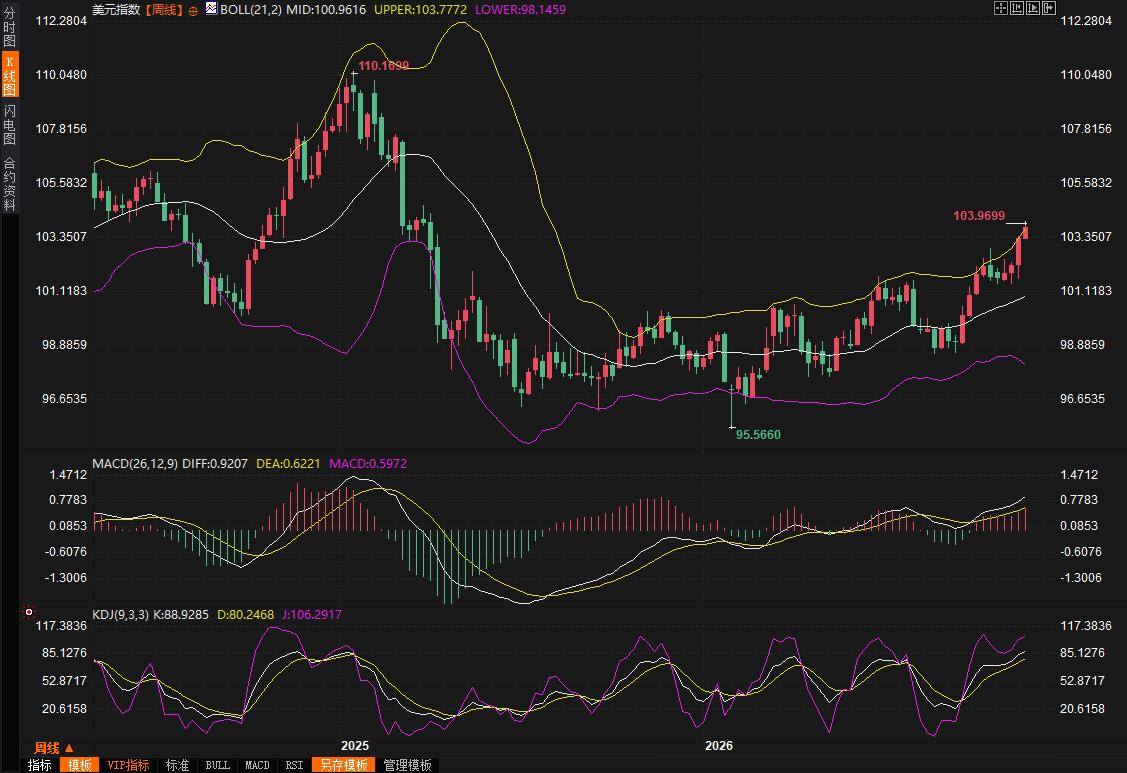 (US Dollar Index Weekly Chart, Source: FX678)
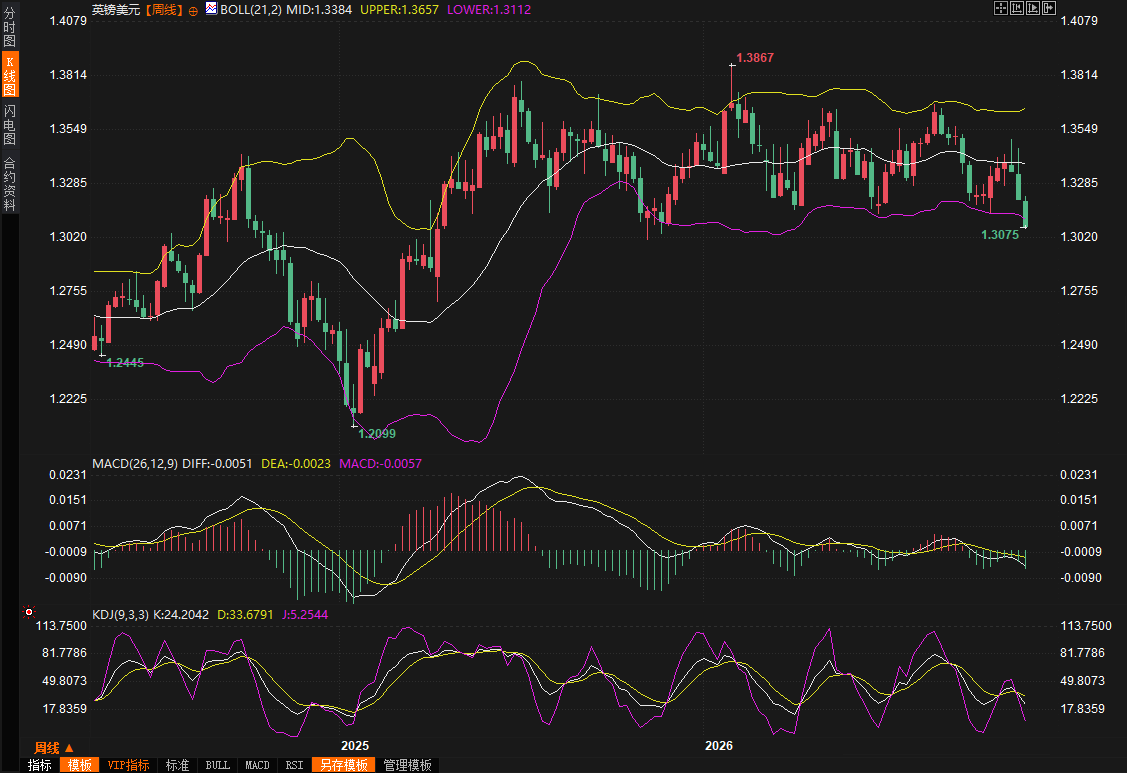 (GBP/USD weekly chart, source: FX678) The yen fluctuated around the 160 level, a sensitive level widely considered to trigger government intervention. USD/JPY remained in the 159-160 range for most of the week, but on Friday, supported by falling US Treasury yields and Japan's October core CPI accelerating to 2.2%, it fell to 158.41, a new low since November 10, before closing at 158.56, a weekly decline of 0.72%, ending a three-week winning streak. Japan's third-quarter GDP unexpectedly contracted by 0.1%, but analysts believe this may not prevent the Bank of Japan from further tightening policy in December. Capital Economics pointed out that with increasingly widespread inflationary pressures, the Bank of Japan may have to take more aggressive tightening measures than previously expected. State Street Investment Management's chief fixed income strategist, Masahiko Loo, cautioned that unless the weakness spreads to wages, the service sector, and potential domestic demand, the Bank of Japan may downplay this period of economic weakness. The market remains highly wary of intervention, with 160 becoming an extremely difficult psychological barrier to break through. The Australian dollar was one of the weakest performing major currencies this week. The continued rise in US Treasury yields, while Australian government bond yields failed to follow suit, weakened interest rate differentials. Australian employment fell for the second consecutive month in October, with the unemployment rate rising to a five-year high of 4.9%, further reinforcing market expectations that the Reserve Bank of Australia's (RBA) interest rates may have peaked. The interest rate market anticipates the RBA to begin cutting rates in the second half of next year, with the probability of a June rate cut rising to 68%, and an August rate cut almost fully priced in. The Australian dollar fell for nine consecutive trading days, briefly dropping to around 0.6608, a new low since the end of December 2025, before closing at 0.6616, a weekly decline of 2.33%, marking its third consecutive week of losses. Lee Hardman, senior foreign exchange analyst at Mitsubishi UFJ Financial Group, stated that the market's hawkish reassessment of expectations for a Fed rate hike is leading to weakness in commodity prices and related currencies.
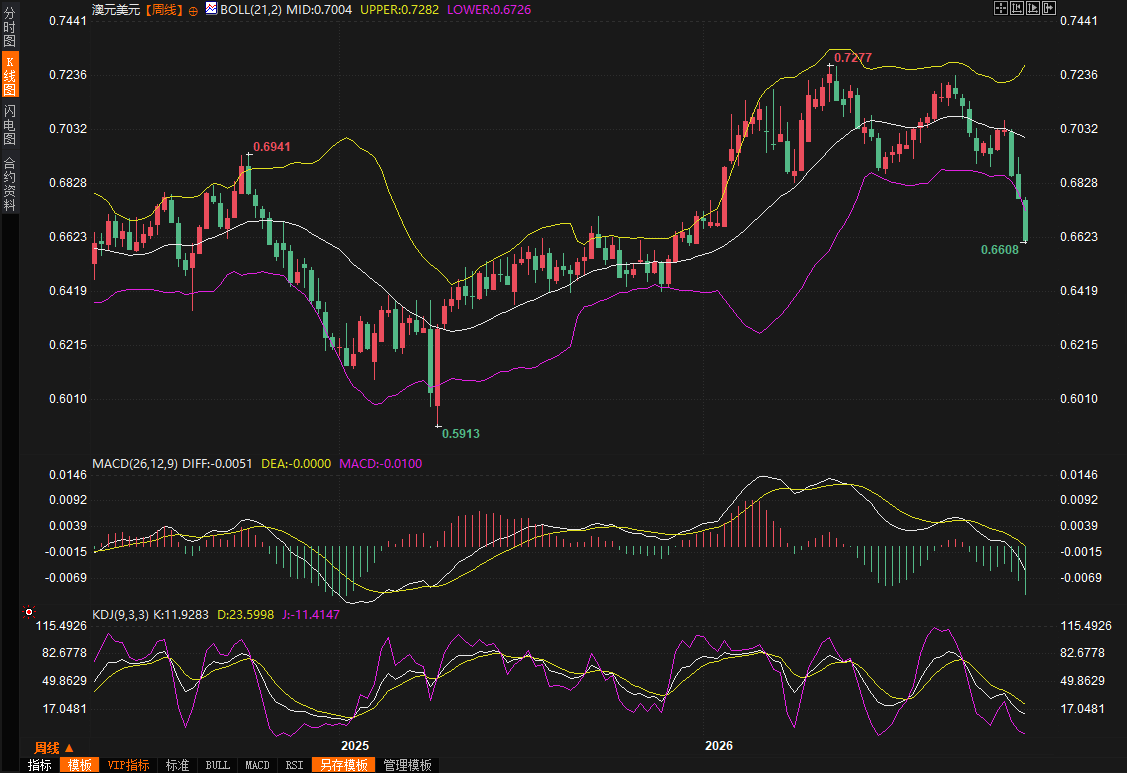 (AUD/USD weekly chart, source: FX678)
Hawkish expectations continue to build, pushing the dollar index above key highs.
The core driving force behind the dollar's strength this week was the resonance between sticky US inflation and hawkish statements from Federal Reserve officials. Following last week's higher-than-expected October consumer price increases, the market quickly reassessed the Fed's policy path. The CME Group's FedWatch tool showed that traders had almost fully priced in an expectation of at least a 25-basis-point rate hike at the December 9th meeting, with the probability of an "unconventional" 50-basis-point hike rising to 10%-15%. Fed Governor Waller explicitly stated mid-week that more forceful action might be needed to effectively reduce inflation, either by raising rates by 50 basis points directly or by guiding market expectations for further tightening through a post-meeting statement. This statement echoed the minutes of the October 27-28 meeting—which showed that while officials unanimously agreed to keep rates unchanged at that time, they recognized the rising risks to controlling inflation. Overall, economic data supported this hawkish narrative. Moderate growth in October retail sales and a larger-than-expected increase in import prices indicated that US demand remained strong and showed no signs of cooling. Brown Brothers Harriman's foreign exchange team points out that robust US economic growth, favorable labor market conditions, and sticky underlying inflation are keeping the dollar trending upward. Although the dollar briefly retreated on Tuesday due to mixed data, strategists generally believe this was merely a pause after a strong rally, not a trend reversal. Corpay's chief market strategist, Karl Schamotta, stated that since Waller's hawkish stance and accelerating inflation, the dollar has outperformed almost all major currencies, with rising interest rate expectations widening interest rate differentials. While the dollar index closed slightly lower on Friday, ending an eight-day winning streak, its momentum has not truly collapsed. Bannockburn Capital Markets' chief market strategist, Marc Chandler, believes the dollar's upward momentum has shown signs of stalling, but it's too early to conclude it has peaked. ING's global market head, Chris Turner, emphasizes that the Fed has no reason to abandon its hawkish stance in the short term, and the upcoming Personal Consumption Expenditures (PCE) price index, the Fed's most closely watched inflation indicator, is likely to further confirm the need for action. (US Dollar Index Weekly Chart, Source: FX678)Cooling risk appetite became the second driving force, and wavering confidence in AI trading exacerbated the capital inflow back to the US dollar.
If policy expectations are the fundamental support for the dollar's rise, then the significant cooling of risk appetite has become an additional catalyst this week. Artificial intelligence-themed trading, previously a major magnet for foreign investment inflows into US assets, has gradually transformed into a new source of risk. Tech stock volatility, rumors of leadership changes at Nvidia, and escalating market concerns about the over-reliance on debt financing for AI infrastructure, coupled with Anthropic's record-breaking IPO, have failed to revive market enthusiasm. Risk-sensitive currencies have been hit hardest, with the Australian dollar and New Zealand dollar falling by approximately 2.7% and 2.3% respectively over the past six trading days. The MSCI Latin America Equity Index fell by about 2% on Thursday, putting pressure on emerging market currencies across the board. Schamotta points out that the market is scrambling for dollar liquidity, and against the backdrop of tightening global financial conditions, the entire emerging market is suffering a severe sell-off. Currencies most vulnerable to a slowdown in AI development and heavily reliant on interest rate arbitrage are under particular pressure. If AI-related assets are further sold off, safe-haven buying and capital repatriation may continue to support the dollar in the short term; however, a more persistent shock to AI trading that dominates the US market could weaken demand for dollar assets in the long run. At present, risk aversion and interest rate differentials still have the upper hand.Major non-US currencies diverged: the euro and pound were under pressure, while the yen tugs at the crossroads between intervention expectations and inflation.
The euro weakened against the dollar this week, hitting near its lowest level since April 2025 on Wednesday, reaching a low of 1.0952, before closing at 1.0965 on Friday, a weekly decline of 0.5%. Jane Foley, head of FX strategy at Rabobank, believes the euro may consolidate around 1.10 for a while before the market has enough confidence to push it lower. Benjamin Ford, a researcher at macro research and strategy firm Macro Hive, is more direct, pointing out that given inflation remains at uncomfortably high levels and the possibility of a surprisingly hawkish stance from the Federal Reserve in 2027, it's not impossible for the euro to reach 1.08 against the dollar by the end of the year. The pound also weakened. The pound fell 0.98% against the dollar this week to 1.3080, hitting a low of around 1.3075 on Friday, a new one-year low. Stable core inflation in the UK in October weakened market expectations for a near-term interest rate hike by the Bank of England, and coupled with a strong dollar, the pound came under significant pressure. Traders are awaiting further employment and inflation data to confirm direction. (GBP/USD weekly chart, source: FX678) The yen fluctuated around the 160 level, a sensitive level widely considered to trigger government intervention. USD/JPY remained in the 159-160 range for most of the week, but on Friday, supported by falling US Treasury yields and Japan's October core CPI accelerating to 2.2%, it fell to 158.41, a new low since November 10, before closing at 158.56, a weekly decline of 0.72%, ending a three-week winning streak. Japan's third-quarter GDP unexpectedly contracted by 0.1%, but analysts believe this may not prevent the Bank of Japan from further tightening policy in December. Capital Economics pointed out that with increasingly widespread inflationary pressures, the Bank of Japan may have to take more aggressive tightening measures than previously expected. State Street Investment Management's chief fixed income strategist, Masahiko Loo, cautioned that unless the weakness spreads to wages, the service sector, and potential domestic demand, the Bank of Japan may downplay this period of economic weakness. The market remains highly wary of intervention, with 160 becoming an extremely difficult psychological barrier to break through. The Australian dollar was one of the weakest performing major currencies this week. The continued rise in US Treasury yields, while Australian government bond yields failed to follow suit, weakened interest rate differentials. Australian employment fell for the second consecutive month in October, with the unemployment rate rising to a five-year high of 4.9%, further reinforcing market expectations that the Reserve Bank of Australia's (RBA) interest rates may have peaked. The interest rate market anticipates the RBA to begin cutting rates in the second half of next year, with the probability of a June rate cut rising to 68%, and an August rate cut almost fully priced in. The Australian dollar fell for nine consecutive trading days, briefly dropping to around 0.6608, a new low since the end of December 2025, before closing at 0.6616, a weekly decline of 2.33%, marking its third consecutive week of losses. Lee Hardman, senior foreign exchange analyst at Mitsubishi UFJ Financial Group, stated that the market's hawkish reassessment of expectations for a Fed rate hike is leading to weakness in commodity prices and related currencies. (AUD/USD weekly chart, source: FX678)Next week's focus: PCE data, Black Friday spending power, and a retest of AI sentiment.
Looking ahead to next week, the market will turn its attention to the actual strength of consumer spending. Black Friday, following Thanksgiving, will kick off the holiday shopping season, and investors will be watching to see how households cope with rising inflation and borrowing costs. Consumer spending accounts for about two-thirds of the US economy, and continued robust data could provide some stability to US stocks, which have recently been volatile due to AI concerns. Meanwhile, the PCE price index, consumer confidence report, and the revised US Q3 GDP figures will all be key indicators. Earnings reports from companies like Dell Technologies and Analog Devices could further influence market confidence in the AI and technology sectors. Strategists generally believe that without new strong catalysts, the dollar's potential for a significant short-term acceleration is limited, but the hawkish outlook from the Federal Reserve will still provide a floor. Shaun Osborne, chief foreign exchange strategist at Scotiabank, points out that dollar bulls need stronger confidence or more positive news to drive further gains. At the same time, if sentiment towards risk assets, especially technology stocks, continues to deteriorate, safe-haven demand may continue to limit the upside potential of non-US currencies. Overall, this week's currency market clearly demonstrates how policy expectations and risk sentiment jointly shape the dollar's trajectory. Sticky inflation and hawkish signals from Federal Reserve officials have provided solid interest rate differentials and fundamental support for the US dollar, while the wavering confidence in AI trading has further amplified this advantage through safe-haven demand and capital inflows. Among non-US dollar currencies, the Japanese yen has been relatively resilient due to the combined effects of intervention expectations and rising domestic inflation, while the euro and pound have largely followed the dollar's lead. The Australian dollar, however, has been under the most pressure due to weak domestic employment and narrowing interest rate differentials. Next week's PCE data and holiday spending performance will be crucial indicators of whether the current narrative can continue. Before a clear shift in the Fed's policy path emerges, the dollar's strong position is unlikely to reverse easily, but any unexpected cooling of inflation or a recovery in risk asset sentiment could trigger a period of adjustment.- Risk Warning and Disclaimer
- The market involves risk, and trading may not be suitable for all investors. This article is for reference only and does not constitute personal investment advice, nor does it take into account certain users’ specific investment objectives, financial situation, or other needs. Any investment decisions made based on this information are at your own risk.

