Despite record-high frequency of attacks in the Taiwan Strait, oil prices have not risen, indicating that geopolitical stimuli are gradually being adapted to by the market.
2026-11-23 15:28:31
Since November 16, a total of seven oil tankers have been attacked in the Strait of Hormuz and off the coast of Oman. Trump publicly stated that Iran is escalating its attacks, and the scale of Iranian drone and missile strikes in the past week reached a new high in over a year; however, most attacks were intercepted and have not yet caused significant damage. The frequency and intensity of the tanker attacks in the Strait of Hormuz have reached a high point since the outbreak of this round of conflict, but strangely, oil prices have not rebounded significantly. 
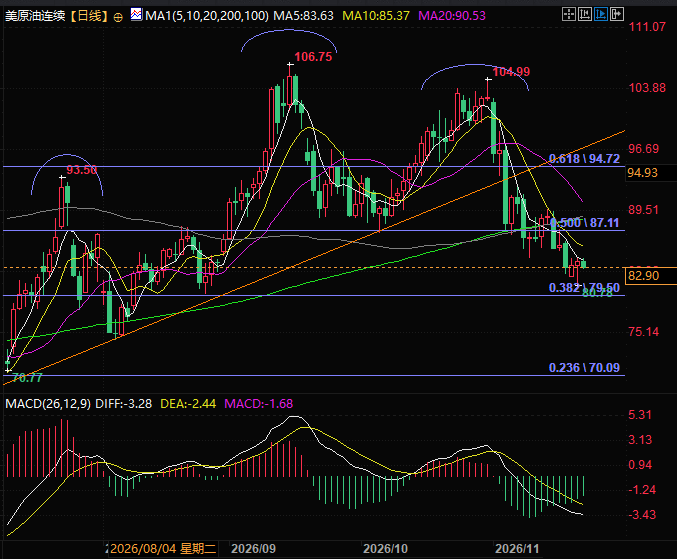 (WTI crude oil futures daily chart, source: EasyTrade) At 15:25 Beijing time, WTI crude oil futures are currently trading at $82.83 per barrel.
The intensity of attacks in the Strait of Hormuz is unprecedented, and geopolitical conflicts in the Gulf continue to escalate.
The U.S. Central Command reported that the maritime blockade of Iranian oil has entered its 130th day, with the U.S. military continuing to block the Iranian Revolutionary Guard from transporting billions of dollars worth of oil abroad. Meanwhile, the battlefield is also in turmoil: Houthi rebels continue to attack Saudi energy facilities, a civilian industrial facility in Bahrain was attacked and caught fire; Saudi airstrikes have hit Hodeidah, Yemen, with reports of casualties. Iran has displayed twin missile launchers at its underground missile city, leading to a diplomatic deadlock. The Iranian Foreign Minister stated his willingness to negotiate through mediation channels, but the Speaker of the Iranian Parliament rejected a prolonged stalemate of "neither war nor peace," demanding either a decisive victory on the battlefield or the U.S. acceptance of Iran's demands. The U.S. planned strike against Iran has been postponed, and the situation shows no signs of de-escalation. Regional civil aviation continues to issue risk warnings, and many Saudi routes remain suspended.Key market change: Frequent attacks failed to push up oil prices.
The most noteworthy shift for traders is that despite the unprecedented frequency of attacks, oil prices have not experienced a sustained upward trend. The risk premium from geopolitical news is being rapidly digested, and the global oil supply and demand system has gradually adapted to the high-risk environment of the Strait of Hormuz. "Frequent attacks on shipping lanes, yet continued oil flow" has become the new normal in the current oil market. The market no longer simply equates tanker attacks with supply disruptions. The supply chain has developed hedging resilience; isolated, sporadic attacks are unlikely to trigger a sustained upward trend in oil prices, and the impulse effect of news is weakening.The UAE's ADNOC wartime transshipment system has become a ballast for the supply chain.
The core of the resilience of Middle Eastern crude oil exports lies in the wartime transportation plan established by Abu Dhabi National Oil Company (ADNOC). Under the coordinated cover of the US and UAE militaries, ADNOC organizes its fleet to traverse the Strait of Hormuz at night, loading UAE and Iraqi crude oil in the Persian Gulf. After leaving the strait, ship-to-ship transshipment is conducted in the open sea before the oil is transferred to ocean-going tankers for global transport. This transshipment model is already operating stably. In August, over 70% of the crude oil transported through the Strait of Hormuz completed its transshipment in the waters near the UAE and Oman. The UAE's crude oil and condensate exports have rebounded from 11,300 barrels per day in March to 2.1 million barrels per day, making it the largest crude oil transport entity in the strait. However, risks are also ever-present: since April, more than 20 ADNOC-operated vessels have been attacked, and Tuesday's attack resulted in crew injuries and deaths, highlighting the real threat at sea.Transaction logic shift: Beware of fragile balance, await a hard supply cut signal
The current supply-demand balance is extremely fragile and does not signify that risks have been cleared. In the event of black swan events such as a large-scale convoy breaking through the blockade, severe damage to core refining/export facilities, or proactive escalation of US military strikes, existing supply chain buffers will instantly fail, and oil prices will immediately be repriced. For traders, the main logic has changed: recurring news of attacks in the Taiwan Strait can only bring short-term, minor disturbances and is unlikely to drive a bullish trend. Going forward, funds need to patiently wait for a solid signal that can genuinely reduce crude oil supply, rather than relying on repetitive geopolitical news. Technically: Oil prices remain suppressed by a double top and head and shoulders pattern on the daily chart. Currently, the price is trading below the 5-day moving average, and the moving averages are in a bearish alignment. The measured downside is around 70, and the recent rebound was a bounce from near the 0.382 Fibonacci retracement level. (WTI crude oil futures daily chart, source: EasyTrade) At 15:25 Beijing time, WTI crude oil futures are currently trading at $82.83 per barrel.
- Risk Warning and Disclaimer
- The market involves risk, and trading may not be suitable for all investors. This article is for reference only and does not constitute personal investment advice, nor does it take into account certain users’ specific investment objectives, financial situation, or other needs. Any investment decisions made based on this information are at your own risk.