Frequent attacks in the Gulf have led to geopolitical premiums supporting oil prices, causing crude oil to fluctuate within a narrow range.
2026-11-23 15:52:33
On Monday (November 23) during Asian trading hours, US crude oil futures fluctuated narrowly, currently trading around $83 per barrel. Continued attacks on shipping and refining facilities in the Middle East are providing risk premium support, but diplomatic maneuvering continues, and market expectations for a sharp escalation of the conflict remain restrained, keeping oil prices within a range. 
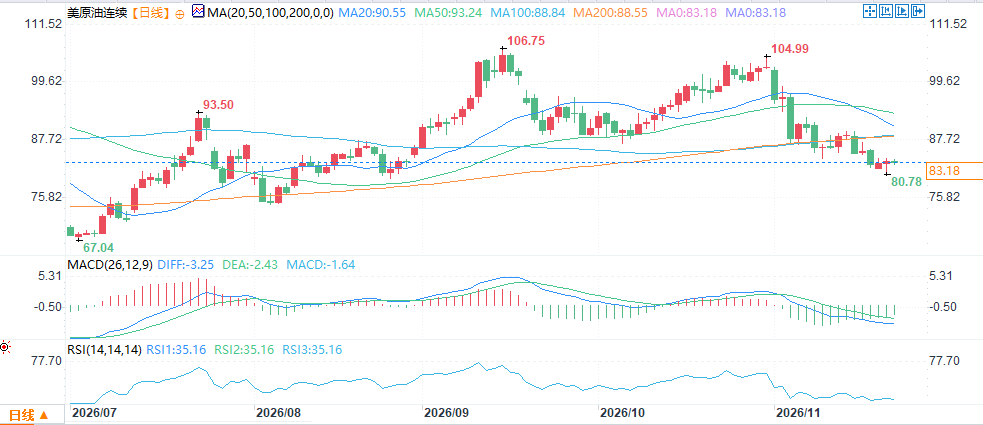 (US crude oil futures daily chart, source: FX678) At 15:40 Beijing time, US crude oil futures were trading at $82.99 per barrel.
The ongoing conflict in the Middle East has provided underlying support for oil prices, with the US-Iran standoff becoming a key factor in the price recovery.
The ongoing conflict between the US and Iran continues to provide support for oil prices. On Sunday, the Iranian-backed Houthi rebels claimed responsibility for an attack on a Saudi oil refinery, and the news quickly spread through the market, raising renewed concerns about the security of Middle Eastern energy infrastructure. Meanwhile, the UK's Office for Maritime Trade Operations reported that several merchant ships were attacked or threatened in the Gulf and Strait of Hormuz over the weekend, significantly increasing shipping risks. Bahrain reported that Iran attacked local civilian industrial facilities on Saturday; the Iranian Revolutionary Guard subsequently responded by claiming to have launched missile and drone strikes against US targets in Bahrain—a key home base for the US Fifth Fleet—further escalating regional tensions. Market analysts point out that the current US-Iran standoff has evolved from mere rhetoric into a substantial threat to shipping lanes and oil refining facilities, making it difficult for the risk premium to completely subside. Vandana Hari, founder of Vanda Insights, believes that the baseline scenario at the end of the year is likely a stalemate in the US-Iran tensions, but the Trump administration could still change its stance and restart military operations. The repeated threats and counterattacks from both sides will continue to generate a marginal geopolitical premium for oil prices. Unless the conflict escalates substantially or key infrastructure suffers significant damage, oil prices are more likely to remain range-bound rather than experience a sharp, one-sided upward trend. The Strait of Hormuz, a vital chokepoint for global oil transportation, means any attack on passing ships will immediately translate into increased insurance costs and risk-averse behavior from shipowners, thus pushing up freight rates and landed costs. News of attacks on Saudi refineries directly impacts the supply side; even if actual capacity losses are limited, the market will immediately price in potential disruption risks. Meanwhile, diplomatic efforts continue, with all parties striving to prevent the conflict from spiraling out of control. This is the key reason why, although oil prices are supported, they are struggling to break through the upper limit of their current range. Overall, the Middle East situation has become the "underlying support" for oil prices; short-term fluctuations depend more on the frequency of attacks and the pace of diplomatic statements than on individual events themselves.COP31 climate conference negotiations break down; oil-producing countries resist statements on phasing out fossil fuels.
The COP31 climate conference in Turkey broke down on Sunday, marking the first time since 2009 that a consensus could not be reached on the final text. The deadlock stemmed from whether to include the phrase "phasing out fossil fuels" in the final agreement. Saudi Arabia and major oil-producing countries strongly opposed the wording, arguing that fossil fuels would retain significant economic and energy security value for the foreseeable future. OPEC had previously defended fossil fuel use during the conference, emphasizing the need for developing countries to consider the feasibility and fairness of their energy transition. The core contradiction in the breakdown was that some developed countries and climate advocates wanted to send a strong signal to the market through a clear "exit" timetable to accelerate the energy transition; while the camp represented by Saudi Arabia, some Gulf states, and some developing oil-producing countries argued that prematurely locking in a phase-out path would harm energy security, employment, and fiscal revenue, and that renewable energy could not yet fully replace the fundamental role of fossil fuels in industry, transportation, and electricity. Ultimately, the two sides failed to find room for compromise on the wording, and the conference ended without a binding text. The direct impact of this outcome on the oil market is a reduction in policy pressure regarding the medium- to long-term expectation of "peak demand." If the COP had successfully incorporated a phase-out statement, the market might have further lowered its forward crude oil demand expectations, thereby suppressing the forward curve and investment intentions. The current breakdown in negotiations means that the "legitimacy" of fossil fuels at the policy level has not been further damaged, at least in the short term. Oil-producing countries have thus gained more narrative space to continue emphasizing that the energy transition should be "orderly, fair, and technically feasible," rather than a "one-size-fits-all exit." For oil prices, this reduces additional downward pressure from climate policies, allowing geopolitical risks and supply and demand fundamentals to once again become the dominant pricing factors. In the coming months, the market will continue to observe whether domestic policies in various countries will accelerate the transition themselves, and whether major oil-producing countries will make corresponding adjustments to their production strategies.A major event is approaching: OPEC+ meeting on November 29 to finalize 2027 production policy.
The OPEC+ ministerial meeting will be held on November 29th, with the core issue being the determination of the 2027 crude oil production policy. This will be the most important fundamental event for the oil market in the coming period. Unlike previous meetings that focused more on short-term quota adjustments, this meeting will look towards the longer-term supply path, directly impacting market expectations for medium- to long-term supply and demand balance. The market is currently focused on several key issues: first, how the overall production ceiling for 2027 will be set, and whether it will be further tightened or moderately relaxed within the existing framework; second, whether the allocation of quotas within member countries will be renegotiated, especially whether a balance can be reached between countries willing to increase production and those adhering to production cuts to stabilize prices; and third, how to address the dual pressures of non-OPEC+ supply growth and slowing global demand. A hawkish outcome (maintaining or deepening production cuts) will strengthen the bottom support for oil prices; a dovish outcome (releasing more supply signals) may suppress forward premiums and trigger short-term profit-taking. Furthermore, the meeting will also convey OPEC+'s collective assessment of current geopolitical risks and the economic outlook. If the statement emphasizes supply caution and price stability as priorities, the market will interpret it as indicating that the alliance still possesses strong coordination capabilities. However, significant internal disagreements or only a vague consensus could weaken market confidence in "supply discipline." Since 2027 falls within the scope of medium-term planning, this policy direction will also influence oil companies' capital expenditure decisions, hedging strategies, and financial institutions' long-term position positioning. Overall, the outcome of the November 29th meeting is expected to be a significant catalyst for oil price movements in the latter half of the fourth quarter, and the market will continue to digest related expectation gaps before the meeting. (US crude oil futures daily chart, source: FX678) At 15:40 Beijing time, US crude oil futures were trading at $82.99 per barrel.
- Risk Warning and Disclaimer
- The market involves risk, and trading may not be suitable for all investors. This article is for reference only and does not constitute personal investment advice, nor does it take into account certain users’ specific investment objectives, financial situation, or other needs. Any investment decisions made based on this information are at your own risk.