Crude oil trading alert: Oversupply concerns are putting downward pressure on oil prices; be wary of a potential acceleration of the US crude oil downtrend.
2026-11-24 09:58:32
US crude oil (WTI) suffered a sharp decline on Monday, with the January contract closing at $80.17 per barrel , a drop of $3.24, or 3.88% , on the day. More importantly, it touched a low of $79.88 during the session, effectively breaking below the $80 mark . This closing price was the lowest since August 10th , and the largest single-day drop since November 9th . Prices traded below $80 during Asian trading hours on Tuesday.  Looking at a longer timeframe, this weakness is not a recent phenomenon. It has declined in five of the past seven trading days , accumulating a 23.00% drop so far this month, and falling 29.02% from its 52-week high of $112.95 reached on April 7th. Brent crude closed at $89.37 during the same period, down 3.46%, its lowest close since August 31st. Although WTI is still up about 39.62% year-to-date, the pullback over the past month has erased a significant portion of those gains. This round of decline was directly triggered by two specific events on the supply side. Firstly, Middle Eastern oil flows continue to recover —despite renewed attacks on commercial vessels and energy facilities in the Persian Gulf over the weekend, Persian Gulf crude oil exports continue, indicating that Middle Eastern supply has gradually adapted to the increased shipping risks; the market interprets this as the narrative of "supply disruption" giving way to the reality of "supply adaptation." Secondly, the Sharara pipeline in Libya has restarted . The chairman of the Libyan National Oil Corporation (NOC) confirmed on Monday that the pipeline has resumed operation, and crude oil has begun being injected into storage tanks at the Akkakus facility in Zawiya. The pipeline's return directly eliminated some of the supply disruption premium previously priced into the market. The International Energy Agency's (IEA) monthly report provides an anchor for the medium-term direction. The report points out that with the continued recovery of oil exports from the Gulf region, global oil supply increased by 2.3 million barrels per day in October, reaching 105.4 million barrels per day , the first time it has exceeded demand since the outbreak of the Middle East conflict. It is projected that the global oil market will shift to a supply surplus of approximately 2 million barrels per day in the fourth quarter of this year . Regarding inventories, driven by increased Gulf crude oil exports, global observable oil inventories increased by 52 million barrels in October, the first increase since June this year ; however, structurally, offshore inventories increased significantly while onshore inventories continued to decline, and global observable inventories have cumulatively decreased by 462 million barrels since the outbreak of the Middle East conflict. This data reveals an important context— the current "surplus" occurs after significant depletion of inventory, leaving little room for maneuver . Geopolitically, a different picture emerges: the conflict has not subsided. According to a statement from the Iranian Islamic Revolutionary Guard Corps Navy in the early hours of November 24, three oil tankers struck mines in the Strait of Hormuz in the past few hours, causing explosions and fires. One tanker was near the southern coast, and the other two were in the eastern waters. Iran specifically noted that these vessels were under heavy air cover and escort by US forces at the time of the incidents. Furthermore, according to data from the UK's Office for Maritime Trade Operations, more than 30 maritime attacks were reported in October, exceeding this threshold for the first time since the conflict began; as of November 22, at least 22 attacks had been reported in November, the second highest number since the conflict began. Iranian Parliament Speaker Ghalibaf stated that Iran possesses the military means to break the blockade and will take action soon if necessary. The market's core contradiction has shifted from "whether the supply glut is valid" to "the speed at which peace talks move from signals to agreements, a race against the policy window" —Trump's statements regarding a "permanent agreement" and the Qatari delegation's visit to Tehran represent, for the first time at the decision-making level, shifting "ending the conflict" from a passive option to an active framework. However, the US and Iran have not yet started formal negotiations, and their differences remain unchanged on core issues such as the destination of 60% enriched uranium storage, the Hormuz transit fee, and the order of sanctions lifting . The market has chosen to price signals first and then verify them , which is the direct reason for the recent declines of over 3% in several trading days. In other words, the oil price decline already includes pre-emptive bets on the success of peace talks ; if negotiations break down, this premium needs to be given back. Institutional forecasts further reinforce the downward tilt. JPMorgan Chase predicts that oil prices may fall to around $70 per barrel in the first half of 2027 due to market oversupply, noting that Middle Eastern production (excluding Iran) will increase next year, with supply in the Americas rising in tandem, primarily driven by the United States. The bank's forward forecast for Brent crude in 2027 is $63 . In contrast, Bank of America 's assessment is more balanced—it believes that geopolitical factors will continue to dominate oil prices, but relatively low global inventories make many regions vulnerable to supply disruptions . Demand-side concerns also exist. The IEA projects that global daily oil demand will decrease by 2.7 million barrels year-on-year to 102.3 million barrels in 2026 , with high oil prices and supply chain disruptions continuing to suppress consumption, although the decline is expected to gradually narrow; demand is projected to increase by 2 million barrels year-on-year in 2027. It should also be noted that improvements in crude oil supply have not yet alleviated the tight supply of refined products such as diesel, and continued attacks on Russian energy facilities have further exacerbated diesel supply pressures. The upcoming key event is the OPEC+ ministerial meeting on November 29th , where major oil-producing countries will discuss their 2027 production strategies. With Middle Eastern production gradually recovering, OPEC+ needs to balance maintaining production and restoring supply with preventing a large-scale global market glut. This decision will be a key variable affecting subsequent oil prices. Technically, on the daily chart, US crude oil continues its downward trend and has broken below the $80 mark . This breach of the psychological level is significant – it's not just a psychological level, but also the lower edge of a dense support zone that has been repeatedly tested over the past few trading days. A decisive break below this level opens up further downside potential . In the short term, the bearish alignment of the moving average system and the price continuing to trade below the Bollinger Band's middle line further solidify the bearish structure . On the 4-hour chart, the price accelerated its decline after breaking below $80, with short-term momentum clearly bearish. Two levels need to be observed: First, whether the rebound can reach and hold above 83 , which is the first criterion for whether the downtrend structure has been broken; second, whether the lower Bollinger Band at 77.16 can provide support. If this level is directly breached, then a test of 75 will come quickly.
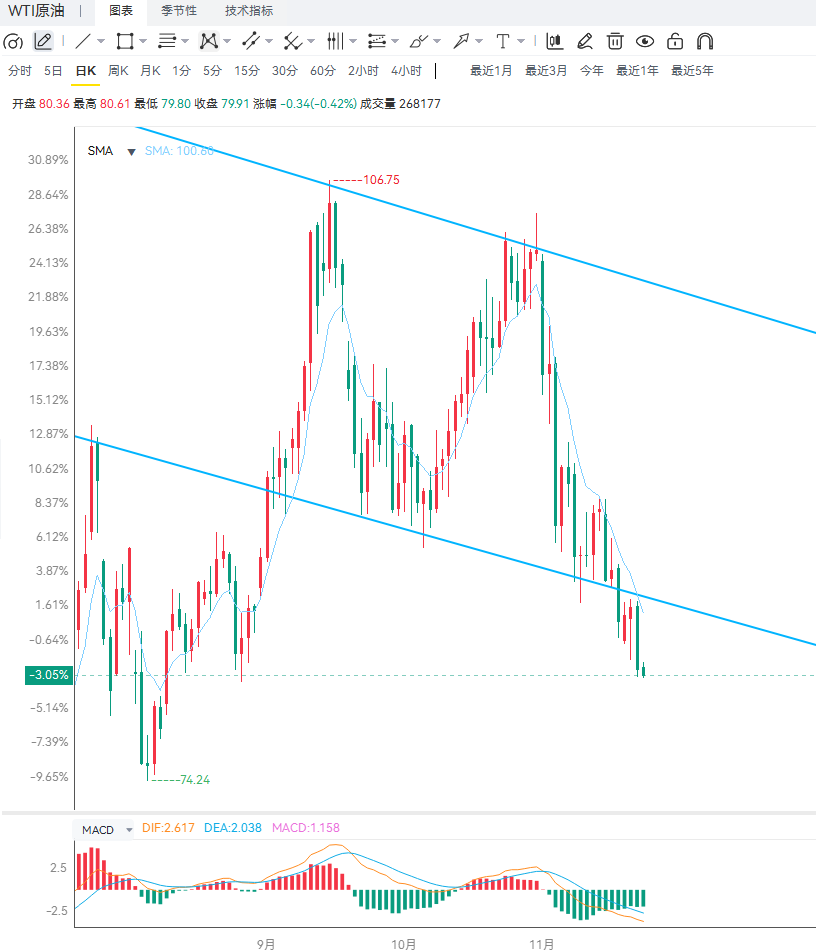 The editor summarizes the event of WTI falling below $80 as marking a shift in pricing – the market has moved from "paying for supply disruptions" to "pricing for oversupply." The IEA confirmed that global supply increased by 2.3 million barrels per day month-on-month in October, with a surplus of about 2 million barrels per day in the fourth quarter. Global observable inventories rose by 52 million barrels for the first time since June. The recovery of Middle Eastern oil flows and the restart of the Sharara pipeline in Libya directly eliminated the supply disruption premium. JPMorgan Chase even gave a forecast of $70 for the first half of 2027 and $63 for Brent in 2027. At the same time, the geopolitical situation has not really cooled down, but the key is that prices are no longer sensitive to it: IG analysts clearly pointed out that "signs of oversupply are becoming increasingly apparent, while the possibility of Trump launching a new round of military strikes seems to be decreasing." The market interprets Trump's tough threats as bargaining chips rather than a premonition of action. This constitutes the most alarming aspect of this round of decline—the decline already includes early bets on the success of the peace talks, and this premium will be quickly given back once Qatar's mediation stalls or negotiations break down.
Looking at a longer timeframe, this weakness is not a recent phenomenon. It has declined in five of the past seven trading days , accumulating a 23.00% drop so far this month, and falling 29.02% from its 52-week high of $112.95 reached on April 7th. Brent crude closed at $89.37 during the same period, down 3.46%, its lowest close since August 31st. Although WTI is still up about 39.62% year-to-date, the pullback over the past month has erased a significant portion of those gains. This round of decline was directly triggered by two specific events on the supply side. Firstly, Middle Eastern oil flows continue to recover —despite renewed attacks on commercial vessels and energy facilities in the Persian Gulf over the weekend, Persian Gulf crude oil exports continue, indicating that Middle Eastern supply has gradually adapted to the increased shipping risks; the market interprets this as the narrative of "supply disruption" giving way to the reality of "supply adaptation." Secondly, the Sharara pipeline in Libya has restarted . The chairman of the Libyan National Oil Corporation (NOC) confirmed on Monday that the pipeline has resumed operation, and crude oil has begun being injected into storage tanks at the Akkakus facility in Zawiya. The pipeline's return directly eliminated some of the supply disruption premium previously priced into the market. The International Energy Agency's (IEA) monthly report provides an anchor for the medium-term direction. The report points out that with the continued recovery of oil exports from the Gulf region, global oil supply increased by 2.3 million barrels per day in October, reaching 105.4 million barrels per day , the first time it has exceeded demand since the outbreak of the Middle East conflict. It is projected that the global oil market will shift to a supply surplus of approximately 2 million barrels per day in the fourth quarter of this year . Regarding inventories, driven by increased Gulf crude oil exports, global observable oil inventories increased by 52 million barrels in October, the first increase since June this year ; however, structurally, offshore inventories increased significantly while onshore inventories continued to decline, and global observable inventories have cumulatively decreased by 462 million barrels since the outbreak of the Middle East conflict. This data reveals an important context— the current "surplus" occurs after significant depletion of inventory, leaving little room for maneuver . Geopolitically, a different picture emerges: the conflict has not subsided. According to a statement from the Iranian Islamic Revolutionary Guard Corps Navy in the early hours of November 24, three oil tankers struck mines in the Strait of Hormuz in the past few hours, causing explosions and fires. One tanker was near the southern coast, and the other two were in the eastern waters. Iran specifically noted that these vessels were under heavy air cover and escort by US forces at the time of the incidents. Furthermore, according to data from the UK's Office for Maritime Trade Operations, more than 30 maritime attacks were reported in October, exceeding this threshold for the first time since the conflict began; as of November 22, at least 22 attacks had been reported in November, the second highest number since the conflict began. Iranian Parliament Speaker Ghalibaf stated that Iran possesses the military means to break the blockade and will take action soon if necessary. The market's core contradiction has shifted from "whether the supply glut is valid" to "the speed at which peace talks move from signals to agreements, a race against the policy window" —Trump's statements regarding a "permanent agreement" and the Qatari delegation's visit to Tehran represent, for the first time at the decision-making level, shifting "ending the conflict" from a passive option to an active framework. However, the US and Iran have not yet started formal negotiations, and their differences remain unchanged on core issues such as the destination of 60% enriched uranium storage, the Hormuz transit fee, and the order of sanctions lifting . The market has chosen to price signals first and then verify them , which is the direct reason for the recent declines of over 3% in several trading days. In other words, the oil price decline already includes pre-emptive bets on the success of peace talks ; if negotiations break down, this premium needs to be given back. Institutional forecasts further reinforce the downward tilt. JPMorgan Chase predicts that oil prices may fall to around $70 per barrel in the first half of 2027 due to market oversupply, noting that Middle Eastern production (excluding Iran) will increase next year, with supply in the Americas rising in tandem, primarily driven by the United States. The bank's forward forecast for Brent crude in 2027 is $63 . In contrast, Bank of America 's assessment is more balanced—it believes that geopolitical factors will continue to dominate oil prices, but relatively low global inventories make many regions vulnerable to supply disruptions . Demand-side concerns also exist. The IEA projects that global daily oil demand will decrease by 2.7 million barrels year-on-year to 102.3 million barrels in 2026 , with high oil prices and supply chain disruptions continuing to suppress consumption, although the decline is expected to gradually narrow; demand is projected to increase by 2 million barrels year-on-year in 2027. It should also be noted that improvements in crude oil supply have not yet alleviated the tight supply of refined products such as diesel, and continued attacks on Russian energy facilities have further exacerbated diesel supply pressures. The upcoming key event is the OPEC+ ministerial meeting on November 29th , where major oil-producing countries will discuss their 2027 production strategies. With Middle Eastern production gradually recovering, OPEC+ needs to balance maintaining production and restoring supply with preventing a large-scale global market glut. This decision will be a key variable affecting subsequent oil prices. Technically, on the daily chart, US crude oil continues its downward trend and has broken below the $80 mark . This breach of the psychological level is significant – it's not just a psychological level, but also the lower edge of a dense support zone that has been repeatedly tested over the past few trading days. A decisive break below this level opens up further downside potential . In the short term, the bearish alignment of the moving average system and the price continuing to trade below the Bollinger Band's middle line further solidify the bearish structure . On the 4-hour chart, the price accelerated its decline after breaking below $80, with short-term momentum clearly bearish. Two levels need to be observed: First, whether the rebound can reach and hold above 83 , which is the first criterion for whether the downtrend structure has been broken; second, whether the lower Bollinger Band at 77.16 can provide support. If this level is directly breached, then a test of 75 will come quickly. The editor summarizes the event of WTI falling below $80 as marking a shift in pricing – the market has moved from "paying for supply disruptions" to "pricing for oversupply." The IEA confirmed that global supply increased by 2.3 million barrels per day month-on-month in October, with a surplus of about 2 million barrels per day in the fourth quarter. Global observable inventories rose by 52 million barrels for the first time since June. The recovery of Middle Eastern oil flows and the restart of the Sharara pipeline in Libya directly eliminated the supply disruption premium. JPMorgan Chase even gave a forecast of $70 for the first half of 2027 and $63 for Brent in 2027. At the same time, the geopolitical situation has not really cooled down, but the key is that prices are no longer sensitive to it: IG analysts clearly pointed out that "signs of oversupply are becoming increasingly apparent, while the possibility of Trump launching a new round of military strikes seems to be decreasing." The market interprets Trump's tough threats as bargaining chips rather than a premonition of action. This constitutes the most alarming aspect of this round of decline—the decline already includes early bets on the success of the peace talks, and this premium will be quickly given back once Qatar's mediation stalls or negotiations break down.
- Risk Warning and Disclaimer
- The market involves risk, and trading may not be suitable for all investors. This article is for reference only and does not constitute personal investment advice, nor does it take into account certain users’ specific investment objectives, financial situation, or other needs. Any investment decisions made based on this information are at your own risk.