Market risk appetite rebounded, and the US dollar index hit a new high.
2026-11-24 15:16:35
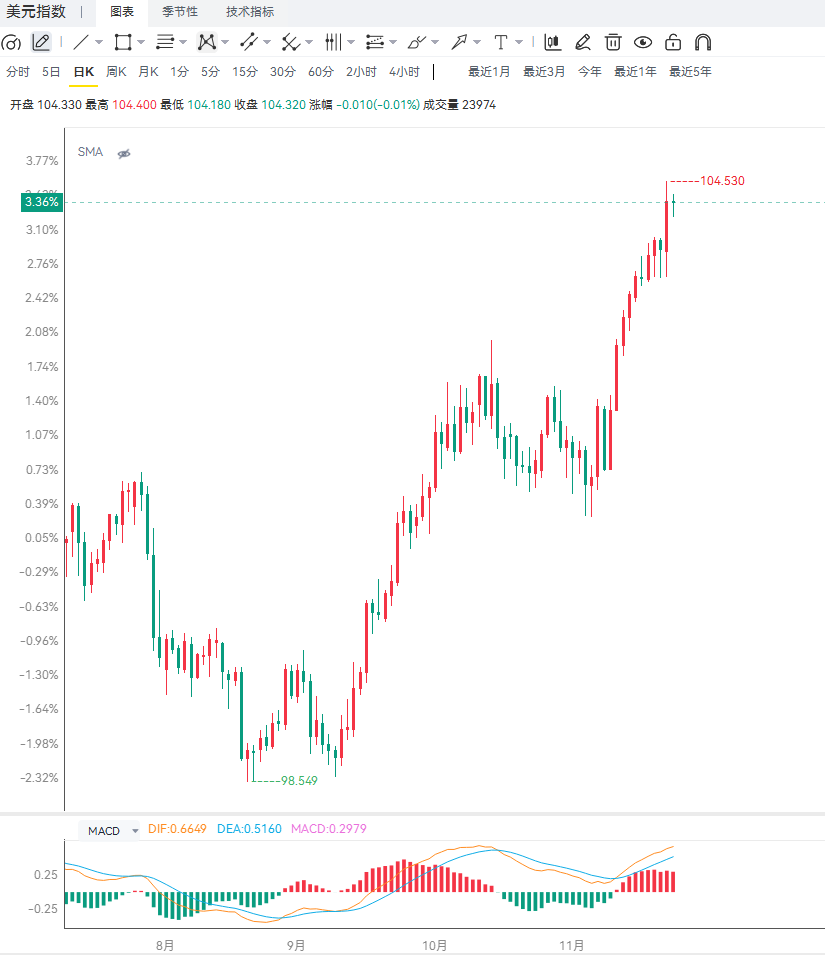
The US dollar index (DXY) was at 104.25 in early European trading on Tuesday, moderately weak but still near its highest level since March 2025. The dollar index failed to break through the 103.80 level on November 18th and was again resisted near that level on November 23rd, making 103.80 a repeatedly marked key resistance level. Now, the price has risen above 104.25, signifying a break of this key resistance level that had held the index for at least two trading weeks.  The current strength of the US dollar is not driven by traditional safe-haven demand, but by a more sophisticated transmission chain. The key lies in the recovery of market risk appetite, which has further strengthened market expectations for continued interest rate hikes by the Federal Reserve. Citi market analyst Preston Pagli 's statement reveals the feedback mechanism: "Our US economists have consistently pointed out that tighter financial conditions and lower valuations may limit the Fed's willingness to tighten further, although (Monday's) movements are reversing some of that pressure." A decline in equity assets tightens financial conditions, thus weakening the Fed's willingness to raise rates; conversely, a rise loosens financial conditions, giving the Fed more confidence to tighten. In other words, the recent strength of the US dollar is rooted in "loose financial conditions that embolden the Fed to raise rates," rather than "an influx of safe-haven funds." Interest rate pricing confirms this logic. According to the CME FedWatch tool, traders have priced in a nearly 95.1% probability of a 25 basis point rate hike next month , while retaining a "very small possibility" of a massive 50 basis point rate hike, a probability that has risen from zero the day before . While the change was small, it signifies a resurgence of tail risks after the "50 basis point drop to zero" on November 23. Regarding Federal Reserve officials, New York Fed President Williams stated on Monday that policymakers "still have more work to do" to bring inflation under control , but also hinted that further action could "take time" as the economy continues to grow . The subtlety of this statement lies in its confirmation of the tightening direction while downplaying the urgency —meaning policy will continue to tighten, but there's no need to rush into a one-time event. This provides directional support for the dollar, but doesn't constitute a reason for accelerated upward movement. The preliminary reading of the US October S&P Global Composite Purchasing Managers' Index (PMI) fell to 54.6, down from 55.9 previously. While still showing strong growth, it represents the slowest expansion since July . The manufacturing PMI fell to 54.5 , lower than September's 54.9 and market expectations of 54.6; the services PMI fell to 54.7 , significantly lower than the previous reading of 56.1 and expectations of 55.8. All three data points fell short of expectations, with clear signs of slowdown , creating some tension with the current strength of the US dollar near its year-to-date high. Mitsubishi UFJ Financial Group (MUFG) offers a noteworthy contrarian perspective. The bank observed that "the performance of the foreign exchange market over the past week was primarily driven by safe-haven trading conditions," and expects "the performance of G10 currencies to remain closely linked to global investor risk sentiment in the coming week." The bank noted that "the US dollar strengthened last week amid stronger safe-haven trading, with the dollar index reaching a new high for the year, slightly below 104.00, but losing some upward momentum by the end of the week." Technically, the daily dollar index maintains a constructive bullish bias, with the price firmly above the 100-day simple moving average and the Bollinger Band middle line, reinforcing the bullish trend. However, the 14-day Relative Strength Index (RSI) has reached 72.08, officially entering overbought territory—meaning that upward momentum has been stretched, and if buyers cannot sustain their offensive, the index will face the vulnerability of a cooling phase. On the upside resistance side, the upper Bollinger Band at approximately 104.70 provides immediate resistance, and any hesitation at this level could trigger consolidation or a corrective pullback. On the downside support side, the middle Bollinger Band at approximately 102.80 is the first level, followed by the 100-day SMA at 101.00 and the lower Bollinger Band at 100.85. These three levels collectively define a broader demand zone, expected to support the bullish structure on any deep pullback. It's worth noting that the breached 103.80 level has now become support.
 Editor's Summary: The US dollar index's breach of the key resistance level of 103.80 indicates that the dollar has entered a new level, rather than oscillating within its previous range. However, the driving mechanism of this round of gains needs to be accurately understood, otherwise its sustainability can be easily misjudged. The root cause of the dollar's strength is not the influx of safe-haven funds, but rather the recovery in risk appetite. While the probability of a 50 basis point rate hike by the Federal Reserve has only slightly increased from zero, it signifies a resurgence of tail risks. The US October PMI figures, all three falling short of expectations and the composite index hitting its slowest pace since July, indicate that an economic slowdown has begun, creating tension with the dollar's strength near its year-to-date high. The MUFG's warning that "weakness in equity assets before the end of the year will more severely challenge rate hike expectations" is the most crucial variable to monitor. Key attention should be paid to Wednesday's actual PCE reading, the actual battle between the 103.80 support level and the 104.70 upper resistance level, whether equity assets can continue their upward trend, and whether the pricing of consecutive rate hikes by the Federal Reserve in December and January has eased.
The current strength of the US dollar is not driven by traditional safe-haven demand, but by a more sophisticated transmission chain. The key lies in the recovery of market risk appetite, which has further strengthened market expectations for continued interest rate hikes by the Federal Reserve. Citi market analyst Preston Pagli 's statement reveals the feedback mechanism: "Our US economists have consistently pointed out that tighter financial conditions and lower valuations may limit the Fed's willingness to tighten further, although (Monday's) movements are reversing some of that pressure." A decline in equity assets tightens financial conditions, thus weakening the Fed's willingness to raise rates; conversely, a rise loosens financial conditions, giving the Fed more confidence to tighten. In other words, the recent strength of the US dollar is rooted in "loose financial conditions that embolden the Fed to raise rates," rather than "an influx of safe-haven funds." Interest rate pricing confirms this logic. According to the CME FedWatch tool, traders have priced in a nearly 95.1% probability of a 25 basis point rate hike next month , while retaining a "very small possibility" of a massive 50 basis point rate hike, a probability that has risen from zero the day before . While the change was small, it signifies a resurgence of tail risks after the "50 basis point drop to zero" on November 23. Regarding Federal Reserve officials, New York Fed President Williams stated on Monday that policymakers "still have more work to do" to bring inflation under control , but also hinted that further action could "take time" as the economy continues to grow . The subtlety of this statement lies in its confirmation of the tightening direction while downplaying the urgency —meaning policy will continue to tighten, but there's no need to rush into a one-time event. This provides directional support for the dollar, but doesn't constitute a reason for accelerated upward movement. The preliminary reading of the US October S&P Global Composite Purchasing Managers' Index (PMI) fell to 54.6, down from 55.9 previously. While still showing strong growth, it represents the slowest expansion since July . The manufacturing PMI fell to 54.5 , lower than September's 54.9 and market expectations of 54.6; the services PMI fell to 54.7 , significantly lower than the previous reading of 56.1 and expectations of 55.8. All three data points fell short of expectations, with clear signs of slowdown , creating some tension with the current strength of the US dollar near its year-to-date high. Mitsubishi UFJ Financial Group (MUFG) offers a noteworthy contrarian perspective. The bank observed that "the performance of the foreign exchange market over the past week was primarily driven by safe-haven trading conditions," and expects "the performance of G10 currencies to remain closely linked to global investor risk sentiment in the coming week." The bank noted that "the US dollar strengthened last week amid stronger safe-haven trading, with the dollar index reaching a new high for the year, slightly below 104.00, but losing some upward momentum by the end of the week." Technically, the daily dollar index maintains a constructive bullish bias, with the price firmly above the 100-day simple moving average and the Bollinger Band middle line, reinforcing the bullish trend. However, the 14-day Relative Strength Index (RSI) has reached 72.08, officially entering overbought territory—meaning that upward momentum has been stretched, and if buyers cannot sustain their offensive, the index will face the vulnerability of a cooling phase. On the upside resistance side, the upper Bollinger Band at approximately 104.70 provides immediate resistance, and any hesitation at this level could trigger consolidation or a corrective pullback. On the downside support side, the middle Bollinger Band at approximately 102.80 is the first level, followed by the 100-day SMA at 101.00 and the lower Bollinger Band at 100.85. These three levels collectively define a broader demand zone, expected to support the bullish structure on any deep pullback. It's worth noting that the breached 103.80 level has now become support. Editor's Summary: The US dollar index's breach of the key resistance level of 103.80 indicates that the dollar has entered a new level, rather than oscillating within its previous range. However, the driving mechanism of this round of gains needs to be accurately understood, otherwise its sustainability can be easily misjudged. The root cause of the dollar's strength is not the influx of safe-haven funds, but rather the recovery in risk appetite. While the probability of a 50 basis point rate hike by the Federal Reserve has only slightly increased from zero, it signifies a resurgence of tail risks. The US October PMI figures, all three falling short of expectations and the composite index hitting its slowest pace since July, indicate that an economic slowdown has begun, creating tension with the dollar's strength near its year-to-date high. The MUFG's warning that "weakness in equity assets before the end of the year will more severely challenge rate hike expectations" is the most crucial variable to monitor. Key attention should be paid to Wednesday's actual PCE reading, the actual battle between the 103.80 support level and the 104.70 upper resistance level, whether equity assets can continue their upward trend, and whether the pricing of consecutive rate hikes by the Federal Reserve in December and January has eased.
- Risk Warning and Disclaimer
- The market involves risk, and trading may not be suitable for all investors. This article is for reference only and does not constitute personal investment advice, nor does it take into account certain users’ specific investment objectives, financial situation, or other needs. Any investment decisions made based on this information are at your own risk.