Has the Japanese government suddenly "backed down"? Its budget guidelines emphasize fiscal sustainability and respect for the Bank of Japan's independence; is the yen about to undergo a major transformation?
2026-11-24 17:30:32
On Tuesday (November 24), the Japanese government submitted a draft of its basic guidelines for budget preparation for the next fiscal year (starting April 2027) to the Economic and Fiscal Policy Advisory Council. The core message is very clear: the government will promote domestic investment, strengthen supply capacity and potential growth rate, while ensuring fiscal sustainability; and, while respecting the Bank of Japan's autonomy in monetary and financial regulation, expects the Bank of Japan to achieve its 2% inflation target in a sustainable and stable manner. The document did not provide specific figures for new debt issuance, only emphasizing "appropriate control," and stating that the scale will be determined in conjunction with the results of tax and expenditure reforms. Key expenditures will be supported by proceeds from the Bank of Japan's sale of ETFs and special accounting surpluses, while expenditures related to economic security will be repaid through "bridging bonds," financed by proceeds from the accelerated sale of Bank of Japan ETFs, and will not be included in regular new debt issuance, debt/GDP, or primary fiscal revenue and expenditure targets.  This seemingly technical statement reflects the Japanese government's recent heightened sensitivity to market sentiment.
 In this environment, marginal changes in fiscal signals will be amplified and interpreted. If the market believes that the Japanese government is truly beginning to prioritize debt sustainability and the Bank of Japan's independence, the yen's risk premium may narrow; conversely, if subsequent budget proposals show continued spending pressure and unclear funding sources, previously accumulated concerns may resurface. Furthermore, the Bank of Japan's accelerated ETF sales arrangements are also noteworthy. Expanding the annual ETF sales scale and allocating some proceeds to government spending essentially transforms assets on the central bank's balance sheet into fiscal resources. This alleviates some of the pressure of direct bond issuance, but it also signifies a closer financial link between the Bank of Japan and the government, and the market will continue to observe whether this affects its perception of the Bank of Japan's policy independence.
This seemingly technical statement reflects the Japanese government's recent heightened sensitivity to market sentiment.From "proactive fiscal policy" to proactively lowering the threshold for fiscal policy
Since taking office last October, Sanae Takaichi has consistently emphasized stimulating growth through increased spending and has appointed figures with a pro-loose fiscal and monetary policy stance to key committees. This led to market concerns that Japan would return to a combination of "large spending + low interest rates," resulting in massive new debt issuance, runaway inflation, and a simultaneous sell-off of Japanese government bonds and the yen. The decline in bonds and the yen earlier this year was a concentrated manifestation of these concerns. Subsequently, the Takaichi cabinet noticeably shifted its stance. In media interviews, she stated that she would control new debt issuance to around 40 trillion yen, even if the budget requests from various ministries next year reached a record 143 trillion yen. This budget guideline further reinforces the statements of "fiscal sustainability" and "respect for the Bank of Japan's independence," aiming to distance itself from the previous image of "growth and loose monetary policy." This shift is not a sudden abandonment of stimulus, but rather an attempt to rebalance between "proactive" and "responsible" approaches. The government still plans to leverage private investment through long-term, predictable fiscal spending, focusing on economic security and growth, but the sources of funding will shift more towards the monetization of existing assets (BOJ ETF) and structural reforms, rather than unlimited bond issuance.The core contradiction that yen traders care about most
For the foreign exchange market, what truly matters is not the budget figures themselves, but the trust relationship between the government and the Bank of Japan, and between fiscal and monetary policies. On the one hand, signals of fiscal discipline help alleviate market concerns about the unsustainability of Japanese debt. Japan's public debt-to-GDP ratio remains one of the highest among developed countries, and any significant expansion of new debt would directly push up long-term interest rates and could potentially depress the yen through capital flows and risk premiums. The government's proactive emphasis on controlling debt issuance and respecting the Bank of Japan's independence helps stabilize bond market expectations and indirectly supports the yen. On the other hand, the Kaohsiung cabinet maintains a "positive" stance. Spending plans such as consumption tax cuts on food and economic security investments are still underway, and there is uncertainty about how the funding gap will be fully filled. If subsequent actual budgets show less control over new debt than expected, or if the market interprets this as "verbal discipline but actual easing," the yen may come under renewed pressure. Meanwhile, the Bank of Japan's own policy path remains a key variable. Inflation remains above the 2% target, and the Bank of Japan has already raised interest rates multiple times, leading the market to expect further tightening. The government's explicit statement of respect for its independence and its desire for "appropriate guidance" of policy to achieve the sustainable 2% target effectively avoids any suspicion of political interference. This is a neutral to slightly positive signal for the yen—at least in the short term, it is unlikely that the government will publicly pressure the Bank of Japan to slow down interest rate hikes.The practical significance in the current foreign exchange market context
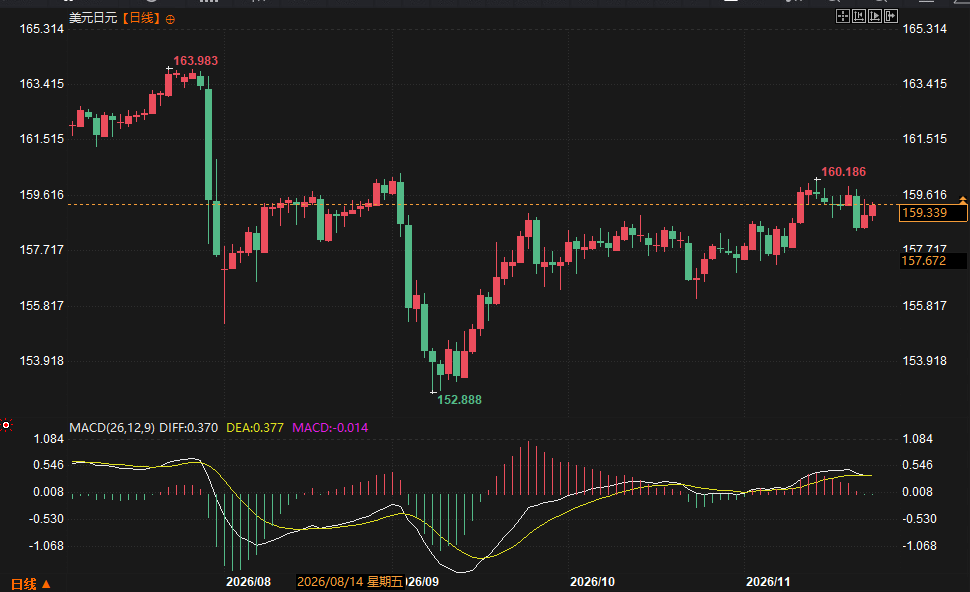
After falling from a high of nearly 164 against the Japanese yen in early August, the USD/JPY pair touched a low of around 152.8 in mid-September before rebounding. It then tested above 160 again in November before consolidating, currently fluctuating around 159. During this period, market expectations of intervention have repeatedly emerged, and Japanese authorities have repeatedly warned of "one-sided, sharp" exchange rate fluctuations. In this environment, marginal changes in fiscal signals will be amplified and interpreted. If the market believes that the Japanese government is truly beginning to prioritize debt sustainability and the Bank of Japan's independence, the yen's risk premium may narrow; conversely, if subsequent budget proposals show continued spending pressure and unclear funding sources, previously accumulated concerns may resurface. Furthermore, the Bank of Japan's accelerated ETF sales arrangements are also noteworthy. Expanding the annual ETF sales scale and allocating some proceeds to government spending essentially transforms assets on the central bank's balance sheet into fiscal resources. This alleviates some of the pressure of direct bond issuance, but it also signifies a closer financial link between the Bank of Japan and the government, and the market will continue to observe whether this affects its perception of the Bank of Japan's policy independence.Mid-term perspective: Trust is more important than numbers
For forex traders, the current narrative surrounding Japan has expanded beyond simple "interest rate differentials" to encompass "fiscal credibility and policy coordination." While interest rate differentials remain the core factor driving the medium- to long-term direction of the USD/JPY exchange rate, market expectations regarding domestic fiscal discipline and the Bank of Japan's independence will influence the yen's elasticity through risk premiums and capital flows. The release of the budget guidelines by the Kaohsiung City Cabinet is a clear market reassurance move. It attempts to reassure investors that Japan will not indefinitely pursue the old path of "large spending and low interest rates," and that fiscal sustainability and central bank independence remain the bottom line. Whether this signal will truly take hold depends on the details of the subsequent formal budget, the actual scale of new debt, and the Bank of Japan's trade-off between inflation and growth. The yen's trajectory is never determined by a single factor. Interest rates, inflation, intervention expectations, and global risk appetite all play a role. However, when the Japanese government proactively adjusts its fiscal narrative, the risk premium and policy premium of this asset change. For forex traders closely monitoring the yen, this is one of the key variables that needs continuous tracking.- Risk Warning and Disclaimer
- The market involves risk, and trading may not be suitable for all investors. This article is for reference only and does not constitute personal investment advice, nor does it take into account certain users’ specific investment objectives, financial situation, or other needs. Any investment decisions made based on this information are at your own risk.