Why has the high liquidity of gold become a "buffer" for deleveraging?
2026-11-24 18:06:38
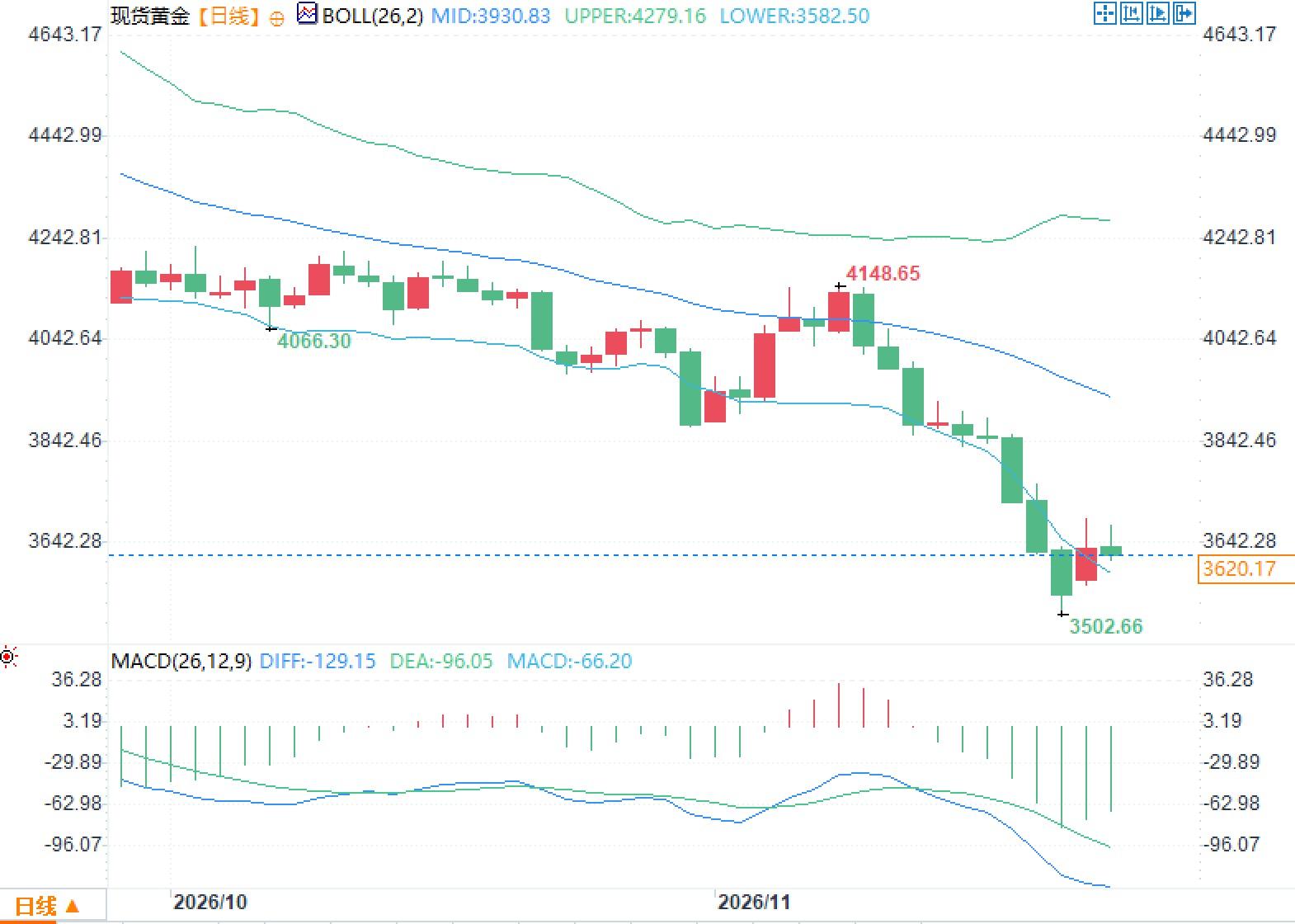
On Tuesday, November 24th, spot gold saw a temporary respite after the previous trading day's rebound in the equity market driven by news related to Nvidia, currently fluctuating around $3620 per ounce. Following the announcement of Jensen Huang's reinstatement, market risk appetite clearly improved, easing the pressure from forced liquidations triggered by the previous continuous decline in the equity market. Spot gold thus ended its significant pullback of several days, but overall remains constrained by interest rate expectations and geopolitical factors, and has not yet broken out of its recent low-level consolidation pattern. 
Equity market sentiment recovery and easing of forced liquidation
Following Nvidia's board's unanimous decision to reinstate Jensen Huang as president, CEO, and board member, the technology sector rebounded rapidly,带动 the broader stock market recovery. This change directly improved market sentiment, correcting last week's extremely cautious pricing. Institutions with portfolios encompassing stocks, gold, and bonds often need to quickly raise cash to cope with margin calls or redemption pressures when stocks fall sharply and trigger losses on leveraged positions. Gold, due to its high liquidity and ease of trading, is often the preferred asset for liquidation. The stock market rebound reduced such passive selling, thus providing temporary support for spot gold. This process suggests that recent gold volatility stems more from cross-asset liquidity rebalancing than from independent drivers of a single fundamental factor.The persistent constraints of interest rate path and real yield
The minutes of the Federal Reserve's October meeting showed that almost all officials, under the baseline scenario, judged that further increases in the federal funds rate would be needed in the coming months to ensure that inflation returns to the target level in a timely manner. Some officials even discussed the possibility of a larger adjustment. The current target range for the federal funds rate remains at 3.75% to 4%, and market pricing already reflects a high probability of further increases this year. The repricing of real yields continues to put pressure on gold. When risk appetite improves due to a stock market rebound, the dollar and real interest rates tend to be supported, increasing the opportunity cost of holding non-yielding assets. Gold is pressured by forced liquidation when stocks fall, and suppressed by interest rate expectations when stocks rebound, creating a two-sided constraint. Economic data and statements from Federal Reserve officials will continue to influence this repricing process, but the current baseline still leans towards a tighter policy path.Limited Transmission of Geopolitical Standoff and Risk Aversion Demand
The standoff between the US and Iran continues, with slow progress in negotiations and both sides maintaining a hardline stance. Trump recently stated that if negotiations fail, he might reassess military options after the New Year. Iran, on the other hand, emphasizes that it will use all available means to counter the blockade and maintain its existing conditions. Geopolitical uncertainty typically provides potential safe-haven demand for gold, but the current ongoing conflict has not triggered a large influx of new funds. When risk appetite briefly rebounds during a stock market rally, the supporting role of geopolitical factors is easily offset by interest rate and liquidity factors. The market is more focused on whether the conflict will escalate further or see substantial easing, rather than simply a continuation of the standoff. This background makes it difficult for gold to gain sustained independent upward momentum solely based on geopolitical narratives.Liquidity characteristics and cross-asset transmission mechanism
Gold's high liquidity makes it a suitable "buffer asset" in a deleveraging environment. When equity markets decline due to growth concerns or specific events, leveraged institutions prioritize selling positions that can be quickly liquidated, causing gold to passively follow suit. Conversely, when stock markets rebound and margin calls ease, selling pressure lessens, leading to a temporary price recovery. This recurring mechanism explains the recent high correlation between gold and stock market volatility. A sustained recovery requires a significant shift in interest rate expectations, whether through weaker data, a change in the Federal Reserve's stance, or a marked easing of geopolitical tensions. However, if the stock market comes under renewed pressure, forced liquidations could be reinstated. Traders should focus on portfolio rebalancing paths, changes in real yields, and liquidity conditions, rather than solely relying on the emotional impact of a single event.Frequently Asked Questions
Question 1: Why did news related to Nvidia alleviate selling pressure on spot gold? Answer: Jensen Huang's return to office improved risk appetite, reducing the demand for leveraged institutions to sell gold due to stock losses. Gold, as a highly liquid asset, was previously often used to quickly raise cash; the stock market rebound temporarily interrupted this process. Question 2: How does the Fed's policy constrain gold's performance? Answer: The meeting minutes showed that most officials expected further interest rate hikes, and rising real yields increased the opportunity cost of holding gold. Even if the stock market rebound eased the pressure to liquidate positions, interest rate repricing could still put downward pressure on gold when risk appetite improves. Question 3: Why has the forced liquidation mechanism repeatedly affected gold recently? Answer: Leveraged portfolios holding both stocks and gold need to be quickly liquidated when stocks fall, and gold, due to its ease of trading, becomes the preferred target for sale. This cross-asset transmission causes gold to fall along with equities when they are under pressure, and to gain a temporary respite when equities recover.- Risk Warning and Disclaimer
- The market involves risk, and trading may not be suitable for all investors. This article is for reference only and does not constitute personal investment advice, nor does it take into account certain users’ specific investment objectives, financial situation, or other needs. Any investment decisions made based on this information are at your own risk.