CBOT Agricultural Commodities Analysis: Soybean meal hits new monthly high, driven by both purchases and new EU regulations; Wheat falls towards a nine-month low, pressured by good-to-excellent ratings and the US dollar.
2026-11-25 09:10:35
On Tuesday (November 24), the CBOT grain market continued to diverge. January soybeans closed at $12.34 per bushel, up 0.39%; January soybean meal closed at $350.90 per short ton, up 1.95%, reaching its highest level since October 20; March corn closed at $4.502 per bushel, up 0.28%; the most active wheat closed at $5.892 per bushel, down 1.05%; and Kansas City December hard red winter wheat closed at $6.157 per bushel, up 0.89%, with an intraday low of $6.102 approaching the nine-month low of $6.045 reached last week. The price movements of soybeans and wheat were driven by two opposing channels: demand expectations and supply expectations. The rise in soybean meal prices was supported by export demand—the Korea Feed Association bought approximately 60,000 tons of soybean meal on Tuesday, coupled with expectations that new EU deforestation regulations might shift soybean meal export demand to the United States. One analyst bluntly stated, "This could be a major event for US soybean exports this year." The decline in wheat prices stemmed from improved supply—the US winter wheat good-to-excellent rating rose for the third consecutive week to 54%, with rainfall in the Plains improving soil moisture, and farmers halting sales after futures prices fell to a nine-month low. Corn prices were caught in the middle: lacking new news, trading was thin before the holiday, and prices closed almost flat. Currently, CBOT grains are divided between "soybean meal export-driven and wheat supply-suppressed," with the dollar's performance providing a common backdrop. The dollar index hovered near a 20-month high after Nvidia CEO Jensen Huang's return to the helm—the resurgence of AI gains has led to market expectations of further interest rate hikes by the Federal Reserve, and a strong dollar makes US grains less competitive in the global market. The performance of the basis reveals the temperature in the spot market: the basis for corn and soybeans in the Midwest remained stable to decline, with Decatur processing plants lowering the soybean basis by 3 cents and Morris River Terminals lowering the corn basis by 2 cents. However, the CIF basis in the US Gulf remained stable, and the decline in the US dollar index aroused the interest of some export buyers.  As of 09:01 AM today (November 25th) in the Asian morning session, here is a summary of the price changes for related commodities.
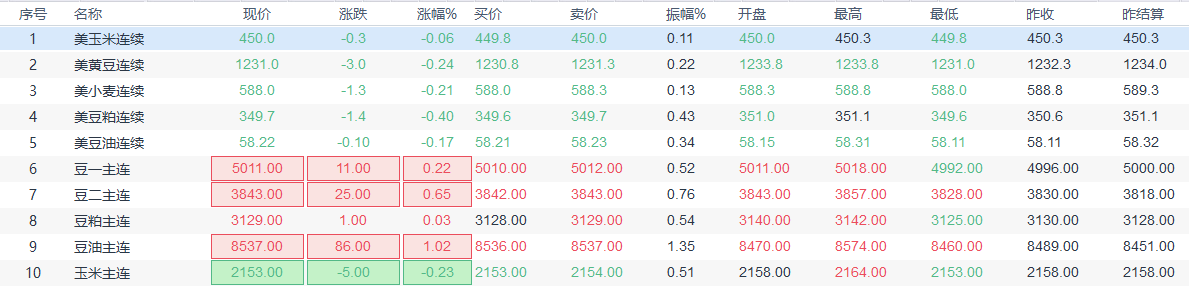 According to FX678's observations, estimates from overseas traders show that on Tuesday (November 24), the speculative positions of commodity funds on corn futures, soybean futures, wheat futures, soybean meal futures, and soybean oil futures at the Chicago Board of Trade (CBOT), namely the net positions and average net positions of CBOT commodity funds, are shown in the chart below specially created by FX678:
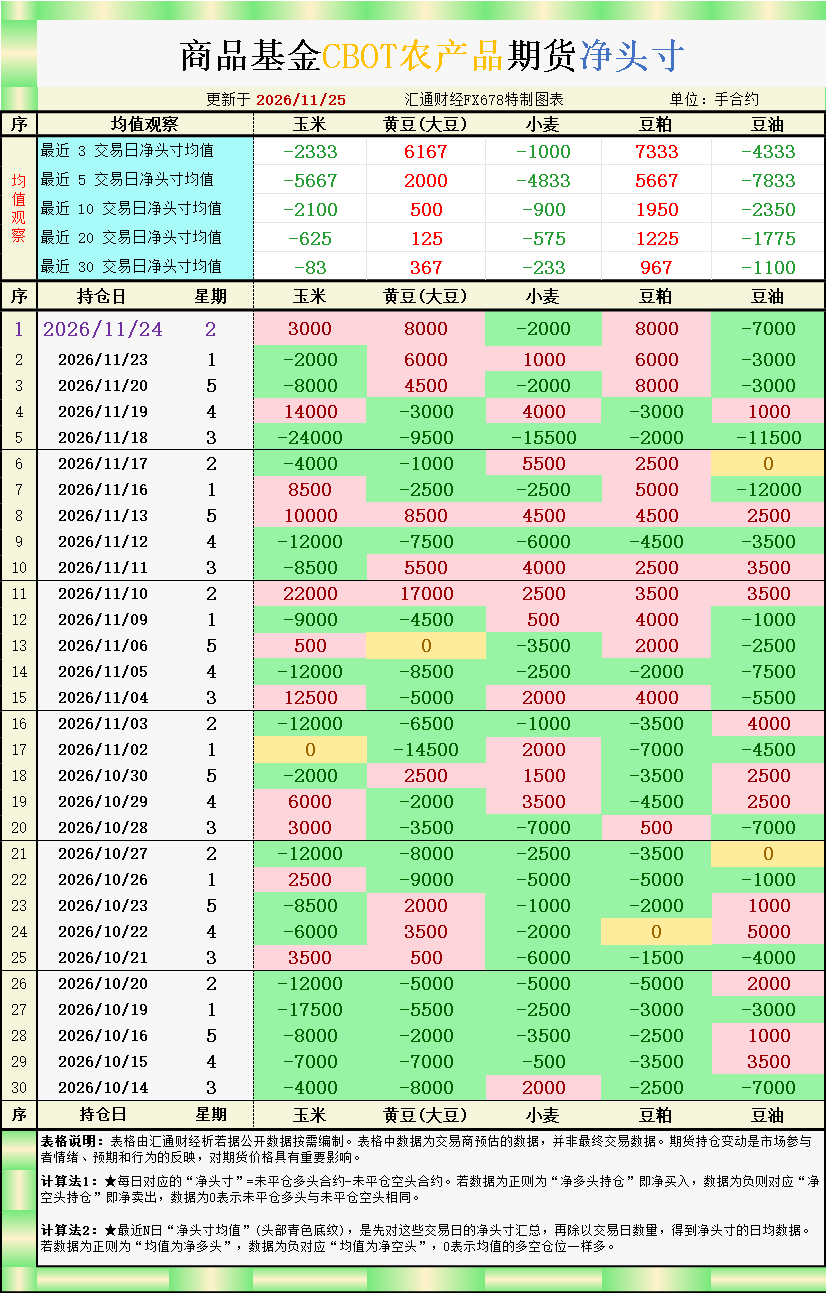 The following is an interpretation of the net positions and averages in the above position charts: [CBOT corn speculative positions: net buying of 3000 contracts; average net selling of 2333 contracts over the past 3 trading days; average net selling of 5667 contracts over the past 5 trading days; average net selling of 2100 contracts over the past 10 trading days; average net selling of 625 contracts over the past 20 trading days; average net selling of 83 contracts over the past 30 trading days.] [CBOT soybean speculative positions: net buying of 8000 contracts; average net buying of 6167 contracts over the past 3 trading days; average net buying of 2000 contracts over the past 5 trading days; average net buying of 500 contracts over the past 10 trading days; average net buying of 125 contracts over the past 20 trading days; average net buying of 367 contracts over the past 30 trading days.] [CBOT wheat speculative positions are net selling 2,000 contracts; the average net position over the past 3 trading days is net selling 1,000 contracts; the average net position over the past 5 trading days is net selling 4,833 contracts; the average net position over the past 10 trading days is net selling 900 contracts; the average net position over the past 20 trading days is net selling 575 contracts; and the average net position over the past 30 trading days is net selling 233 contracts.] [CBOT soybean meal speculative positions are net buying 8,000 contracts; the average net position over the past 3 trading days is net buying 7,333 contracts; the average net position over the past 5 trading days is net buying 5,667 contracts; the average net position over the past 10 trading days is net buying 1,950 contracts; the average net position over the past 20 trading days is net buying 1,225 contracts; and the average net position over the past 30 trading days is net buying 967 contracts.] [CBOT soybean oil speculative positions are net sold at 7,000 contracts; the average net position over the past 3 trading days is net sold at 4,333 contracts; the average net position over the past 5 trading days is net sold at 7,833 contracts; the average net position over the past 10 trading days is net sold at 2,350 contracts; the average net position over the past 20 trading days is net sold at 1,775 contracts; and the average net position over the past 30 trading days is net sold at 1,100 contracts.] CBOT grain positions, basis, and international supply and demand reveal new market trends. Detailed analysis of each commodity is provided below.
As of 09:01 AM today (November 25th) in the Asian morning session, here is a summary of the price changes for related commodities. According to FX678's observations, estimates from overseas traders show that on Tuesday (November 24), the speculative positions of commodity funds on corn futures, soybean futures, wheat futures, soybean meal futures, and soybean oil futures at the Chicago Board of Trade (CBOT), namely the net positions and average net positions of CBOT commodity funds, are shown in the chart below specially created by FX678: The following is an interpretation of the net positions and averages in the above position charts: [CBOT corn speculative positions: net buying of 3000 contracts; average net selling of 2333 contracts over the past 3 trading days; average net selling of 5667 contracts over the past 5 trading days; average net selling of 2100 contracts over the past 10 trading days; average net selling of 625 contracts over the past 20 trading days; average net selling of 83 contracts over the past 30 trading days.] [CBOT soybean speculative positions: net buying of 8000 contracts; average net buying of 6167 contracts over the past 3 trading days; average net buying of 2000 contracts over the past 5 trading days; average net buying of 500 contracts over the past 10 trading days; average net buying of 125 contracts over the past 20 trading days; average net buying of 367 contracts over the past 30 trading days.] [CBOT wheat speculative positions are net selling 2,000 contracts; the average net position over the past 3 trading days is net selling 1,000 contracts; the average net position over the past 5 trading days is net selling 4,833 contracts; the average net position over the past 10 trading days is net selling 900 contracts; the average net position over the past 20 trading days is net selling 575 contracts; and the average net position over the past 30 trading days is net selling 233 contracts.] [CBOT soybean meal speculative positions are net buying 8,000 contracts; the average net position over the past 3 trading days is net buying 7,333 contracts; the average net position over the past 5 trading days is net buying 5,667 contracts; the average net position over the past 10 trading days is net buying 1,950 contracts; the average net position over the past 20 trading days is net buying 1,225 contracts; and the average net position over the past 30 trading days is net buying 967 contracts.] [CBOT soybean oil speculative positions are net sold at 7,000 contracts; the average net position over the past 3 trading days is net sold at 4,333 contracts; the average net position over the past 5 trading days is net sold at 7,833 contracts; the average net position over the past 10 trading days is net sold at 2,350 contracts; the average net position over the past 20 trading days is net sold at 1,775 contracts; and the average net position over the past 30 trading days is net sold at 1,100 contracts.] CBOT grain positions, basis, and international supply and demand reveal new market trends. Detailed analysis of each commodity is provided below.Soybean meal: Net buying of 8,000 lots, consistent direction for three consecutive days, export demand confirmed by position.
On Tuesday, commodity funds made net purchases of 8,000 contracts of soybean meal, consistent with the 3-day average of 7,333 contracts and the 5-day average of 5,667 contracts – net buying has continued for several days, indicating that fund purchases are gradual and sustained. The January contract closed at $350.90, up $6.40, reaching its highest level since October 20. Support came from two directions. First, export confirmation – the Korea Feed Association bought approximately 60,000 tons of soybean meal on Tuesday; second, the EU's new deforestation regulations – analysts pointed out that the EU's deforestation rules, which will take effect at the end of December, may shift soybean meal export demand to US supply. One analyst bluntly stated, "This could be a major event for US soybean exports this year," although there is a possibility of delays in the EU rules. On the supply side, analysts pointed out that due to the delayed US soybean harvest this fall, crushing plant inventories have declined, and the replenishment of US supply pipelines has been slow – providing a supply-side basis for the basis. In terms of basis, soybean meal basis remained largely stable, with buyers having already prepared the supply needed for this week; however, CIF prices for the first quarter of 2027 strengthened due to anticipated demand. Net fund purchases of 8,000 lots echoed the assessment of "export demand + tight supply." The closing price was $350.90, with upside targets at $355 to $358. The sustainability of the rebound depends on whether South Korean purchases continue and the actual implementation of the EU's new deforestation regulations.Soybeans: Net buying of 8,000 lots, consistent three-day trend; soybean meal demand offsets Brazilian planting pressure.
On Tuesday, commodity funds net bought 8,000 soybean contracts, in line with the 3-day average of 6,167 contracts and 2,000 contracts higher than the 5-day average—the consistent net buying direction indicates accelerating fund purchases. The January contract closed at $12.34, up 5.25 cents, after rising as much as 10.25 cents during the session before retreating. Strong demand for soybean meal supported the market—confirmed soybean meal exports and expectations of new EU deforestation regulations provided demand-side support for the entire soybean sector. However, planting progress in Brazil weighed on prices—consulting firm AgRural reported that as of last Thursday, Brazilian farmers had planted 86% of the 2026/27 soybean crop, up from 78% a week earlier and 81% at the same time last year. The prospect of a bumper harvest in South America provided an upper limit for soybean prices. In terms of basis, Midwest soybean basis remained stable to lower, with Decatur processing plants lowering basis by 3 cents; the CIF premium for November shipments of US Gulf soybeans was 106 cents, and for December shipments, it was 110 cents, both unchanged. The decline in the US dollar index sparked interest from some export buyers. Net fund purchases of 8,000 contracts echoed the assessment of "demand-driven growth in soybean meal," but pressure from Brazilian planting limited the rebound's potential. The closing price was $12.34, with an upside target of $12.40. The sustainability of the rebound depends on whether soybean meal exports can continue and whether Brazilian weather conditions will cause problems.Wheat: Net selling of 2,000 lots, continuing the bearish trend, a tug-of-war between improving quality and farmers halting sales.
On Tuesday, commodity funds net sold 2,000 wheat contracts, consistent with the 3-day average of 1,000 contracts and the 5-day average of 4,833 contracts – this consistent net selling direction indicates that the funds' bearish stance continues. The most active contract closed at $5.892, down 6.25 cents; the Kansas City December hard red winter wheat contract closed at $6.157, down 5.5 cents, with its intraday low approaching last week's nine-month low. The core factor suppressing the price was improved supply: the USDA on Monday revised its winter wheat condition rating upward from 53% to 54%, marking the third consecutive week of increase; 60% of the crop in Kansas was rated good or excellent, and 90% had emerged; rainfall in the Plains improved soil moisture. However, there was support on the downside: farmers stopped selling after futures prices fell to a nine-month low, as they had no intention of selling before the end of the year. On the basis front, the basis for hard red winter wheat in the U.S. Plains remained stable as futures prices approached a nine-month low. In international trade, Jordan purchased approximately 60,000 tons of hard milled wheat; Bangladesh issued a tender for 50,000 tons; and Pakistan issued an import tender for 800,000 tons. Net selling of 2,000 contracts by funds echoed the assessment of "improved supply," but farmers' reluctance to sell limited downside. The closing price was $5.892, with a target of $5.85. A rebound would require a weaker dollar or an escalation of tensions in the Black Sea.Corn: Net buying of 3,000 lots, but below the short-term average, indicating moderate buying amid pre-holiday quiet.
Corn commodity funds saw net buying of 3,000 contracts on Tuesday, compared to a 3-day average of net selling of 2,333 contracts and a 5-day average of net selling of 5,667 contracts—a shift from bearish to bullish sentiment in a single day, but the magnitude was moderate, indicating that the fund buying was "tentative" rather than "aggressive." The March contract closed at $4.502, up 0.5 cents, with mixed movements during the session. One analyst bluntly stated, "With the holidays approaching, there's been little movement." The core factors suppressing the market are the strength of the US dollar and the progress of planting in South America—the dollar hovering near a 20-month high makes US grains less competitive; successful planting in Brazil provides a relaxed outlook for global supply. Support comes from the lag in harvesting—the corn harvest is 94% complete, below the five-year average of 96%, with states like South Dakota, Michigan, and Ohio lagging behind schedule. In terms of basis, corn basis in the Midwest remained stable to lower, with Morris River Terminals reducing its basis by 2 cents; CIF corn basis in the US Gulf remained stable; and inland waterway barge rates remained firm due to tight supply. In international trading, the Korea Feed Leaders Committee purchased approximately 68,000 tons of feed corn. Net fund purchases of 3,000 contracts echoed the assessment of "light trading before the holiday," indicating that buying interest existed but its strength was limited. The closing price was $4.502, with a downside target of $4.45. A rebound would require a weaker dollar or stronger-than-expected export sales.Soybean oil: Net selling of 7,000 lots, continuing the selling pressure from the 5-day moving average, a weak point within the soybean futures market.
On Tuesday, commodity funds saw a net sell of 7,000 contracts of soybean oil, close to the 5-day average of 7,833 contracts and higher than the 3-day average of 4,333 contracts—the consistent direction of net selling indicates continued selling pressure from funds. As a feedstock for biodiesel, soybean oil's pricing logic is tied to both soybeans (cost side) and crude oil (energy side). Soybeans rose 5.25 cents on Tuesday, providing upward pressure from the cost side; however, analysts pointed out that "the weakness in soybean oil prices limited the gains in the soybean sector"—this statement suggests that soybean oil underperformed soybean meal on Tuesday, possibly due to drag from the energy side or increased crushing supply. Looking at the crushing chain, rising soybean prices increase crushing costs, while soybean meal rose by $6.40, a larger increase than soybeans, improving crushing margins and potentially stimulating crushing volume and increasing soybean oil supply, creating a bearish variable for soybean oil. The net sell of 7,000 contracts by funds echoes the assessment of "improved crushing margins and increased soybean oil supply." Soybean oil currently lacks independent upward momentum and is likely to remain weak and volatile in the short term, but the decline may be limited by support from the energy sector.Summary: Simultaneous net buying of soybean meal and soybeans, coupled with a continued bearish trend in wheat, has deepened the divergence between soybean and wheat commodities.
A clear divergence is emerging based on the combined open interest data of the five major commodities: soybean meal saw net buying of 8,000 contracts, soybeans saw net buying of 8,000 contracts (both moving in the same direction over the past three days), corn saw net buying of 3,000 contracts (but below the short-term average), while wheat saw net selling of 2,000 contracts and soybean oil saw net selling of 7,000 contracts. This divergence means that fund buying is concentrated in commodities with confirmed export demand (soybean meal and soybeans), while selling is concentrated in commodities with improved supply (wheat) and commodities with improved crushing margins and increased supply (soybean oil). The simultaneous net buying of soybean meal and soybeans indicates that the chain of "soybean meal exports → soybean demand → tightening inventory" has been confirmed by the positions; while the net selling of wheat indicates that the supply pressure from improved quality is still dominating pricing. The divergence between basis and futures is a consistent signal. The basis for corn and soybeans in the Midwest remained stable to decline, while the CIF basis for the US Gulf Coast remained stable and inland waterway barge rates remained firm due to tight supply. This pattern implies that the basis in the domestic distribution sector is under pressure due to the end of the harvest and slowdown in farmer sales, but the basis in the export sector is supported by logistical constraints. Looking ahead, whether soybean meal can break through $355, whether soybeans can hold $12.30, and whether wheat can find support around $5.85 are three key indicators to watch to see if the current divergence in market positions can continue. The key indicators for the next one to two weeks are: the sustainability of soybean meal exports (if South Korea's 60,000-ton purchase continues and the EU's new deforestation regulations direct demand to the US, the rise in soybean prices will receive substantial support), wheat supply pressure (the good-to-excellent rating has improved for the third consecutive week, but farmers' halting sales at a nine-month low provides a price buffer), and the direction of the US dollar (if the dollar continues to strengthen due to expectations of a Fed rate hike, the export competitiveness of all commodities will continue to be under pressure). Given the combined backdrop of soybean exports driving growth, wheat supply constraints, and the US dollar providing support, the short-term direction of the market will vary depending on the commodity—soybeans will be relatively strong, wheat relatively weak, and corn will fluctuate. Whether these three factors can resonate together depends on whether there are new changes in the three exogenous variables: the US dollar, South America, and major Asian countries.- Risk Warning and Disclaimer
- The market involves risk, and trading may not be suitable for all investors. This article is for reference only and does not constitute personal investment advice, nor does it take into account certain users’ specific investment objectives, financial situation, or other needs. Any investment decisions made based on this information are at your own risk.