Crude oil trading alert: US crude oil rebounds after overselling, but the downward trend remains unchanged.
2026-11-25 09:50:33
US crude oil traded at $81.55 per barrel in Asian trading on Wednesday, with a rebound ending the previous losing streak. On a shorter timeframe, the significance of this rebound lies in its level: prices have rebounded by more than $2 from the intraday low of $79.88 on November 23 , and have regained the $80 mark . The $80 level had been breached intraday the previous day, but this close's recovery changes the nature of the "breakdown" from a "substantial breakdown" to an "intraday breach."  However, the rebound has a clear upper limit. WTI crude oil rebounded to around $83 during the session but ultimately failed to break through. This directly echoes the core assessment: the short-term resistance level of $83 has been tested in this rebound and failed . In other words, the rebound did attempt, but was rejected after the attempt , which is more informative than simply saying "it rebounded." This rebound was driven by two factors. First, the re-inclusion of geopolitical risk premiums : a new round of ship attacks in and around the Strait of Hormuz pushed oil prices up from their lows. Second, the support from the US dollar : on November 24 , the US dollar index fell below 104, closing down 0.48% at 103.82 , and the 10-year US Treasury yield fell to 4.924% , and the 2-year yield to 4.687% . Crude oil priced in US dollars usually finds support when the dollar weakens. However, the pricing weight of oversupply still outweighs geopolitical disturbances, which is the fundamental reason why the rebound failed to break through $83 . The International Energy Agency (IEA) previously projected that the global oil market would shift to a supply surplus of approximately 2 million barrels per day in the fourth quarter of 2026. Global observable inventories increased by 52 million barrels in October, the first increase since June . This structural assessment has provided sustained downward pressure on oil prices. Inventory data provides empirical evidence for this narrative. Data from the U.S. Energy Information Administration (EIA) for the week ending November 13 showed that commercial crude oil inventories increased by 3.38 million barrels to 417.8 million barrels , while the market expected an increase of only 58,000 barrels; gasoline inventories increased by 5.192 million barrels to 215.9 million barrels , compared to an expected increase of 1.6 million barrels; and distillate fuel inventories increased by 1.571 million barrels to 104.9 million barrels , compared to an expected increase of 1.3 million barrels. All three inventory categories exceeded expected accumulations . Production also exerted pressure: U.S. crude oil production increased by 19,000 barrels per day to 14.032 million barrels per day, marking the fourth consecutive week of record highs ; refinery crude oil processing decreased by 129,000 barrels per day to 16.918 million barrels per day, while capacity utilization rose by 0.5 percentage points to 95.7%. However, the latest marginal signals show a noteworthy shift. Data from the American Petroleum Institute (API) shows that crude oil inventories increased by only 126,000 barrels in the week ending November 20 , compared to an increase of 5.278 million barrels the previous week ; the rate of inventory accumulation has slowed significantly . During the same period, Cushing inventories decreased by 666,000 barrels, gasoline inventories decreased by 47,000 barrels, and distillate fuel inventories increased by 1.647 million barrels . The significance of this change is that if production remains high and demand does not deteriorate further, the rate of inventory accumulation is slowing , creating directional tension with the narrative of "unrestrained oversupply." Official data for the week ending November 20th will be released tonight by the EIA. Analysts expect crude oil and refined product inventories to increase by approximately 900,000 barrels. The actual reading will directly determine whether the "slowing inventory accumulation" is an isolated incident or a trend: if the actual increase is significantly lower than expected, or if inventory reduction occurs, it will provide further room for this rebound; if it accumulates significantly more than expected again, the logic of oversupply will be reaffirmed. Geopolitically, a signal that could potentially change the landscape has emerged. The Trump administration is discussing a plan to directly strike Iranian leaders. If this option is pursued, its impact on supply will far exceed that of previous tanker attacks; currently, the impact on oil prices is limited to the short-term inclusion of risk premiums, rather than actual supply disruptions. This also explains why the rebound on November 24th stopped at 83: the market chose "the possibility of geopolitical escalation" as its pricing benchmark over "the certainty of oversupply." Technically, the daily chart for US crude oil shows an oversold rebound pattern, but it has not changed the existing downward trend. The rebound from 79.88 to 82.05, approximately 2.6%, represents a technical correction after a sharp drop, rather than a trend reversal. The MACD indicator remains in bearish territory, indicating that the medium-term momentum has not changed, and the price increase is still a correction within the bearish structure. The $83 level constitutes clear short-term resistance. If $83 cannot be effectively broken, the downward structure will continue. On the downside, the $80 psychological level was briefly broken and then recovered, its nature shifting from "loss of control" to "repeated struggle." A break below $79 followed by another drop could trigger an accelerated decline.
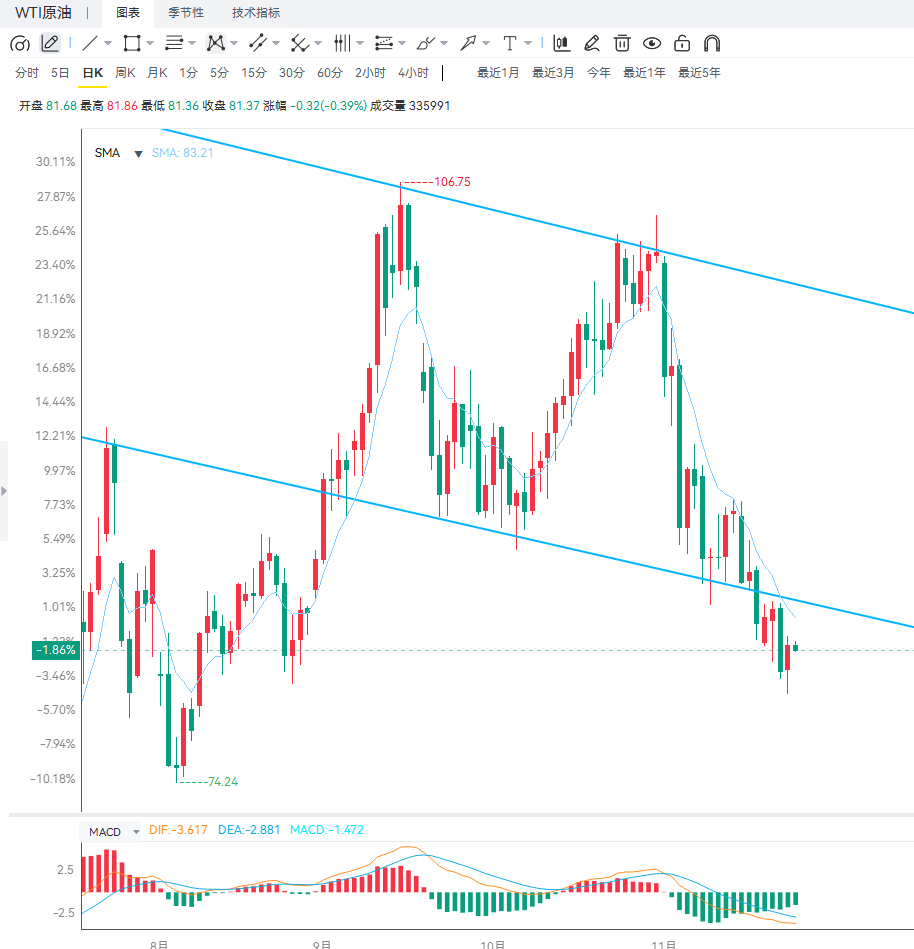 Editor's Summary: Yesterday's rebound in US crude oil was a correction after a sharp drop, not a trend reversal. The $83 level was tested and retested during the session, confirming its resistance level. The MACD remains in bearish territory, and the medium-term momentum direction remains unchanged. The rebound was driven by the latest round of ship attacks in the Hormuz and the dollar falling below 104, with the oversupply factor carrying greater weight: the IEA expects a surplus of approximately 2 million barrels per day in the fourth quarter, and EIA's three inventory data all exceeded expectations, with production hitting record highs for four consecutive weeks. However, the API crude oil increase for the week ending November 20th was only 126,000 barrels, compared to 5.278 million barrels the previous week, indicating a significant slowdown in inventory accumulation. Therefore, tonight's EIA report will be a key confirmation.
However, the rebound has a clear upper limit. WTI crude oil rebounded to around $83 during the session but ultimately failed to break through. This directly echoes the core assessment: the short-term resistance level of $83 has been tested in this rebound and failed . In other words, the rebound did attempt, but was rejected after the attempt , which is more informative than simply saying "it rebounded." This rebound was driven by two factors. First, the re-inclusion of geopolitical risk premiums : a new round of ship attacks in and around the Strait of Hormuz pushed oil prices up from their lows. Second, the support from the US dollar : on November 24 , the US dollar index fell below 104, closing down 0.48% at 103.82 , and the 10-year US Treasury yield fell to 4.924% , and the 2-year yield to 4.687% . Crude oil priced in US dollars usually finds support when the dollar weakens. However, the pricing weight of oversupply still outweighs geopolitical disturbances, which is the fundamental reason why the rebound failed to break through $83 . The International Energy Agency (IEA) previously projected that the global oil market would shift to a supply surplus of approximately 2 million barrels per day in the fourth quarter of 2026. Global observable inventories increased by 52 million barrels in October, the first increase since June . This structural assessment has provided sustained downward pressure on oil prices. Inventory data provides empirical evidence for this narrative. Data from the U.S. Energy Information Administration (EIA) for the week ending November 13 showed that commercial crude oil inventories increased by 3.38 million barrels to 417.8 million barrels , while the market expected an increase of only 58,000 barrels; gasoline inventories increased by 5.192 million barrels to 215.9 million barrels , compared to an expected increase of 1.6 million barrels; and distillate fuel inventories increased by 1.571 million barrels to 104.9 million barrels , compared to an expected increase of 1.3 million barrels. All three inventory categories exceeded expected accumulations . Production also exerted pressure: U.S. crude oil production increased by 19,000 barrels per day to 14.032 million barrels per day, marking the fourth consecutive week of record highs ; refinery crude oil processing decreased by 129,000 barrels per day to 16.918 million barrels per day, while capacity utilization rose by 0.5 percentage points to 95.7%. However, the latest marginal signals show a noteworthy shift. Data from the American Petroleum Institute (API) shows that crude oil inventories increased by only 126,000 barrels in the week ending November 20 , compared to an increase of 5.278 million barrels the previous week ; the rate of inventory accumulation has slowed significantly . During the same period, Cushing inventories decreased by 666,000 barrels, gasoline inventories decreased by 47,000 barrels, and distillate fuel inventories increased by 1.647 million barrels . The significance of this change is that if production remains high and demand does not deteriorate further, the rate of inventory accumulation is slowing , creating directional tension with the narrative of "unrestrained oversupply." Official data for the week ending November 20th will be released tonight by the EIA. Analysts expect crude oil and refined product inventories to increase by approximately 900,000 barrels. The actual reading will directly determine whether the "slowing inventory accumulation" is an isolated incident or a trend: if the actual increase is significantly lower than expected, or if inventory reduction occurs, it will provide further room for this rebound; if it accumulates significantly more than expected again, the logic of oversupply will be reaffirmed. Geopolitically, a signal that could potentially change the landscape has emerged. The Trump administration is discussing a plan to directly strike Iranian leaders. If this option is pursued, its impact on supply will far exceed that of previous tanker attacks; currently, the impact on oil prices is limited to the short-term inclusion of risk premiums, rather than actual supply disruptions. This also explains why the rebound on November 24th stopped at 83: the market chose "the possibility of geopolitical escalation" as its pricing benchmark over "the certainty of oversupply." Technically, the daily chart for US crude oil shows an oversold rebound pattern, but it has not changed the existing downward trend. The rebound from 79.88 to 82.05, approximately 2.6%, represents a technical correction after a sharp drop, rather than a trend reversal. The MACD indicator remains in bearish territory, indicating that the medium-term momentum has not changed, and the price increase is still a correction within the bearish structure. The $83 level constitutes clear short-term resistance. If $83 cannot be effectively broken, the downward structure will continue. On the downside, the $80 psychological level was briefly broken and then recovered, its nature shifting from "loss of control" to "repeated struggle." A break below $79 followed by another drop could trigger an accelerated decline. Editor's Summary: Yesterday's rebound in US crude oil was a correction after a sharp drop, not a trend reversal. The $83 level was tested and retested during the session, confirming its resistance level. The MACD remains in bearish territory, and the medium-term momentum direction remains unchanged. The rebound was driven by the latest round of ship attacks in the Hormuz and the dollar falling below 104, with the oversupply factor carrying greater weight: the IEA expects a surplus of approximately 2 million barrels per day in the fourth quarter, and EIA's three inventory data all exceeded expectations, with production hitting record highs for four consecutive weeks. However, the API crude oil increase for the week ending November 20th was only 126,000 barrels, compared to 5.278 million barrels the previous week, indicating a significant slowdown in inventory accumulation. Therefore, tonight's EIA report will be a key confirmation.
- Risk Warning and Disclaimer
- The market involves risk, and trading may not be suitable for all investors. This article is for reference only and does not constitute personal investment advice, nor does it take into account certain users’ specific investment objectives, financial situation, or other needs. Any investment decisions made based on this information are at your own risk.