CBOT Agricultural Commodities Analysis: Soybean meal hits a new monthly high, soybeans reach a one-month high, driven by both new EU deforestation regulations and processing shutdowns.
2026-11-26 09:20:34
On Wednesday (November 25), the CBOT grain market was sharply divided ahead of the Thanksgiving holiday. January soybeans settled at $12.44 per bushel, up 10 cents, hitting a one-month high; January soybean meal settled at $355.20 per short ton, up $4.10, reaching its highest level since October 19; March corn settled at $4.565 per bushel, up 6.25 cents, rebounding from a five-month low hit the previous day; March wheat settled at $5.875 per bushel, down 1.75 cents, hitting its lowest level since June 30 during the session; Kansas City December hard red winter wheat settled at $5.99 per bushel, down 13.5 cents, hitting a low of $5.975, its lowest level since February 17 during the session. The rise in soybeans was driven by a combination of a strong export narrative and increased crushing demand, while the decline in wheat was driven by a combination of improved supply and demand headwinds. One chief strategist bluntly stated, "Soybean meal is hot, our crushing will be strong, and we will export a lot of soybean meal. Major Asian countries will buy those 25 million tons, regardless of any difficulties or tariffs." This statement highlights the core of the soybean price surge—even with the Trump administration's proposed new tariffs on 14 major trading partners, including major Asian countries, the market still judges that soybean purchases by these Asian countries will not be severely impacted, as they have already met their annual purchase commitments. Wheat, on the other hand, faces the opposite situation: a stronger dollar is creating demand headwinds, and improved US crop conditions, combined, have caused prices to fall below February lows. Currently, CBOT grains are in a state of divergence between "strengthened soybean export narratives and wheat supply pressures," and the basis performance reveals the true temperature of the spot market. Corn and soybean basis spreads rose at some Iowa facilities in the Midwest—a grain depot in Consel Bluffs raised both corn and soybean basis spreads by 5 cents, and a facility in Des Moines raised soybean basis spreads by 10 cents, as traders tried to encourage farmers to sell; however, a major processing plant in Decatur lowered corn basis spreads by 15 cents and soybean basis spreads by 2 cents. Soybean meal cash basis spreads remained stable, but Gulf barge prices rose due to recent supply tightening caused by processing facility shutdowns.  According to FX678's observations, estimates from overseas traders show that on Wednesday (November 25th), the speculative positions of commodity funds on corn futures, soybean futures, wheat futures, soybean meal futures, and soybean oil futures at the Chicago Board of Trade (CBOT), specifically the net positions and average net positions of CBOT commodity funds, are shown in the chart below created by FX678.
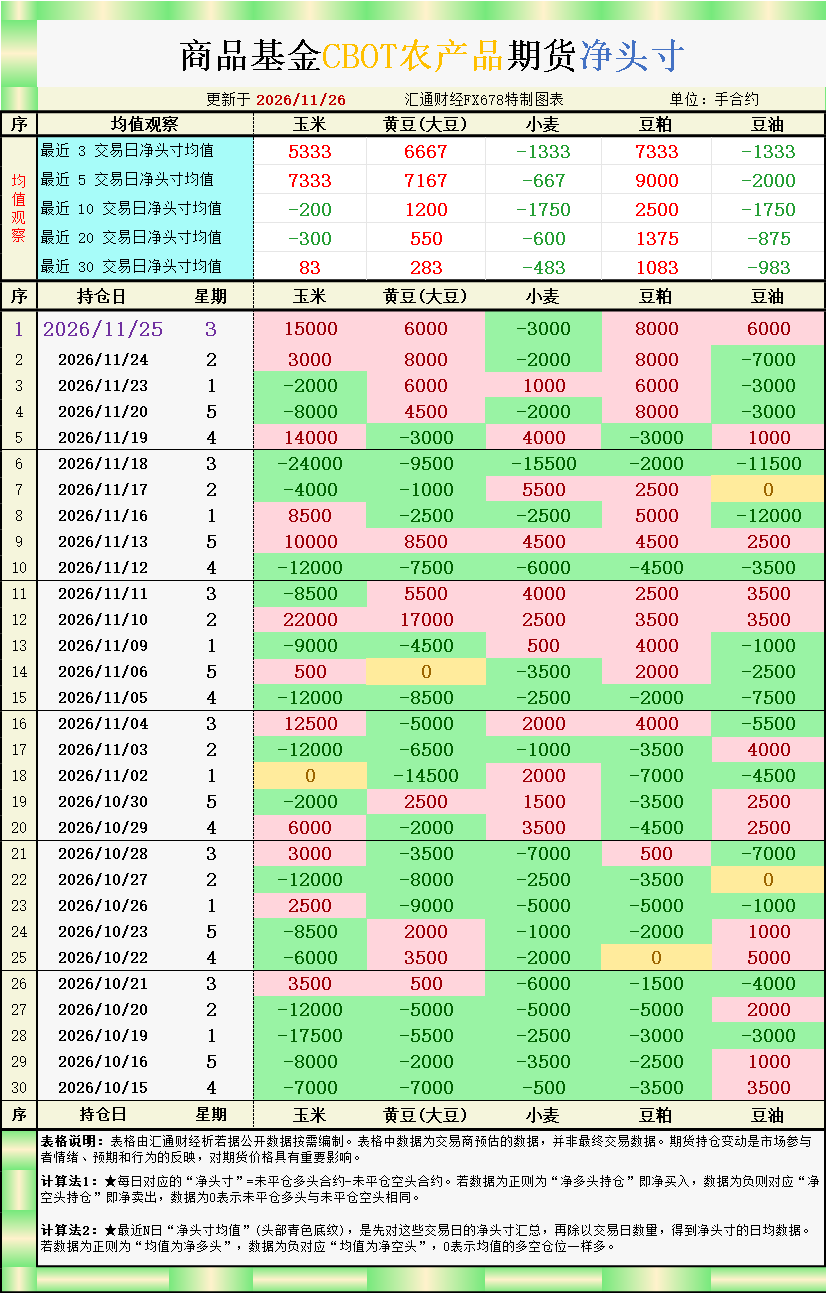 The following is an interpretation of the net positions and averages in the above position charts: [CBOT corn speculative positions: net buying of 15,000 contracts; average net position over the last 3 trading days: net buying of 5,333 contracts; average net position over the last 5 trading days: net buying of 7,333 contracts; average net position over the last 10 trading days: net selling of 200 contracts; average net position over the last 20 trading days: net selling of 300 contracts; average net position over the last 30 trading days: net buying of 83 contracts.] [CBOT soybean speculative positions: net buying of 6,000 contracts; average net position over the last 3 trading days: net buying of 6,667 contracts; average net position over the last 5 trading days: net buying of 7,167 contracts; average net position over the last 10 trading days: net buying of 1,200 contracts; average net position over the last 20 trading days: net buying of 550 contracts; average net position over the last 30 trading days: net buying of 283 contracts.] [CBOT wheat speculative positions are net selling 3,000 contracts; the average net position over the past 3 trading days is net selling 1,333 contracts; the average net position over the past 5 trading days is net selling 667 contracts; the average net position over the past 10 trading days is net selling 1,750 contracts; the average net position over the past 20 trading days is net selling 600 contracts; and the average net position over the past 30 trading days is net selling 483 contracts.] [CBOT soybean meal speculative positions are net buying 8,000 contracts; the average net position over the past 3 trading days is net buying 7,333 contracts; the average net position over the past 5 trading days is net buying 9,000 contracts; the average net position over the past 10 trading days is net buying 2,500 contracts; the average net position over the past 20 trading days is net buying 1,375 contracts; and the average net position over the past 30 trading days is net buying 1,083 contracts.] [CBOT soybean oil speculative positions are net buys of 6,000 contracts; the average net position over the past 3 trading days is net sells of 1,333 contracts; the average net position over the past 5 trading days is net sells of 2,000 contracts; the average net position over the past 10 trading days is net sells of 1,750 contracts; the average net position over the past 20 trading days is net sells of 875 contracts; and the average net position over the past 30 trading days is net sells of 983 contracts.] CBOT grain positions, basis, and international supply and demand reveal new market trends. Detailed analysis of each commodity is provided below.
According to FX678's observations, estimates from overseas traders show that on Wednesday (November 25th), the speculative positions of commodity funds on corn futures, soybean futures, wheat futures, soybean meal futures, and soybean oil futures at the Chicago Board of Trade (CBOT), specifically the net positions and average net positions of CBOT commodity funds, are shown in the chart below created by FX678. The following is an interpretation of the net positions and averages in the above position charts: [CBOT corn speculative positions: net buying of 15,000 contracts; average net position over the last 3 trading days: net buying of 5,333 contracts; average net position over the last 5 trading days: net buying of 7,333 contracts; average net position over the last 10 trading days: net selling of 200 contracts; average net position over the last 20 trading days: net selling of 300 contracts; average net position over the last 30 trading days: net buying of 83 contracts.] [CBOT soybean speculative positions: net buying of 6,000 contracts; average net position over the last 3 trading days: net buying of 6,667 contracts; average net position over the last 5 trading days: net buying of 7,167 contracts; average net position over the last 10 trading days: net buying of 1,200 contracts; average net position over the last 20 trading days: net buying of 550 contracts; average net position over the last 30 trading days: net buying of 283 contracts.] [CBOT wheat speculative positions are net selling 3,000 contracts; the average net position over the past 3 trading days is net selling 1,333 contracts; the average net position over the past 5 trading days is net selling 667 contracts; the average net position over the past 10 trading days is net selling 1,750 contracts; the average net position over the past 20 trading days is net selling 600 contracts; and the average net position over the past 30 trading days is net selling 483 contracts.] [CBOT soybean meal speculative positions are net buying 8,000 contracts; the average net position over the past 3 trading days is net buying 7,333 contracts; the average net position over the past 5 trading days is net buying 9,000 contracts; the average net position over the past 10 trading days is net buying 2,500 contracts; the average net position over the past 20 trading days is net buying 1,375 contracts; and the average net position over the past 30 trading days is net buying 1,083 contracts.] [CBOT soybean oil speculative positions are net buys of 6,000 contracts; the average net position over the past 3 trading days is net sells of 1,333 contracts; the average net position over the past 5 trading days is net sells of 2,000 contracts; the average net position over the past 10 trading days is net sells of 1,750 contracts; the average net position over the past 20 trading days is net sells of 875 contracts; and the average net position over the past 30 trading days is net sells of 983 contracts.] CBOT grain positions, basis, and international supply and demand reveal new market trends. Detailed analysis of each commodity is provided below.Corn: Net buying of 15,000 lots, nearly three times the 3-day average, reflecting pre-holiday short covering and support at lower levels.
Corn commodity funds net bought 15,000 contracts on Wednesday, compared with a 3-day average of 5,333 contracts and a 5-day average of 7,333 contracts – nearly three times the short-term average, indicating concentrated and directional buying by funds. The March contract closed at $4.565, up 6.25 cents, rebounding from a five-month low hit the previous day. The drivers were twofold: short covering ahead of the Thanksgiving holiday – traders closed short positions before the holiday; and buying on dips – prices found support after hitting a five-month low the previous day. On the basis, Midwestern corn basis rose at some facilities in Iowa, with a grain depot in Consel Bluffs raising its basis by 5 cents; however, major processors in Decatur lowered their basis by 15 cents. This divergence means that buyers in some areas are trying to encourage farmers to sell, while major processors are lowering basis after the harvest is nearing completion. The harvest is 94% complete, below the five-year average, but essentially finished. US Gulf CIF corn futures for November shipment were at a premium of 80 cents, and for January-March shipments, the premium was 94 cents, remaining stable to rising. Net fund buying of 15,000 contracts echoed the assessment of "short covering before the holiday + buying support at lower levels." The closing price was $4.565, with upside targets at $4.60 to $4.65. The sustainability of the rebound depends on whether export sales can take over from technical buying.Soybeans: Net buying of 6,000 lots, continuing the trend of net buying, driven by purchase commitments from major Asian countries and soybean meal.
On Wednesday, commodity funds net bought 6,000 soybean contracts, consistent with the 3-day average of 6,667 contracts and the 5-day average of 7,167 contracts – net buying has continued for several days, indicating that fund purchases are gradual and sustained. The January contract closed at $12.44, up 10 cents, hitting a one-month high. Support came from three directions: First, purchases by major Asian countries – the USDA confirmed the sale of 132,000 tons of soybeans for the 2026/27 marketing year to major Asian countries, and these countries have already met their annual purchase commitments, so the market judges that trade tensions will not seriously impact this pace; second, South American risks – analysts pointed out that any crop shortages in South America could trigger additional demand for US soybeans; and third, the boost from soybean meal – soybean meal hit a new monthly high, providing demand-side support for the entire soybean sector. One chief strategist bluntly stated, "Asia's major powers will buy those 25 million tons, regardless of any difficulties or tariffs." Regarding basis, soybean basis in the Midwest rose at some facilities in Iowa, with one facility in Des Moines raising it by 10 cents; the CIF premium for November shipment of US Gulf soybeans was 109 cents, and for December shipment, it was 114 cents. Net fund purchases of 6,000 contracts echoed the assessment of "purchases from major Asian powers + soybean meal-driven growth." The closing price was $12.44, with an upside target of $12.50. The sustainability of the rebound depends on whether purchases from major Asian powers continue and whether South American weather issues arise.Soybean meal: Net buying of 8,000 lots, 5-day moving average net buying of 9,000 lots, driven by both export expectations and tightening supply.
On Wednesday, commodity funds net bought 8,000 contracts of soybean meal, close to the 3-day average of 7,333 contracts and slightly lower than the 5-day average of 9,000 contracts—the net buying direction is consistent, indicating that fund purchases are gradual. The January contract closed at $355.20, up $4.10, reaching its highest level since October 19. Support came from two directions: firstly, the EU's new deforestation regulations—analysts pointed out that the EU's deforestation rules, which will take effect at the end of December, may shift global soybean meal demand to US supply, and traders are watching US soybean meal export sales to verify this expectation; secondly, the tightening of supply—some traders said that supply has tightened recently due to processing facility shutdowns, and customers are also accelerating delivery before the Thanksgiving holiday. In terms of basis, the basis for spot soybean meal in the Midwest was generally stable, but barge prices at the US Gulf export terminal rose—this divergence means that domestic supply is tightening due to processing shutdowns, while demand at the export stage is strengthening due to expectations of the new EU regulations. The net purchase of 8,000 lots by funds echoes the assessment of "export expectations + tightening supply". The closing price was $355.20, with upside targets at $360-$365. The sustainability of the rebound depends on whether Friday's export sales data can confirm a shift in EU demand.Wheat: Net selling of 3,000 contracts, continuing the bearish trend, pressured by both improved supply and a strong US dollar.
On Wednesday, commodity funds net sold 3,000 wheat contracts, higher than the 3-day average of 1,333 contracts and the 5-day average of 667 contracts—the consistent net selling direction indicates that the funds' bearish stance continues. The March contract closed at $5.875, down 1.75 cents, hitting its lowest level since June 30 during the session; the Kansas City December hard red winter wheat contract closed at $5.99, down 13.5 cents, also hitting its lowest level since February 17. There are two main factors suppressing the price: firstly, improved supply—the condition of the US winter wheat crop continues to improve, with 97% of Kansas wheat planted and 90% emerging, in line with the average; secondly, a strong US dollar—the dollar is creating demand headwinds, making US wheat less competitive in the global market. However, there is support on the downside: farmers have stopped selling due to low prices and have already completed planting for next year's harvest. In terms of basis, the basis for hard red winter wheat in the US Plains region has remained largely stable. Regarding weather, a freezing warning is in effect in central Texas, adding uncertainty to the crop outlook. The net selling of 3,000 contracts by funds echoes the assessment of "improved supply + dollar pressure," but farmers' halt in selling limited the downside. March wheat closed at $5.875; the downside target is $5.85. A rebound would require a weaker dollar or an escalation of tensions in the Black Sea.Soybean oil: Net buying of 6,000 lots, completely reversing the 5-day net selling, reflecting spillover from soybean futures and support at lower levels.
On Wednesday, commodity funds saw a net inflow of 6,000 contracts into soybean oil, while the 3-day average was a net outflow of 1,333 contracts and the 5-day average was a net outflow of 2,000 contracts—a single-day shift from bearish to bullish, completely reversing the short-term net selling trend. As a biodiesel feedstock, soybean oil's pricing logic is tied to both soybeans (cost side) and crude oil (energy side). Soybeans rose 10 cents on Wednesday, providing upward support from the cost side; soybean meal rose $4.10, a larger increase than soybeans, improving crushing margins and theoretically creating a bearish variable for soybean oil—yet funds still made a net inflow of 6,000 contracts, indicating that the support from "soybean spillover" outweighed the negative impact of crushing margins. Soybean oil currently lacks independent upward momentum and is more passively following the trends of soybeans and crude oil. The net inflow of 6,000 contracts by funds echoes the assessment of "soybean spillover + low-level support," suggesting a higher probability of short-term volatile but upward-biased movements, but highly dependent on energy sector trends.Summary: The reversal in corn and soybean oil prices, the divergence between soybeans and wheat, and the collective shift in portfolio allocation before the holiday all indicate a shift in positions.
Based on the combined open interest data of the five major commodities, a clear pattern is emerging: net buying of 15,000 contracts in corn (nearly three times the 3-day average), net buying of 8,000 contracts in soybean meal, net buying of 6,000 contracts in soybeans, and net buying of 6,000 contracts in soybean oil (completely reversing the 5-day net selling), while net selling of 3,000 contracts in wheat. This pattern implies that fund buying covers all soybean-related commodities and corn, while selling is concentrated in wheat—soybean buying is supported by export narratives and new EU regulations, corn buying is supported by pre-holiday short covering and buying at low levels, while wheat selling reflects the dual pressure of improved supply and a weakening dollar. The divergence between basis and futures is a consistent signal. The basis for corn and soybeans rose in some Iowa facilities but fell in Decatur processing plants—this divergence means that buyers in some regions are encouraging farmers to sell, while major processing plants are lowering basis after the harvest is nearing completion; the rising price of soybean meal on Gulf Coast barges indicates that demand in the export sector is stronger than domestic circulation. This pattern implies that the spot market has not followed the pessimistic pricing of the futures market, and the resilience of the basis provides a buffer on the downside. Looking ahead, whether corn can hold above $4.50 and continue net buying momentum, whether soybean meal can break through $360, and whether wheat can find support around $5.85 are three key points to observe for the sustainability of this round of position shifts. The key verification points in the next one to two weeks are: Friday's US export sales data (if soybean meal exports confirm a shift in EU demand, the rise in soybean futures will receive substantial support), the implementation of tariffs (if new tariffs are formally implemented and major Asian countries respond by reducing purchases, the export narrative for soybeans will face challenges), and the evolution of the US dollar and the Black Sea situation. With the strengthening export narrative for soybean futures, pre-holiday corn replenishment, and wheat supply pressure dominating the market, the short-term direction will vary depending on the commodity—soybeans will be stronger, corn stronger, and wheat weaker. Whether these three can resonate depends on whether there are new changes in the three exogenous variables: tariffs, South America, and major Asian countries.- Risk Warning and Disclaimer
- The market involves risk, and trading may not be suitable for all investors. This article is for reference only and does not constitute personal investment advice, nor does it take into account certain users’ specific investment objectives, financial situation, or other needs. Any investment decisions made based on this information are at your own risk.