Gold prices rebounded slightly as US Treasury yields fell, while expectations of a Fed rate hike weighed on prices.
2026-11-26 09:44:38
The immediate driver of the short-term gold price recovery was the pullback in the US dollar and US Treasury yields. The previous trading day saw significant market volatility, with AI stocks plunging and risk assets experiencing a sell-off. Funds flowed into the bond market for safe haven, pushing down US Treasury yields and causing the dollar to give back its previous gains. Gold is priced in US dollars; a weaker dollar and lower nominal yields reduce the opportunity cost of holding non-interest-bearing gold, attracting short-term buying and pushing gold prices back up to around $3560.  However, inflation data has re-anchored the Fed's tightening path, limiting the upside potential for gold prices. The US BEA reported that the October PCE price index rose 3.8% year-on-year, in line with expectations; the core PCE rose 3.3% year-on-year, higher than the market expectation of 3.2%, reaching a new high since 2023, confirming that inflation remains sticky. After multiple inflation indicators consistently exceeded targets and officials continued to make hawkish statements, the market has regarded a 25 basis point rate hike in December as almost a certainty. Gold itself does not generate interest, and the rising interest rate cycle will exert downward pressure on gold prices in the medium to long term. Commerzbank gave a medium- to long-term scenario assessment: if there is no significant rebound before the end of the year, gold is likely to record its largest annual decline in 13 years. Currently, federal funds rate futures are already priced in up to three rate hikes by the middle of next year, which is the core negative factor suppressing gold prices. The bank also proposed a counter-argument: once the market begins to eliminate expectations of a third rate hike, gold prices are expected to recover; the US fiscal risks will also limit the Fed's room for continued rate hikes, maintaining an optimistic outlook in the medium to long term, predicting that gold prices will reach $4,100 by the end of 2027, at which point the market will begin trading expectations of a rate cut in 2028. Fed official Williams' speech maintained his consistent tone, with his FXS rating remaining stable at 6.2, emphasizing that there is still much work to be done to reach the 2% inflation target, and that inflation risks are skewed to the upside. While acknowledging stable employment and limited signs of inflation spread, the overall message was that "high interest rates will be maintained for longer." The FXS Fed sentiment index rose to 152.49, remaining in hawkish territory, supporting the dollar and fundamentally limiting the extent of any gold rebound. On the daily chart, the short-term bearish pattern for XAU/USD remains unchanged, with the price deeply below the 100-day moving average and the Bollinger middle band. These two indicators together create heavy supply pressure above, making any rebound likely to be met with resistance. The current price is closer to the lower Bollinger Band, and the 14-period RSI is around 32, indicating continued selling pressure and a gradual move into oversold territory. This level could trigger a short-term rebound, but simply being oversold in indicators does not equate to a trend reversal. The first resistance level is $3660, followed by the area around $3730, forming a cluster of resistance. For gold to reverse its downtrend, it needs to consistently break above this area. The key support level is the lower Bollinger Band at $3490. A decisive break below this level would allow the bears to regain control and open up further downside potential. The 4-hour chart shows a low-level consolidation after the decline; the current rebound is a short-term correction following the realization of negative news, not a trend reversal. Until the price breaks above the moving average resistance zone, this rebound is more accurately described as a consolidation within a weak market. We should remain wary of renewed selling pressure driven by rising inflation expectations.
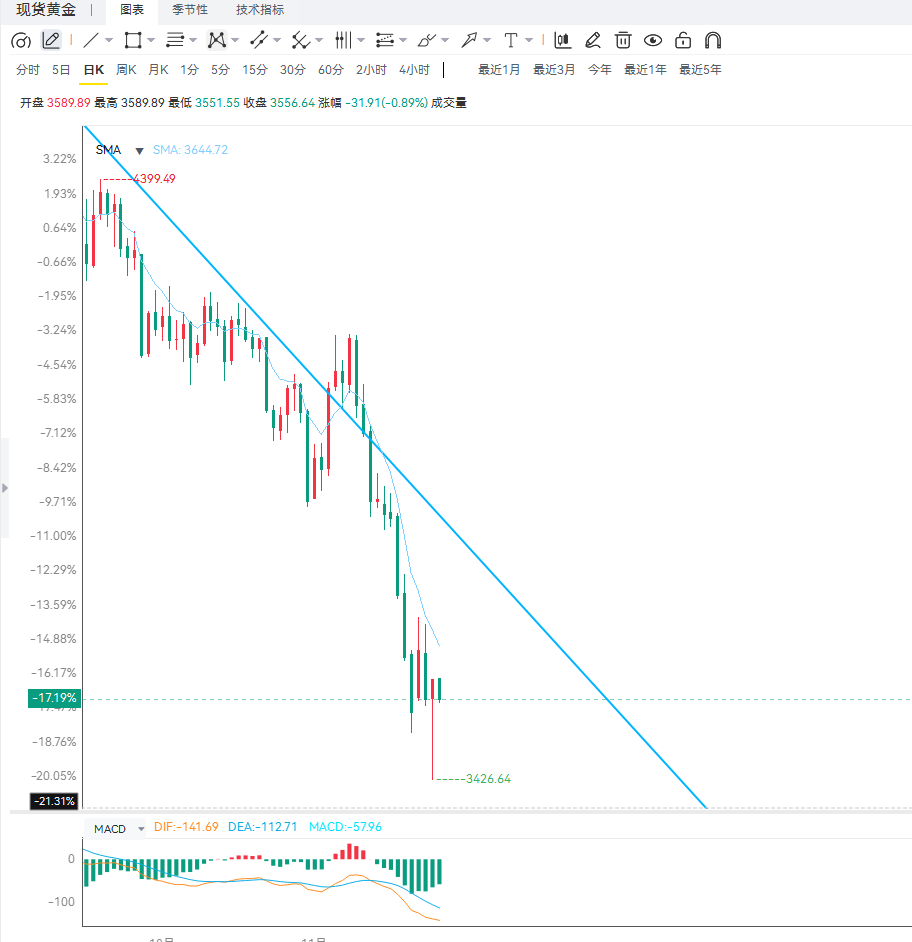 Editor's Summary: Gold prices recovered from their lows thanks to a pullback in US Treasury yields and the dollar, but stronger-than-expected core PCE inflation has raised expectations of a Fed rate hike, creating significant upside pressure. Institutions warn of substantial short-term downside risks, while also noting that a cooling of rate hike expectations could present a medium-term recovery opportunity for gold. Technically, the downtrend remains intact, and indicators nearing oversold levels present short-term trading opportunities. The sustainability of the rebound depends on whether US Treasury yields and Fed expectations can further shift towards a dovish stance.
However, inflation data has re-anchored the Fed's tightening path, limiting the upside potential for gold prices. The US BEA reported that the October PCE price index rose 3.8% year-on-year, in line with expectations; the core PCE rose 3.3% year-on-year, higher than the market expectation of 3.2%, reaching a new high since 2023, confirming that inflation remains sticky. After multiple inflation indicators consistently exceeded targets and officials continued to make hawkish statements, the market has regarded a 25 basis point rate hike in December as almost a certainty. Gold itself does not generate interest, and the rising interest rate cycle will exert downward pressure on gold prices in the medium to long term. Commerzbank gave a medium- to long-term scenario assessment: if there is no significant rebound before the end of the year, gold is likely to record its largest annual decline in 13 years. Currently, federal funds rate futures are already priced in up to three rate hikes by the middle of next year, which is the core negative factor suppressing gold prices. The bank also proposed a counter-argument: once the market begins to eliminate expectations of a third rate hike, gold prices are expected to recover; the US fiscal risks will also limit the Fed's room for continued rate hikes, maintaining an optimistic outlook in the medium to long term, predicting that gold prices will reach $4,100 by the end of 2027, at which point the market will begin trading expectations of a rate cut in 2028. Fed official Williams' speech maintained his consistent tone, with his FXS rating remaining stable at 6.2, emphasizing that there is still much work to be done to reach the 2% inflation target, and that inflation risks are skewed to the upside. While acknowledging stable employment and limited signs of inflation spread, the overall message was that "high interest rates will be maintained for longer." The FXS Fed sentiment index rose to 152.49, remaining in hawkish territory, supporting the dollar and fundamentally limiting the extent of any gold rebound. On the daily chart, the short-term bearish pattern for XAU/USD remains unchanged, with the price deeply below the 100-day moving average and the Bollinger middle band. These two indicators together create heavy supply pressure above, making any rebound likely to be met with resistance. The current price is closer to the lower Bollinger Band, and the 14-period RSI is around 32, indicating continued selling pressure and a gradual move into oversold territory. This level could trigger a short-term rebound, but simply being oversold in indicators does not equate to a trend reversal. The first resistance level is $3660, followed by the area around $3730, forming a cluster of resistance. For gold to reverse its downtrend, it needs to consistently break above this area. The key support level is the lower Bollinger Band at $3490. A decisive break below this level would allow the bears to regain control and open up further downside potential. The 4-hour chart shows a low-level consolidation after the decline; the current rebound is a short-term correction following the realization of negative news, not a trend reversal. Until the price breaks above the moving average resistance zone, this rebound is more accurately described as a consolidation within a weak market. We should remain wary of renewed selling pressure driven by rising inflation expectations. Editor's Summary: Gold prices recovered from their lows thanks to a pullback in US Treasury yields and the dollar, but stronger-than-expected core PCE inflation has raised expectations of a Fed rate hike, creating significant upside pressure. Institutions warn of substantial short-term downside risks, while also noting that a cooling of rate hike expectations could present a medium-term recovery opportunity for gold. Technically, the downtrend remains intact, and indicators nearing oversold levels present short-term trading opportunities. The sustainability of the rebound depends on whether US Treasury yields and Fed expectations can further shift towards a dovish stance.
- Risk Warning and Disclaimer
- The market involves risk, and trading may not be suitable for all investors. This article is for reference only and does not constitute personal investment advice, nor does it take into account certain users’ specific investment objectives, financial situation, or other needs. Any investment decisions made based on this information are at your own risk.