Crude oil trading alert: Geopolitical shocks provide temporary support, but supply recovery and inventory pressure limit the extent of the price rebound.
2026-11-26 09:26:34
On Thursday during Asian trading hours, US crude oil traded around $84.20, with geopolitical news providing short-term support. The Houthi rebels in Yemen claimed responsibility on Wednesday for an attack on Saudi Arabia's Ras al-Stanura refinery—the country's largest refining facility—while also targeting Riyadh's financial district. A UK maritime trading agency also reported an explosion near an oil tanker about 50 nautical miles west of Dubai. These attacks on key Middle Eastern oil processing and shipping points have heightened market concerns about disruptions to the energy supply chain, injecting a temporary risk premium into oil prices and pushing them back up to around $84.16. However, most institutions believe that Gulf states have already established alternative solutions such as detours and ship-to-ship transshipment, limiting the impact of a single attack on actual crude oil export flows.  Inventory data continues to reflect ample US crude oil supply. For the week ending November 20, the EIA reported a crude oil inventory increase of 1.109 million barrels, a significant narrowing from the previous week's 3.38 million barrel increase, but still indicating continued inventory accumulation. The head of Mizuho Energy Futures explained that the inventory rise was mainly due to weakening crude oil exports and increased imports. Earlier API data showed a lower-than-expected inventory increase, which somewhat eased pessimistic sentiment but did not change the overall trend of inventory accumulation. ING's strategy team pointed out that supply recovery is continuously offsetting shipping lane safety risks. Oil prices opened more than 1% lower in early trading, with Brent falling to around $90 and WTI approaching $80. Iran claimed that at least six oil tankers had been targeted since Tuesday and threatened to tighten control over waterways, but Persian Gulf exports steadily recovered, easing market panic over an immediate supply disruption. The futures curve also confirms this shift in expectations, with the November contract price spread turning into a premium of approximately $1.20, compared to a deep discount of $5 to $7 just a month ago, indicating a rapid decline in the shortage premium. Market focus has shifted to Sunday's OPEC+ meeting, where parties will finalize the 2027 production policy. The UAE is no longer bound by group production quotas, and Iraq continues to seek to expand its production capacity. Differences in member states' demands may complicate negotiations on new production baselines and production cut arrangements, increasing medium-term supply variables in the oil market. On the daily chart, WTI maintains a short-term weak structure, currently priced at $84.16. Prices continue to be pressured below the 100-day moving average and the 20-period Bollinger Band middle line. These two moving averages form a dense supply area above, making any rebound likely to encounter resistance and fall back. The 14-period RSI is at 41.21, in a neutral to weak range, indicating that bearish momentum is still being released, but it has not reached extreme oversold levels, and a period of consolidation and correction cannot be ruled out. The first resistance level is the Bollinger Middle Band at $87.85, followed by the 100-day moving average at $88.05. These two levels combined form a strong resistance ceiling. The next resistance level is the Bollinger Upper Band at $100.25. The primary support level is the Bollinger Lower Band at $75.50. If the bears continue their upward momentum, this level could be a potential support zone. Until the price stabilizes above the moving average resistance zone, the short-term outlook remains bearish. The 4-hour chart shows a weak, oscillating pattern. The current price of $84.16 is a correction after the decline, with geopolitical news triggering a brief upward surge, but its sustainability is weak. Ahead of the OPEC+ meeting, funds are likely to be cautious, and volatility is likely to converge temporarily. A directional breakout may occur after the meeting concludes.
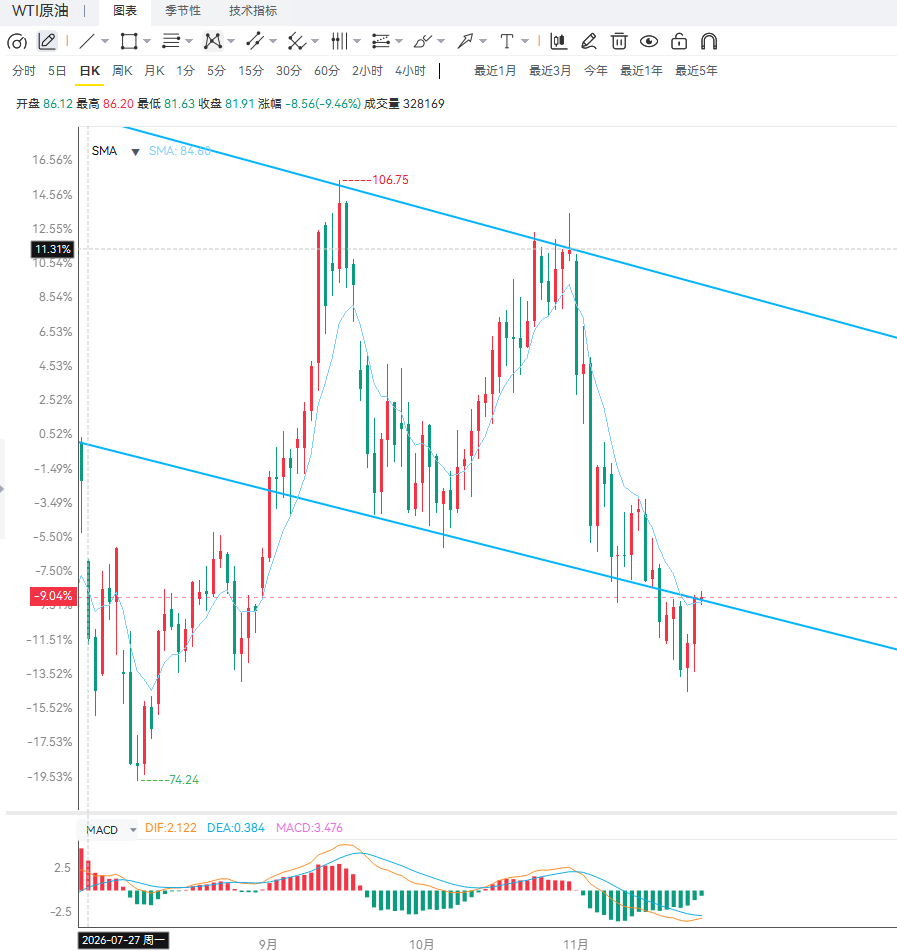 Editor's Summary: Crude oil is currently in a tug-of-war between geopolitical risk premiums and loose supply and demand. News of attacks in the Middle East brought a short-term rebound, with oil prices rising to around $84.16. However, the recovery of Gulf exports, the accumulation of US inventories, and the futures curve turning to a premium are collectively suppressing the upward potential of oil prices. Disagreements within OPEC+ regarding production increases add uncertainty to the market outlook. Technically, the bearish framework remains intact, with concentrated resistance above. Before a decisive break above the moving average resistance, the rebound is more accurately interpreted as a correction within a weak consolidation pattern.
Inventory data continues to reflect ample US crude oil supply. For the week ending November 20, the EIA reported a crude oil inventory increase of 1.109 million barrels, a significant narrowing from the previous week's 3.38 million barrel increase, but still indicating continued inventory accumulation. The head of Mizuho Energy Futures explained that the inventory rise was mainly due to weakening crude oil exports and increased imports. Earlier API data showed a lower-than-expected inventory increase, which somewhat eased pessimistic sentiment but did not change the overall trend of inventory accumulation. ING's strategy team pointed out that supply recovery is continuously offsetting shipping lane safety risks. Oil prices opened more than 1% lower in early trading, with Brent falling to around $90 and WTI approaching $80. Iran claimed that at least six oil tankers had been targeted since Tuesday and threatened to tighten control over waterways, but Persian Gulf exports steadily recovered, easing market panic over an immediate supply disruption. The futures curve also confirms this shift in expectations, with the November contract price spread turning into a premium of approximately $1.20, compared to a deep discount of $5 to $7 just a month ago, indicating a rapid decline in the shortage premium. Market focus has shifted to Sunday's OPEC+ meeting, where parties will finalize the 2027 production policy. The UAE is no longer bound by group production quotas, and Iraq continues to seek to expand its production capacity. Differences in member states' demands may complicate negotiations on new production baselines and production cut arrangements, increasing medium-term supply variables in the oil market. On the daily chart, WTI maintains a short-term weak structure, currently priced at $84.16. Prices continue to be pressured below the 100-day moving average and the 20-period Bollinger Band middle line. These two moving averages form a dense supply area above, making any rebound likely to encounter resistance and fall back. The 14-period RSI is at 41.21, in a neutral to weak range, indicating that bearish momentum is still being released, but it has not reached extreme oversold levels, and a period of consolidation and correction cannot be ruled out. The first resistance level is the Bollinger Middle Band at $87.85, followed by the 100-day moving average at $88.05. These two levels combined form a strong resistance ceiling. The next resistance level is the Bollinger Upper Band at $100.25. The primary support level is the Bollinger Lower Band at $75.50. If the bears continue their upward momentum, this level could be a potential support zone. Until the price stabilizes above the moving average resistance zone, the short-term outlook remains bearish. The 4-hour chart shows a weak, oscillating pattern. The current price of $84.16 is a correction after the decline, with geopolitical news triggering a brief upward surge, but its sustainability is weak. Ahead of the OPEC+ meeting, funds are likely to be cautious, and volatility is likely to converge temporarily. A directional breakout may occur after the meeting concludes. Editor's Summary: Crude oil is currently in a tug-of-war between geopolitical risk premiums and loose supply and demand. News of attacks in the Middle East brought a short-term rebound, with oil prices rising to around $84.16. However, the recovery of Gulf exports, the accumulation of US inventories, and the futures curve turning to a premium are collectively suppressing the upward potential of oil prices. Disagreements within OPEC+ regarding production increases add uncertainty to the market outlook. Technically, the bearish framework remains intact, with concentrated resistance above. Before a decisive break above the moving average resistance, the rebound is more accurately interpreted as a correction within a weak consolidation pattern.
- Risk Warning and Disclaimer
- The market involves risk, and trading may not be suitable for all investors. This article is for reference only and does not constitute personal investment advice, nor does it take into account certain users’ specific investment objectives, financial situation, or other needs. Any investment decisions made based on this information are at your own risk.