The Bank of England's hawkish stance, aimed at offsetting US inflationary pressures, kept the pound low against the dollar.
2026-11-26 14:02:36
Bank of England Governor Bailey, Deputy Governor Lombardy, and External Committee member Mann collectively stated on Wednesday that the inflationary risks posed by high energy prices cannot be ignored. They emphasized that unless the situation in the Middle East eases rapidly and energy costs fall, the central bank will need to take further tightening measures. Bailey's speech received an FXS rating of 8.4, significantly higher than his historical average of 7.1, indicating strong market influence. He also pointed out that the UK economy's resilience has improved and the pace of cooling in the labor market has slowed, weakening the logic for an early rate cut. Scotiabank added that Committee member Green also signaled tightening, with swap pricing implying a rate hike of approximately 19 basis points at the December 17th meeting, consistent with the officials' statements.  Supported by inflation expectations, the pound sterling has shown signs of stabilization after its previous sharp decline. Analysts believe that the earlier drop in GBP/USD has been largely priced in, with the price returning above 1.31, but the rebound lacks sustainability. To further open up upward space, it needs to hold above the 1.3110-1.3120 range and then advance towards 1.32. On the other hand, US inflation data continues to support the dollar. October PCE rose 3.8% year-on-year, and core PCE rose 3.3% year-on-year, higher than expected, confirming sticky inflation, and the market continues to price in a Fed rate hike in December. The simultaneous rise in rate hike expectations in both the US and UK creates a hedge, which is the core reason why GBP/USD is stuck in a narrow trading range. Coupled with the US Thanksgiving holiday, trading activity has decreased, short-term signals are less reliable, and funds tend to wait for new catalysts after the holiday. On the daily chart, GBP/USD maintains a short-term bearish bias, with the price trading below the 20-period Bollinger Band middle line and the 100-day moving average, while also far from the upper Bollinger Band. The price is currently oscillating in the lower half of its current trading range. The 14-period RSI is at 39, indicating some easing of bearish momentum, but it hasn't reached extreme oversold levels and doesn't necessarily signal a trend reversal. On the upside, the first resistance level is the Bollinger Band middle line at 1.3255; a decisive break above this level would alleviate short-term downward pressure. Subsequent strong resistance levels are the 100-day moving average at 1.3380 and the upper Bollinger Band at 1.3535. On the downside, the lower Bollinger Band at 1.2975 is a key support level; a break below this level would strengthen the bearish structure and open up further downside potential. The 4-hour chart shows a low-level consolidation pattern with balanced bullish and bearish forces. During the holiday break, the price is likely to remain within a narrow range, and a directional breakout will require confirmation from post-holiday liquidity recovery and new data releases.
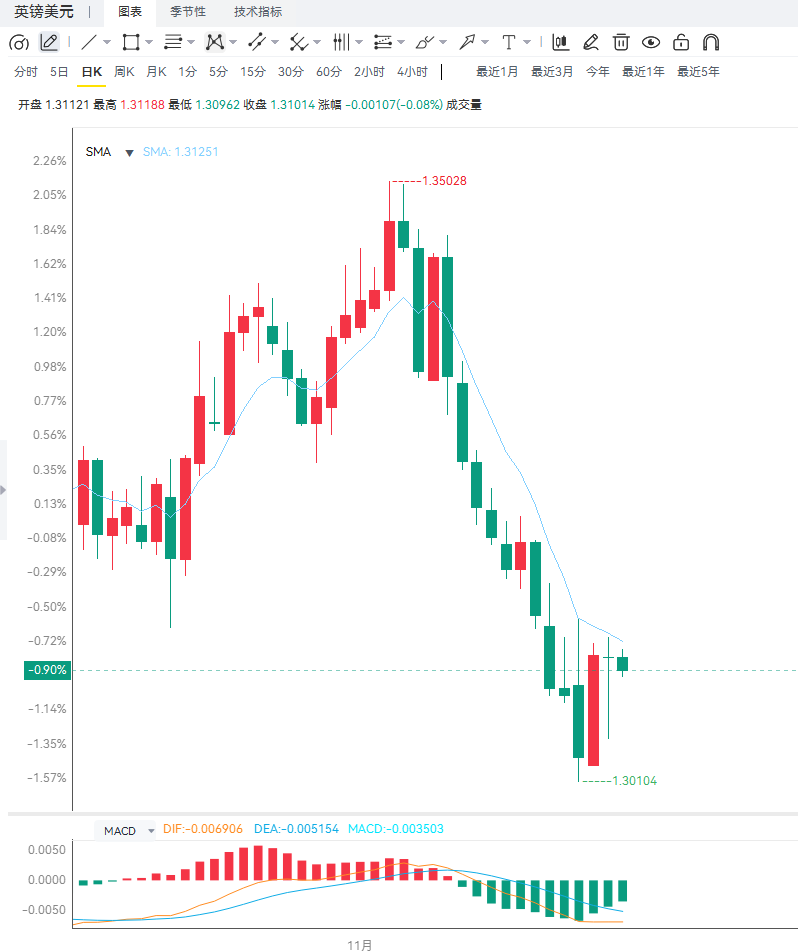 Editor's Summary: The GBP/USD pair is currently in a state of equilibrium, with expectations of interest rate hikes from both central banks offsetting each other. The Bank of England's concerns about energy inflation are providing support for the pound, while US inflation data is limiting the dollar's rebound. Holiday liquidity tightening is suppressing market volatility, and short-term trading is expected to be range-bound. Technically, the bearish framework remains intact; only a firm hold above the Bollinger Band's middle line could reverse the short-term weakness.
Supported by inflation expectations, the pound sterling has shown signs of stabilization after its previous sharp decline. Analysts believe that the earlier drop in GBP/USD has been largely priced in, with the price returning above 1.31, but the rebound lacks sustainability. To further open up upward space, it needs to hold above the 1.3110-1.3120 range and then advance towards 1.32. On the other hand, US inflation data continues to support the dollar. October PCE rose 3.8% year-on-year, and core PCE rose 3.3% year-on-year, higher than expected, confirming sticky inflation, and the market continues to price in a Fed rate hike in December. The simultaneous rise in rate hike expectations in both the US and UK creates a hedge, which is the core reason why GBP/USD is stuck in a narrow trading range. Coupled with the US Thanksgiving holiday, trading activity has decreased, short-term signals are less reliable, and funds tend to wait for new catalysts after the holiday. On the daily chart, GBP/USD maintains a short-term bearish bias, with the price trading below the 20-period Bollinger Band middle line and the 100-day moving average, while also far from the upper Bollinger Band. The price is currently oscillating in the lower half of its current trading range. The 14-period RSI is at 39, indicating some easing of bearish momentum, but it hasn't reached extreme oversold levels and doesn't necessarily signal a trend reversal. On the upside, the first resistance level is the Bollinger Band middle line at 1.3255; a decisive break above this level would alleviate short-term downward pressure. Subsequent strong resistance levels are the 100-day moving average at 1.3380 and the upper Bollinger Band at 1.3535. On the downside, the lower Bollinger Band at 1.2975 is a key support level; a break below this level would strengthen the bearish structure and open up further downside potential. The 4-hour chart shows a low-level consolidation pattern with balanced bullish and bearish forces. During the holiday break, the price is likely to remain within a narrow range, and a directional breakout will require confirmation from post-holiday liquidity recovery and new data releases. Editor's Summary: The GBP/USD pair is currently in a state of equilibrium, with expectations of interest rate hikes from both central banks offsetting each other. The Bank of England's concerns about energy inflation are providing support for the pound, while US inflation data is limiting the dollar's rebound. Holiday liquidity tightening is suppressing market volatility, and short-term trading is expected to be range-bound. Technically, the bearish framework remains intact; only a firm hold above the Bollinger Band's middle line could reverse the short-term weakness.
- Risk Warning and Disclaimer
- The market involves risk, and trading may not be suitable for all investors. This article is for reference only and does not constitute personal investment advice, nor does it take into account certain users’ specific investment objectives, financial situation, or other needs. Any investment decisions made based on this information are at your own risk.