Funds fleeing the AI sector are flowing into India. Is the pullback in the Indian rupee just a temporary pause?
2026-11-26 15:30:33
On Thursday (November 26), during the European session, the US dollar fluctuated slightly higher against the Indian rupee, recovering from an eight-month low of 92.17 reached around 92.50. However, the market believes that this correction is likely short-term, and continued inflows of foreign capital into the Indian stock market are expected to drive the rupee stronger again. On Wednesday, foreign institutional investors (FIIs) made net purchases of 447.908 billion rupees; they maintained net purchases on all full trading days in November, with a cumulative investment of 12,210.146 billion rupees. 
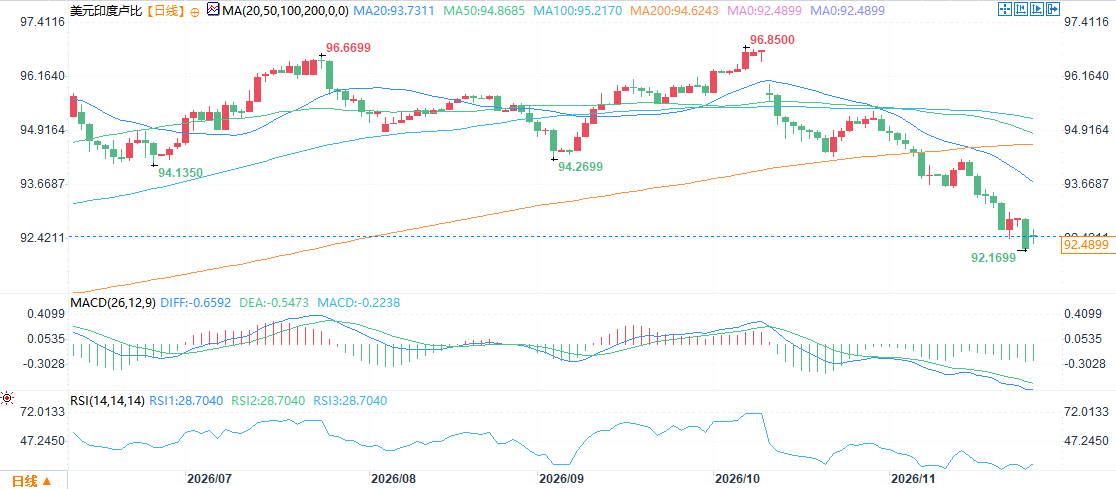 (USD/INR daily chart, source: FX678) At 15:25 Beijing time, the USD/INR exchange rate was 92.48/49.
Funding Logic: Global funds are rotating from sector A to the Indian market.
A recent analysis by Brown Brothers Harriman (BBH) indicates that global funds are gradually withdrawing from the highly concentrated AI trading theme and shifting towards new allocation directions. Technology stocks are under pressure due to valuation corrections related to AI, while the global bond market is strengthening due to risk aversion and adjustments in interest rate expectations. Against this backdrop, Indian stock indices, with their relatively low exposure to the AI sector, have become an important safe haven for overseas institutions to reposition. On Wednesday, foreign institutional investors (FIIs) made net purchases of 447.908 billion rupees, maintaining a net buying status on every full trading day in November, with a cumulative total of 12,210.146 billion rupees, fully demonstrating the continued favor of funds towards the Indian market. However, risks also exist. The news of Nvidia CEO's reinstatement led to a Nasdaq rebound; if the global AI market recovers again, foreign investors' enthusiasm for allocating to Indian assets may be temporarily weakened. During the US Thanksgiving holiday, US stock futures rose further overnight, also indicating that global risk appetite remains uncertain. Overall, as long as the pace of capital inflows into AI-themed markets slows, India's relative advantage as a market with "high exposure to non-AI" will continue to support the rupee's medium-term strength.PMI data demonstrates economic resilience, and inflation breaking out of its range opens up room for interest rate hikes.
Commerzbank's interpretation of the latest PMI data shows that the robust manufacturing sector in India has effectively offset the pressure from the slowdown in the service sector. New factory orders and output continue to improve, with strong demand in the electronics, chemicals, metals, and infrastructure-related industries. Export orders have also improved, reflecting the dual support from both domestic and external demand. Although input cost inflation is generally moderate and price increases are weaker than historical levels, the survey data did not fully cover the recent shocks in food and energy prices. India's October CPI rose to 6.1% year-on-year, exceeding the upper limit of the central bank's 2%-6% target range. While economic growth remains resilient, inflation is rebounding, providing clear room for monetary policy tightening. Following the 25 basis point rate hike to 5.50% in October, Commerzbank expects the Reserve Bank of India to raise rates again by 25 basis points at its December 4th policy meeting, pushing the policy rate to 5.75%. This policy orientation of "growth first, inflation control" is expected to further strengthen the rupee's interest rate support logic.Market Outlook: Capital Inflows and Interest Rate Hike Expectations Provide Dual Support
The USD/INR exchange rate has rebounded from an eight-month low yesterday to around 92.50, showing a short-term correction. The market generally believes this pullback is likely short-term and unlikely to change the rupee's overall strong medium-term trend. Continued foreign capital inflows into the stock market, coupled with expectations of a potential interest rate hike by the Reserve Bank of India (RBI), will jointly limit the rupee's depreciation potential. Two key variables need to be monitored: first, whether global AI sector fund flows will intensify again, diverting foreign investment from the Indian market; and second, the specific statements and the magnitude of the interest rate hike in the RBI's monetary policy decision in early December. If the RBI raises interest rates as expected and signals continued tightening, coupled with continued net foreign buying, the USD/INR exchange rate is expected to come under renewed downward pressure after the correction. Conversely, if global risk appetite recovers rapidly or Indian inflation data deteriorates more than expected, the current rebound cycle may be prolonged. Overall, capital inflows and policy expectations continue to provide dual support for the rupee. (USD/INR daily chart, source: FX678) At 15:25 Beijing time, the USD/INR exchange rate was 92.48/49.
- Risk Warning and Disclaimer
- The market involves risk, and trading may not be suitable for all investors. This article is for reference only and does not constitute personal investment advice, nor does it take into account certain users’ specific investment objectives, financial situation, or other needs. Any investment decisions made based on this information are at your own risk.