The asymmetric depletion between the US and Iran has raised the central level of oil prices, but the potential for a significant increase is limited.
2026-11-26 16:16:36
The Middle East conflict has entered a new equilibrium phase, with the market pricing in a long-term attrition relationship between the US and Iran. Short-term attack news continues to disrupt the market, and the balance between bullish and bearish logic remains. 
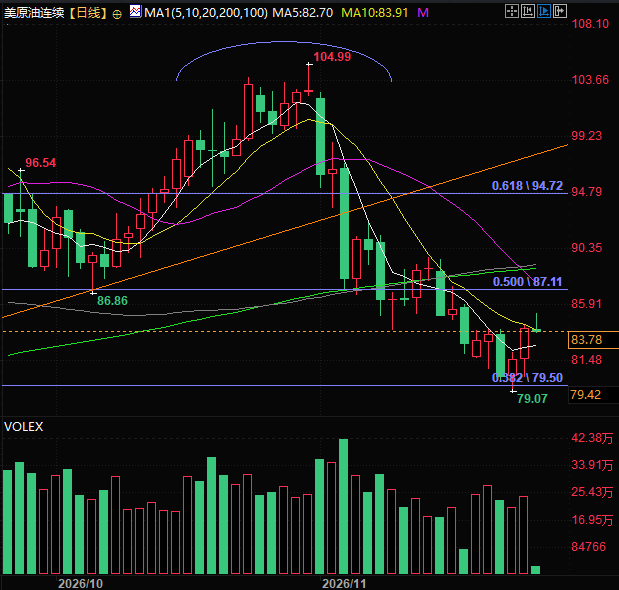 (WTI crude oil daily chart, source: EasyForex) At 16:14 Beijing time, the WTI crude oil futures contract is currently trading at $84.08 per barrel.
Market Movements: Oil prices rebounded in early Asian trading as oversupply expectations faced challenges.
Recent attacks in the Strait of Hormuz, coupled with Houthi attacks on Saudi ports and refining facilities, led to a rebound in crude oil prices in early Asian trading, breaking the previous days' decline suppressed by expectations of oversupply. As of the time of the news release, Brent crude was trading at $94.45 per barrel, and WTI crude was around $83.86 per barrel, with trading funds beginning to reprice the risk of supply disruptions along Middle Eastern shipping routes. The turning point in this round of market movements stemmed from the frequent tanker mine-related incidents in the Strait of Hormuz. Attacks on ships in the strait have become almost commonplace recently, with multiple incidents occurring in a single day. Data from shipping tracking agency Kpler shows that the average daily outbound crude oil shipments from the Persian Gulf have declined, and regional crude oil exports are significantly lower than before the US-Israel attacks on Iran at the end of February, continuously weakening the mainstream narrative of "oversupply" in the market. The market is gradually adapting to this new normal of strategic maneuvering: the conflict will not end quickly, and geopolitical risks will be embedded in pricing for a long time.Conflict spillover: Houthi attacks on key Saudi oil and gas nodes
The conflict chain continues to spread outwards. The Houthi rebels have been active recently, first attacking the Ras Tanura oil refinery in Saudi Arabia—the largest oil refining facility in the country, located on the Persian Gulf coast and a key crude oil export hub; then announcing two rounds of attacks on the ports of Jeddah and Jizan in response to the coalition airstrikes on the port of Hodeidah, and vowing immediate retaliation against the attack on Hodeidah. These successive attacks on refining and port nodes serve as a reminder to the trading market that the prospects for peace in the Middle East are bleak, and the conflict could escalate in stages. Meanwhile, Gulf oil-producing countries also have clear concerns: a sustained and significant rise in oil prices would suppress global crude oil demand, erode their own long-term profits, and accelerate the global energy substitution process. Therefore, there are implicit constraints among all parties to prevent the situation from spiraling out of control. To protect its domestic energy assets, the UAE has also implemented control measures, imposing restrictions on passage through the waters under the jurisdiction of the Abu Dhabi National Oil Company. Crude oil and refined oil tankers are prohibited from entering the waters near the Ruwais refining area and the Das Island loading terminal without approval. Water controls directly increase uncertainty in Gulf shipping, shipping costs, and insurance premiums, becoming variables that need to be continuously monitored in crude oil trading.Standoff: The US and Iran are locked in a war of attrition, with Iran under pressure but refusing to compromise.
At the level of great power rivalry, the US and Iran are locked in a high-intensity standoff. The US continues to escalate financial sanctions against Iran, and the number of ships attacked in the Strait of Hormuz has reached a high point since the start of this conflict. However, both sides are avoiding a full-scale war, maintaining a stalemate of "neither war nor peace." Iran has stated it is not afraid of a maritime blockade and is striving to stabilize domestic prices by activating other border crossings to divert goods and stockpiling strategic materials. Although domestic inflationary pressures in Iran remain high—with the October CPI rising 88.7% year-on-year and food and beverage prices soaring 112.6% year-on-year—Iran possesses strong long-term resilience thanks to its food security, barter trade, and priority supply from its military-industrial complex. It can sustain itself under sanctions and high inflation and will not easily concede on the nuclear issue. On the US side, although the January military spending deadline is approaching, it does not mean the blockade will end immediately. The US can maintain the basic posture of the blockade through internal allocation of baseline military spending and resource reallocation; however, the cost pressure of a sustained high-intensity blockade will gradually become apparent. Iran's strategy is to create threats intermittently: launching attacks on ships in the Strait of Hormuz from time to time, relying on proxies such as the Houthis to exert pressure, continuously depleting US resources, while actively controlling the intensity to avoid triggering a full-scale war.Institutional View: Inventory Logic and Geopolitical Risks Create a Tug-of-War
There is a clear divergence of opinion among institutions and analysts. ANZ analysts believe that the spread of the conflict may disrupt the recent recovery in crude oil circulation. Although Persian Gulf crude oil exports rebounded slightly last week, the overall downward trend has not been reversed. Energy analyst John Kemp points out that while global crude oil inventories did rise in October, the increase is highly dependent on the US-led maritime blockade and ship transshipment. This control scheme is costly and unsustainable in the medium to long term, both financially and practically.Trading theme: Oil prices are rising under the new normal, but there is a ceiling to the upside potential.
From a trading perspective, the current crude oil market is driven by two main themes: on one hand, previously priced-in global inventory increases and expectations of ample supply are suppressing oil price increases; on the other hand, frequent attacks on shipping lanes and port facilities, along with tightening maritime controls by oil-producing countries, are continuously pushing up geopolitical risk premiums. In the long term, multiple forces are consolidating a sustained surge in oil prices: high oil prices could trigger a global economic contraction, suppressing crude oil demand; and the ongoing green energy reforms in economies like Europe mean that long-term pressure for energy substitution remains. Ultimately, a stable state is more likely: the central oil price will be higher than before the conflict, but the upside potential will be limited, with mainly pulse-like disturbances and wide-range fluctuations. The key point to observe in the subsequent market is not the news of a single attack, but whether the outbound flow of Persian Gulf crude oil can continue to decline and whether the operational status of major export hubs is damaged. Once the efficiency of shipping lanes substantially declines, the upward elasticity of oil prices will open up in stages. Technical Analysis: Oil prices found support near the 0.382 Fibonacci retracement level, forming a bottoming pattern on the daily chart. A reversal of the downtrend is now possible, with 82 being a key support level in the near term. However, it's worth noting that oil prices have not yet reached the minimum measured move of the 70-point head and shoulders pattern. (WTI crude oil daily chart, source: EasyForex) At 16:14 Beijing time, the WTI crude oil futures contract is currently trading at $84.08 per barrel.- Risk Warning and Disclaimer
- The market involves risk, and trading may not be suitable for all investors. This article is for reference only and does not constitute personal investment advice, nor does it take into account certain users’ specific investment objectives, financial situation, or other needs. Any investment decisions made based on this information are at your own risk.