Hawkish signals from the Bank of England provided support, extending the pound's rebound against the dollar.
2026-11-27 15:20:36
The hawkish stance of Bank of England officials was the core driver of the pound's short-term recovery. Three key members of the board—Bayley, Lombardy, and Mann—spoke publicly on Wednesday, emphasizing the potential impact of energy risks on inflation. Bailey further added that if international energy prices remain at current levels, UK inflation may not rise as sharply as predicted earlier this month. FXS's speech tracking tool gave Bailey's speech a high score of 8.4, significantly higher than the historical average of 7.1, releasing a stronger policy signal than usual. He emphasized the resilience of the UK economy and that the labor market is no longer experiencing a sustained cooling; however, he also warned that if energy prices remain high, interest rates are "more likely to rise further." Bailey also mentioned that while oil shipments through the Channel have recovered somewhat, the future situation remains uncertain, and he expressed reservations about the overly optimistic energy futures curve, reinforcing his assessment of the upside risks to inflation. The resilience of the domestic economy, coupled with the potential inflationary threat from the energy sector, jointly supports market expectations that the Bank of England will maintain high interest rates or even raise rates again.  However, the pound bulls also face strong resistance from the dollar. US core PCE inflation remained high in October, while Q3 GDP data was revised upwards, confirming the resilience of the US economy. The market has almost fully priced in the Fed's 25 basis point rate hike on December 9th. The expectation of continued Fed tightening is supporting the dollar, limiting the upside potential of the pound/dollar pair. With both the UK and US central banks potentially raising rates, these expectations are offsetting each other, making it difficult for the pound/dollar pair to break out of a one-sided trend, instead exhibiting a range-bound trading pattern. UOB stated in its latest research report that the previously expected moderate rise in the pound has not materialized, with the exchange rate recently fluctuating quietly within a narrow range of 1.3096-1.3122, and various momentum indicators remaining largely flat. The bank judges that GBP/USD will likely trade within the 1.3085-1.3130 range today. Looking at a longer timeframe of 1-3 weeks, the original view remains unchanged: the previous weeks-long decline in the pound has likely come to an end, and the exchange rate is expected to oscillate within a wide range of 1.3025-1.3215. As the weekend approaches, market funds will avoid overly aggressive positions, awaiting further macroeconomic events for directional confirmation. On the daily chart, GBP/USD maintains a short-term bearish bias, with the price trading below the 100-day simple moving average and the 20-day Bollinger Band middle line, in the lower half of its recent trading range. The 14-day RSI reading is around 40, reflecting weak momentum and the presence of bearish forces, but it has not yet reached oversold levels, and therefore does not indicate an immediate reversal. The upper resistance levels are clear: the first resistance is the 20-day Bollinger Band middle line at 1.3240; the key strong resistance is the 100-day moving average at 1.3375; only a successful break above this level could lead to a further test of the upper Bollinger Band at 1.3520. The first support level is the November 23 low at 1.3010; followed by the lower Bollinger Band at 1.2965, which is likely to attract short-selling profit-taking; if the price continues to break below 1.2965, it will open up further downside potential, targeting the March 27, 2025 low of 1.2871. The 4-hour chart shows a low-level consolidation pattern, with prices fluctuating within a range without clearly defined highs or lows, indicating a sideways market. A fundamental catalyst is needed to break through the upper and lower boundaries to confirm the start of a new trend.
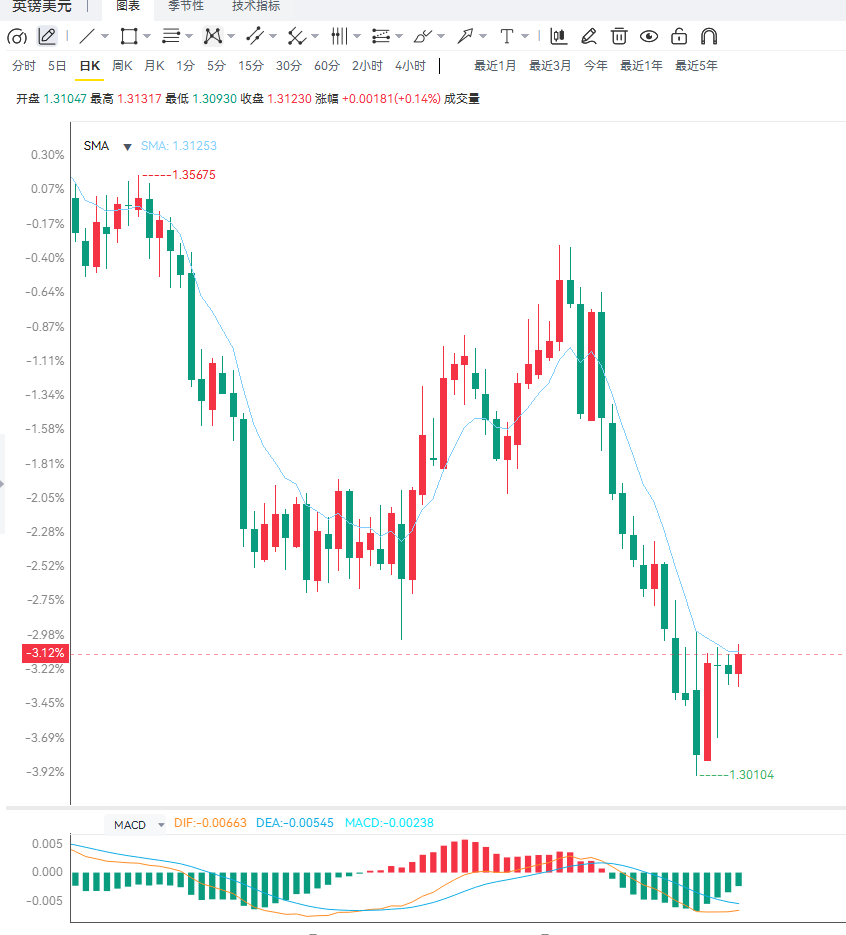 Editor's Summary: The pound rose slightly against the dollar, boosted by hawkish comments from Bank of England officials, recovering slightly near 1.3125. UK energy inflation risks increased the probability of a December rate hike, but US inflation and economic data also solidified expectations of a Fed rate hike, limiting the pound's rebound. Analysts predict short-term trading will be range-bound, with the overall daily downtrend remaining intact. Significant resistance lies at 1.3240-1.3375, while the key support level to watch is the 1.3010 support level.
However, the pound bulls also face strong resistance from the dollar. US core PCE inflation remained high in October, while Q3 GDP data was revised upwards, confirming the resilience of the US economy. The market has almost fully priced in the Fed's 25 basis point rate hike on December 9th. The expectation of continued Fed tightening is supporting the dollar, limiting the upside potential of the pound/dollar pair. With both the UK and US central banks potentially raising rates, these expectations are offsetting each other, making it difficult for the pound/dollar pair to break out of a one-sided trend, instead exhibiting a range-bound trading pattern. UOB stated in its latest research report that the previously expected moderate rise in the pound has not materialized, with the exchange rate recently fluctuating quietly within a narrow range of 1.3096-1.3122, and various momentum indicators remaining largely flat. The bank judges that GBP/USD will likely trade within the 1.3085-1.3130 range today. Looking at a longer timeframe of 1-3 weeks, the original view remains unchanged: the previous weeks-long decline in the pound has likely come to an end, and the exchange rate is expected to oscillate within a wide range of 1.3025-1.3215. As the weekend approaches, market funds will avoid overly aggressive positions, awaiting further macroeconomic events for directional confirmation. On the daily chart, GBP/USD maintains a short-term bearish bias, with the price trading below the 100-day simple moving average and the 20-day Bollinger Band middle line, in the lower half of its recent trading range. The 14-day RSI reading is around 40, reflecting weak momentum and the presence of bearish forces, but it has not yet reached oversold levels, and therefore does not indicate an immediate reversal. The upper resistance levels are clear: the first resistance is the 20-day Bollinger Band middle line at 1.3240; the key strong resistance is the 100-day moving average at 1.3375; only a successful break above this level could lead to a further test of the upper Bollinger Band at 1.3520. The first support level is the November 23 low at 1.3010; followed by the lower Bollinger Band at 1.2965, which is likely to attract short-selling profit-taking; if the price continues to break below 1.2965, it will open up further downside potential, targeting the March 27, 2025 low of 1.2871. The 4-hour chart shows a low-level consolidation pattern, with prices fluctuating within a range without clearly defined highs or lows, indicating a sideways market. A fundamental catalyst is needed to break through the upper and lower boundaries to confirm the start of a new trend. Editor's Summary: The pound rose slightly against the dollar, boosted by hawkish comments from Bank of England officials, recovering slightly near 1.3125. UK energy inflation risks increased the probability of a December rate hike, but US inflation and economic data also solidified expectations of a Fed rate hike, limiting the pound's rebound. Analysts predict short-term trading will be range-bound, with the overall daily downtrend remaining intact. Significant resistance lies at 1.3240-1.3375, while the key support level to watch is the 1.3010 support level.
- Risk Warning and Disclaimer
- The market involves risk, and trading may not be suitable for all investors. This article is for reference only and does not constitute personal investment advice, nor does it take into account certain users’ specific investment objectives, financial situation, or other needs. Any investment decisions made based on this information are at your own risk.