The Indian rupee is caught in a battle between bulls and bears: oil prices are hit by headwinds, while foreign capital inflows and expectations of interest rate hikes provide support.
2026-11-27 16:00:36
On Friday (November 27) during the European session, the US dollar rose to around 92.80 against the Indian rupee. Escalating shipping tensions in the Strait of Hormuz drove up oil prices, putting pressure on the rupee, which is heavily reliant on oil imports. However, continued large-scale purchases of Indian stocks by foreign institutional investors (FIIs) limited the rupee's downside potential. The market is almost certain that the Reserve Bank of India (RBI) will raise the repurchase rate at its policy meeting next week, with a possibility of an even larger rate hike on December 4. 
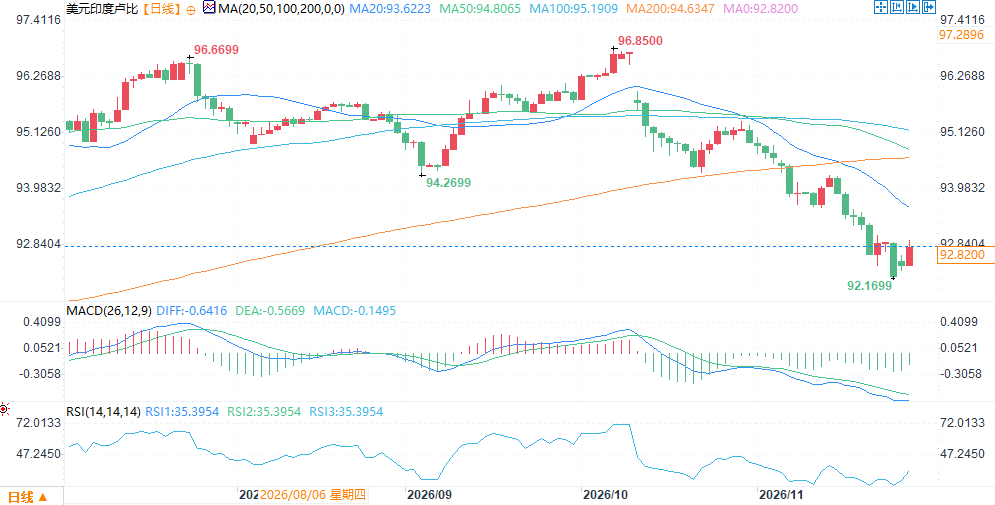 (USD/INR daily chart, source: FX678) At 15:40 Beijing time, the USD/INR exchange rate was 92.81/82.
Geopolitical risks in the Taiwan Strait boosted crude oil prices, putting pressure on the rupee, an import-intensive currency.
MCX crude oil futures contracts expiring on December 18th closed higher for the fourth consecutive trading day, rising 1.5% and approaching 8,000 rupees. Scotiabank strategists pointed out that this round of oil price increases is not a typical technical rebound; the ongoing news of potential Iranian attacks on oil tankers transiting the Strait of Hormuz has exacerbated market concerns about disruptions to this crucial global energy shipping route. India is highly dependent on crude oil imports, and rising oil prices will directly increase its import bill, creating a natural bearish factor for the rupee.Foreign capital continues to flow into the stock market, forming an important buffer for the rupee.
The negative factors are not one-sided. Overseas institutional funds continue to flow into the Indian stock market, limiting the rupee's depreciation. Since November, foreign institutional investors (FIIs) have maintained net buying on all full trading days, with a cumulative net purchase of 12,794.479 billion rupees. In terms of fund allocation logic, the Democratic victory in the US midterm elections and corporate governance issues at chip giant Nvidia have prompted some funds to withdraw from the booming global AI market and shift their focus to the Indian market.A rate hike by the Reserve Bank of India next week is almost a certainty, but there is a risk of an unexpected rate hike.
Deutsche Bank analysts stated that India's current CPI inflation has exceeded the tolerance range, and inflationary pressures are spreading. Even with the geopolitical crisis in West Asia, the actual economic growth rate is likely to remain above 7%, requiring the Reserve Bank of India to continue tightening monetary policy. According to media reports, the repo rate hike at the December 4th policy meeting represents the baseline scenario, and the market also faces the risk of a larger interest rate hike. This tightening of monetary policy is expected to provide policy support for the rupee.Summarize
Short-term geopolitical risks in the Strait of Hormuz and rising oil prices are the main negative factors for the rupee; however, foreign capital inflows into stocks and expectations of a central bank interest rate hike provide support, and the USD/IRR exchange rate is likely to remain range-bound. Going forward, key factors to monitor include oil price fluctuations, FII fund flows, and the final magnitude of the Reserve Bank of India's interest rate hike. (USD/INR daily chart, source: FX678) At 15:40 Beijing time, the USD/INR exchange rate was 92.81/82.- Risk Warning and Disclaimer
- The market involves risk, and trading may not be suitable for all investors. This article is for reference only and does not constitute personal investment advice, nor does it take into account certain users’ specific investment objectives, financial situation, or other needs. Any investment decisions made based on this information are at your own risk.