The resilience of shipping in the Hormuz exceeded expectations, while Iraqi crude oil delays disrupted spot prices.
2026-11-27 16:08:33
On Friday (November 27), during the Asian and European sessions, international oil futures prices, as a financial asset, rebounded along with a significant recovery in global risk appetite. Iraq's large-scale supply disruptions and the Houthi attack on the Saudi Jizan refinery further propelled the rebound in international oil prices. A flurry of Middle East geopolitical news, including the Straits attack on a ship, US-Iran mediation, regional defense agreements, and disruptions to crude oil supply, caused oil prices to fluctuate between geopolitical risks and physical supply and demand. 
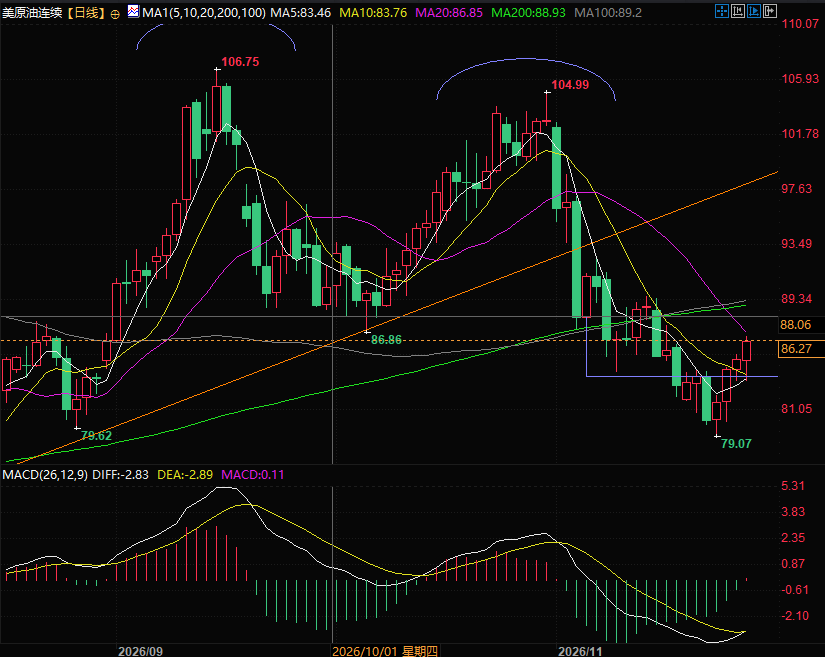 (WTI crude oil futures daily chart, source: EasyTrade) At 16:05 Beijing time, WTI crude oil futures are currently trading at $86.14 per barrel.
Despite frequent attacks on shipping lanes, tanker traffic has increased rather than decreased, while Iran's control of neighboring oil fields has raised costs.
Despite record-high numbers of ship attacks and minefield incidents in the Strait of Hormuz since the start of the current conflict, and escalating risks in the waterway, the total number of oil tankers passing through the strait has actually increased. Data from shipping agency Vortexa shows that from November 1st to 19th, the 7-day moving average of crude oil, refined oil, and LNG carriers remained stable at over 26 vessels per day, better than October's levels. The market has observed a significant adjustment in the shipping structure: VLCCs and Suezmax vessels are passing less, while Aframax medium and small tankers and converted LR2 refined oil tankers have become the mainstay, with transshipment by sea becoming the mainstream method for transporting crude oil from the Persian Gulf. However, the large number of ships disabling their AIS transponders, coupled with signal interference, makes accurate statistics on the actual volume difficult to obtain. The resilience of the shipping industry has, to some extent, offset market fears of supply disruptions. Meanwhile, Turkey has formally completed the approval of the Mecca Joint Defense Agreement, establishing a regional defense alliance, which will increase military costs and risks in the Gulf region. Furthermore, the Houthi attack on the Saudi Jizan oil refinery continues to divert oil and refined oil prices, contributing to energy inflation.Diplomatic channels remain open for communication, but expectations for US-Iran negotiations are fluctuating.
Despite the tense situation, diplomatic channels have not been closed, and a window for negotiation remains between the US and Iran. Iranian Foreign Minister Araqchi revealed that Qatar and Pakistan continue to act as mediators, relaying messages between the US and Iran, and several solutions are being discussed; however, Iran's position is clear: its core demands must be met for the Strait of Hormuz to be reopened. During Thanksgiving, Trump stated that the US is confident of victory on the Iran issue and can achieve results at any time, and is currently exercising restraint to give Iran a chance to reach an agreement, only expressing doubt about Iran's willingness to accept the proposed solution. These statements from both sides have sent a positive signal of communication to the market.Crude oil supply and demand are rebalancing; OPEC+ will not adjust production quotas for the time being.
Supply and demand are dynamically rebalancing. OPEC+ is likely to maintain its current production targets, and major quota adjustments may be postponed until next year. This means that OPEC+ is currently not increasing crude oil production, thus maintaining supply and demand and suppressing supply. Meanwhile, Iraq shows continued tight demand in some areas. The shipment of 20-30 million barrels of Basra crude oil, originally scheduled for November, has been delayed, with some shipments not expected until early December at the earliest. Asian refineries are actively seeking alternative spot sources, and the Dubai crude oil price spread has shifted from parity to a premium, indicating a tightening of the regional spot market. With OPEC+ providing support on the supply side, and localized shipping delays creating short-term spot shortages, buyers are actively comparing prices and switching oils. The balance of power between bullish and bearish forces is creating a phase where oil prices are jointly determined by geopolitical risks and physical supply and demand.Summary and Technical Analysis:
Overall, the current crude oil market is characterized by a balance between geopolitical risk premiums and the resilience of physical supply. While shipping lanes continue to be attacked, and the Houthi attacks on Saudi refineries continue to stimulate risk sentiment, tankers are maintaining outbound shipments through vessel type changes and transshipment at sea. The US and Iran maintaining a negotiation channel provides an expectation of easing tensions. Delays in Iraqi crude oil production have led to regional spot tightness; however, with no immediate plans for OPEC+ to increase or decrease production, a one-sided trend is unlikely. The key focus for future market movements will be the progress of US-Iran negotiations and whether there will be any substantial disruption to shipping across the Straits. Technically, international oil prices have rebounded from a head and shoulders bottom pattern on the daily chart, with a measured upward move of 88.06. (WTI crude oil futures daily chart, source: EasyTrade) At 16:05 Beijing time, WTI crude oil futures are currently trading at $86.14 per barrel.
- Risk Warning and Disclaimer
- The market involves risk, and trading may not be suitable for all investors. This article is for reference only and does not constitute personal investment advice, nor does it take into account certain users’ specific investment objectives, financial situation, or other needs. Any investment decisions made based on this information are at your own risk.