Gold rose above $3,600, silver surged, and a weakening dollar provided support.
2026-11-27 22:44:33
Gold and silver prices surged in early U.S. trading on Friday (November 27), rebounding from recent lows. Despite widespread market expectations that the Federal Reserve will continue tightening monetary policy, a weaker dollar, the return of physical buying from China, and improved global stock market sentiment all provided support for precious metals. Earlier this week, gold fell to its lowest level since September 2025, but has now climbed back above $3,600 per ounce. Silver's gains were even more pronounced, driven by bargain hunting and a return of speculative buying, with a faster pace of rebound.  Trading activity declined after the US Thanksgiving holiday, easing selling pressure on precious metals from the previous stock market crash. Spot gold traded around $3635.74 per ounce, up $69.48, or 1.95%; silver was around $43.767 per ounce, up about $5.48, or 5.48%. Intraday trading range for gold: $3557.8-$3685.11 per ounce; for silver: $43.767-$43.813 per ounce. US economic data released on Wednesday further strengthened market expectations that the Federal Reserve would maintain its tight monetary policy: economic growth exceeded expectations, while underlying inflation remained high. The second revision of third-quarter GDP annualized growth was raised to 4.3%, indicating that the US economy remains resilient despite high borrowing costs. Personal income rose 0.7% in October, and personal consumption expenditure increased by 0.3%, but inflation-adjusted real consumption was essentially flat. Initial jobless claims fell to 189,000, indicating continued resilience in the labor market; durable goods orders rose by only 0.2%. Stronger growth and inflation data led the market to bet on further interest rate hikes by the Federal Reserve; however, Friday's rebound in precious metals suggests that a weaker dollar and a receding sell-off temporarily offset the negative impact of rising interest rate expectations. Market positioning indicates that investors are highly betting on another rate hike by the Fed at its December 8-9 meeting. Latest futures market pricing shows a roughly 96% probability of a 25 basis point rate hike. Wednesday's strong GDP and core PCE data confirm that policymakers remain focused on curbing inflation, despite recent volatility in technology stocks and weakening industrial activity causing market concerns about the economic outlook. At Wednesday's close, the yield on the 10-year US Treasury note was around 4.85%, and the yield on the 2-year Treasury note was 4.63%, a slight easing of pressure compared to the extremely high financing rates that weighed on precious metals earlier in November. The dollar index also retreated from recent highs, contributing to Friday's rebound in precious metals. Following Thanksgiving, US trading hours are shortened, and the market will focus on subsequent economic data, with the November jobs report, released at 8:30 AM (Eastern Time) on December 4th, being particularly crucial. If labor market data weakens or inflation expectations cool, US Treasury yields are expected to decline, further benefiting gold prices; if inflationary pressures persist, it will support the Federal Reserve's continued tightening of policy. On Friday, the Strait of Hormuz and the US-Iran situation remain major uncertainties in the energy market. Attacks on commercial vessels and Saudi energy facilities threaten Persian Gulf oil exports. Although oil exports have recovered significantly compared to the previous period of disruption, the attacks on oil tankers and Saudi energy facilities have renewed market concerns about regional oil transportation security. The US naval blockade of Iranian ports, stalled diplomatic negotiations, and the prospect of a full reconciliation remain distant, with the risk of escalating military conflict still present. Brent crude oil prices rebounded, approaching their highest level since November, as traders reassessed the risk of supply disruptions, but expectations of a global oil supply glut still limit the long-term upside potential for oil prices. For gold, the unresolved geopolitical conflict provided a safe-haven buying floor; however, improved risk sentiment, a weaker dollar, and the return of physical buying were the more direct drivers of Friday's gold price rebound. Crude oil prices rose on Friday, ending several weeks of declines, boosted by the risks of tanker attacks and attacks on Saudi energy facilities. Brent crude futures were near $96.61 per barrel in early Asian trading, rising slightly after a nearly $2 surge on Thursday; New York WTI crude was at around $85.78 per barrel, up about 2.5% from Wednesday's close. Due to the Thanksgiving holiday, there was no regular settlement for WTI crude on Thursday. Both major crude oil benchmarks are on track for their first weekly gain in four weeks, with shipping security threats in the Persian Gulf pushing up geopolitical risk premiums. However, the recovery of Middle Eastern oil exports and the potential increase in global inventories mean the market does not anticipate a sustained global supply shortage. Rising oil prices will push up inflation expectations, posing challenges to Federal Reserve policy; however, Friday's rebound in precious metals indicates that a weaker dollar and reduced selling in financial markets have provided support against these negative factors. Global stock markets generally rallied on Friday, with technology and semiconductor sectors recovering from previous sharp declines; the US market saw a shortened trading day following Thanksgiving. On Wednesday, the Dow Jones Industrial Average rose 0.33% to close at 50,182.95; the S&P 500 fell 0.25% to 7,182.78; and the Nasdaq Composite fell 0.62% to 23,585.80. On Thursday, the Toronto Stock Exchange Composite Index rose 246.89 points (0.72%) to close at 34,426.88, benefiting from improved global stock market sentiment. European stocks closed sharply higher on Thursday, with the Stoxx Europe 600 index rising 1.75%, the German DAX index rising 2.08%, and the UK FTSE 100 index rising 1.75%. Asian stocks continued their recovery on Friday: the Nikkei 225 index rose 2.1%, the South Korean KOSPI index surged 4.3%, and the Shanghai Composite Index rose 3.7%. European markets also rose in early trading on Friday, with the German DAX up about 0.7% and the French CAC40 up 0.3%. US stock index futures opened higher, with improved sentiment in the technology sector and stabilizing risk appetite; however, Wall Street will close early at 1 p.m. ET, and overall trading volume is expected to remain low. Other overseas market overview: In early Asian trading, New York WTI crude oil was around $84.08/barrel, and Brent crude oil was around $91.26/barrel; the US dollar index retreated from its highs, which is beneficial to precious metals; the 10-year US Treasury yield closed near 4.897% before the Thanksgiving holiday. The expectation of a Fed rate hike in December remains a headwind for gold and silver, but the stock market recovery, the return of physical buying in China, and the easing of selling pressure supported the rebound in precious metals on Friday. Gold Technical Analysis : The next upside target for gold bulls is a break above the $3651-$3697/oz resistance range; if it effectively breaks above the upper limit of the range, the short-term bullish signal will strengthen, and it may challenge $3700/oz.
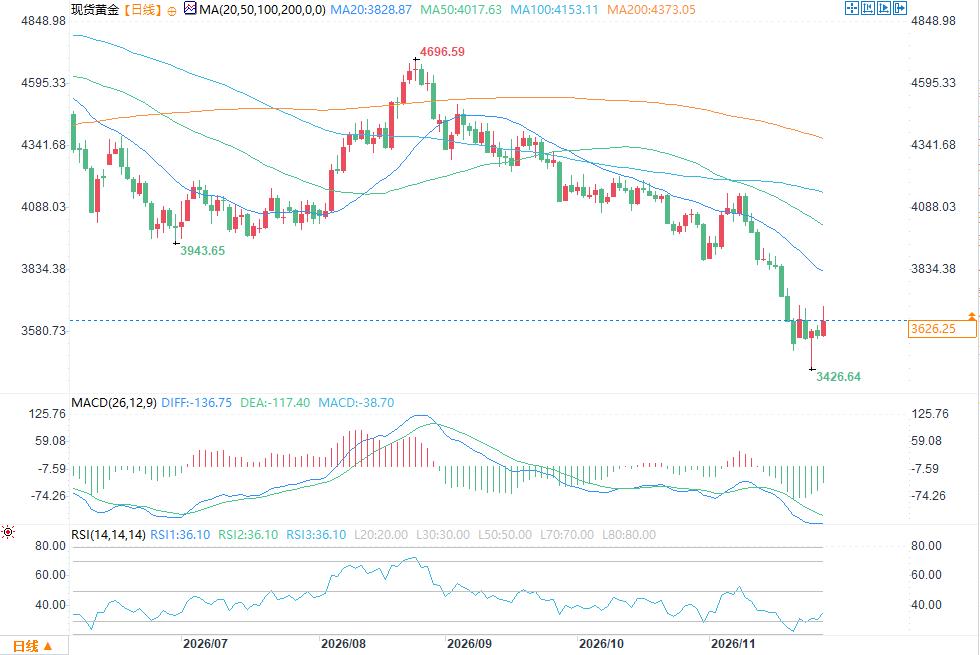 The next short-term downside target for bears: a break below $3595/oz, with a further target of $3503/oz. First resistance level: $3651; Second resistance level: $3697. First support level: $3595; Second support level: $3503. Silver Technical Analysis The next upside target for silver bulls: a break above the $44.570-$46.870/oz resistance range; if it holds above the upper limit of the range, the rebound will further target $49.000/oz.
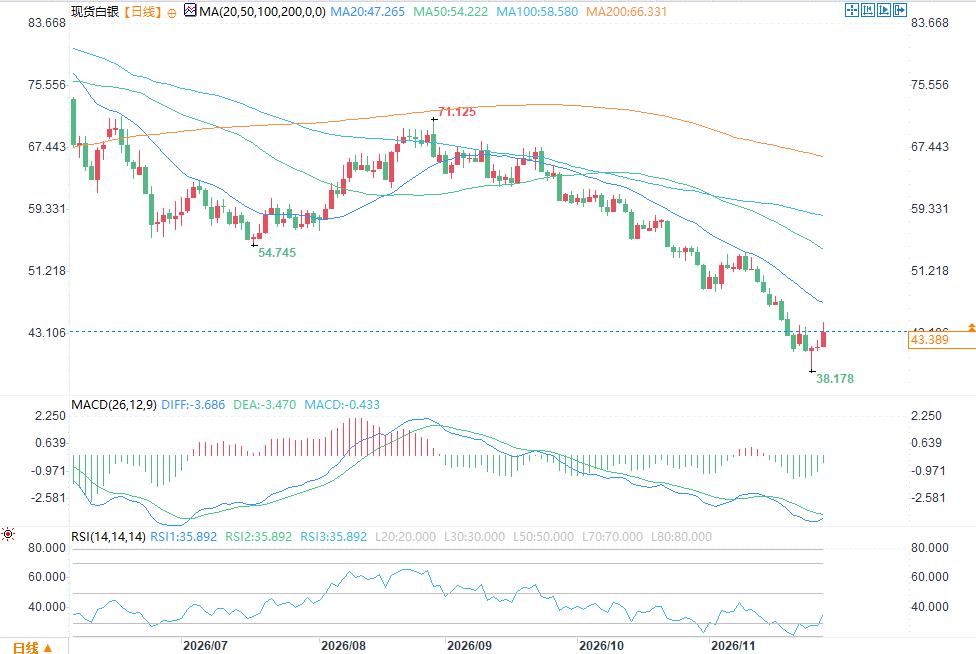 The next downside target for the bears is a break below $42.700/oz, with a deeper target of $41.340/oz. First resistance: $44.570; Second resistance: $46.870. First support: $42.700; Second support: $41.340.
Trading activity declined after the US Thanksgiving holiday, easing selling pressure on precious metals from the previous stock market crash. Spot gold traded around $3635.74 per ounce, up $69.48, or 1.95%; silver was around $43.767 per ounce, up about $5.48, or 5.48%. Intraday trading range for gold: $3557.8-$3685.11 per ounce; for silver: $43.767-$43.813 per ounce. US economic data released on Wednesday further strengthened market expectations that the Federal Reserve would maintain its tight monetary policy: economic growth exceeded expectations, while underlying inflation remained high. The second revision of third-quarter GDP annualized growth was raised to 4.3%, indicating that the US economy remains resilient despite high borrowing costs. Personal income rose 0.7% in October, and personal consumption expenditure increased by 0.3%, but inflation-adjusted real consumption was essentially flat. Initial jobless claims fell to 189,000, indicating continued resilience in the labor market; durable goods orders rose by only 0.2%. Stronger growth and inflation data led the market to bet on further interest rate hikes by the Federal Reserve; however, Friday's rebound in precious metals suggests that a weaker dollar and a receding sell-off temporarily offset the negative impact of rising interest rate expectations. Market positioning indicates that investors are highly betting on another rate hike by the Fed at its December 8-9 meeting. Latest futures market pricing shows a roughly 96% probability of a 25 basis point rate hike. Wednesday's strong GDP and core PCE data confirm that policymakers remain focused on curbing inflation, despite recent volatility in technology stocks and weakening industrial activity causing market concerns about the economic outlook. At Wednesday's close, the yield on the 10-year US Treasury note was around 4.85%, and the yield on the 2-year Treasury note was 4.63%, a slight easing of pressure compared to the extremely high financing rates that weighed on precious metals earlier in November. The dollar index also retreated from recent highs, contributing to Friday's rebound in precious metals. Following Thanksgiving, US trading hours are shortened, and the market will focus on subsequent economic data, with the November jobs report, released at 8:30 AM (Eastern Time) on December 4th, being particularly crucial. If labor market data weakens or inflation expectations cool, US Treasury yields are expected to decline, further benefiting gold prices; if inflationary pressures persist, it will support the Federal Reserve's continued tightening of policy. On Friday, the Strait of Hormuz and the US-Iran situation remain major uncertainties in the energy market. Attacks on commercial vessels and Saudi energy facilities threaten Persian Gulf oil exports. Although oil exports have recovered significantly compared to the previous period of disruption, the attacks on oil tankers and Saudi energy facilities have renewed market concerns about regional oil transportation security. The US naval blockade of Iranian ports, stalled diplomatic negotiations, and the prospect of a full reconciliation remain distant, with the risk of escalating military conflict still present. Brent crude oil prices rebounded, approaching their highest level since November, as traders reassessed the risk of supply disruptions, but expectations of a global oil supply glut still limit the long-term upside potential for oil prices. For gold, the unresolved geopolitical conflict provided a safe-haven buying floor; however, improved risk sentiment, a weaker dollar, and the return of physical buying were the more direct drivers of Friday's gold price rebound. Crude oil prices rose on Friday, ending several weeks of declines, boosted by the risks of tanker attacks and attacks on Saudi energy facilities. Brent crude futures were near $96.61 per barrel in early Asian trading, rising slightly after a nearly $2 surge on Thursday; New York WTI crude was at around $85.78 per barrel, up about 2.5% from Wednesday's close. Due to the Thanksgiving holiday, there was no regular settlement for WTI crude on Thursday. Both major crude oil benchmarks are on track for their first weekly gain in four weeks, with shipping security threats in the Persian Gulf pushing up geopolitical risk premiums. However, the recovery of Middle Eastern oil exports and the potential increase in global inventories mean the market does not anticipate a sustained global supply shortage. Rising oil prices will push up inflation expectations, posing challenges to Federal Reserve policy; however, Friday's rebound in precious metals indicates that a weaker dollar and reduced selling in financial markets have provided support against these negative factors. Global stock markets generally rallied on Friday, with technology and semiconductor sectors recovering from previous sharp declines; the US market saw a shortened trading day following Thanksgiving. On Wednesday, the Dow Jones Industrial Average rose 0.33% to close at 50,182.95; the S&P 500 fell 0.25% to 7,182.78; and the Nasdaq Composite fell 0.62% to 23,585.80. On Thursday, the Toronto Stock Exchange Composite Index rose 246.89 points (0.72%) to close at 34,426.88, benefiting from improved global stock market sentiment. European stocks closed sharply higher on Thursday, with the Stoxx Europe 600 index rising 1.75%, the German DAX index rising 2.08%, and the UK FTSE 100 index rising 1.75%. Asian stocks continued their recovery on Friday: the Nikkei 225 index rose 2.1%, the South Korean KOSPI index surged 4.3%, and the Shanghai Composite Index rose 3.7%. European markets also rose in early trading on Friday, with the German DAX up about 0.7% and the French CAC40 up 0.3%. US stock index futures opened higher, with improved sentiment in the technology sector and stabilizing risk appetite; however, Wall Street will close early at 1 p.m. ET, and overall trading volume is expected to remain low. Other overseas market overview: In early Asian trading, New York WTI crude oil was around $84.08/barrel, and Brent crude oil was around $91.26/barrel; the US dollar index retreated from its highs, which is beneficial to precious metals; the 10-year US Treasury yield closed near 4.897% before the Thanksgiving holiday. The expectation of a Fed rate hike in December remains a headwind for gold and silver, but the stock market recovery, the return of physical buying in China, and the easing of selling pressure supported the rebound in precious metals on Friday. Gold Technical Analysis : The next upside target for gold bulls is a break above the $3651-$3697/oz resistance range; if it effectively breaks above the upper limit of the range, the short-term bullish signal will strengthen, and it may challenge $3700/oz. The next short-term downside target for bears: a break below $3595/oz, with a further target of $3503/oz. First resistance level: $3651; Second resistance level: $3697. First support level: $3595; Second support level: $3503. Silver Technical Analysis The next upside target for silver bulls: a break above the $44.570-$46.870/oz resistance range; if it holds above the upper limit of the range, the rebound will further target $49.000/oz. The next downside target for the bears is a break below $42.700/oz, with a deeper target of $41.340/oz. First resistance: $44.570; Second resistance: $46.870. First support: $42.700; Second support: $41.340.- Risk Warning and Disclaimer
- The market involves risk, and trading may not be suitable for all investors. This article is for reference only and does not constitute personal investment advice, nor does it take into account certain users’ specific investment objectives, financial situation, or other needs. Any investment decisions made based on this information are at your own risk.