A chart shows that the Baltic Dry Index has declined slightly, and Capesize freight rates have weakened.
2026-11-27 23:02:33
The latest data shows that on November 27, 2026, the Baltic Dry Index (BDI) was 3137 points, a decrease of 0.48% compared to the previous week, marking the largest drop since November 17, 2026. Looking at the short-term charts, the BDI has seen positive growth 5 times, negative growth 6 times, and zero growth 0 times in the last 11 BDI data points. Specifically, the Panamax Freight Index (BPI) was 2315 points, up 1.85% from the previous week; the Capesize Freight Index (BCI) was 5023 points, down 1.51%; and the Supramax Freight Index (BSI) was 1818 points, up 0.11%. For detailed charts of the latest 720-day and 10-year trends of the Baltic Dry Index and its three main sub-indices, please refer to the charts specially created by FX678. 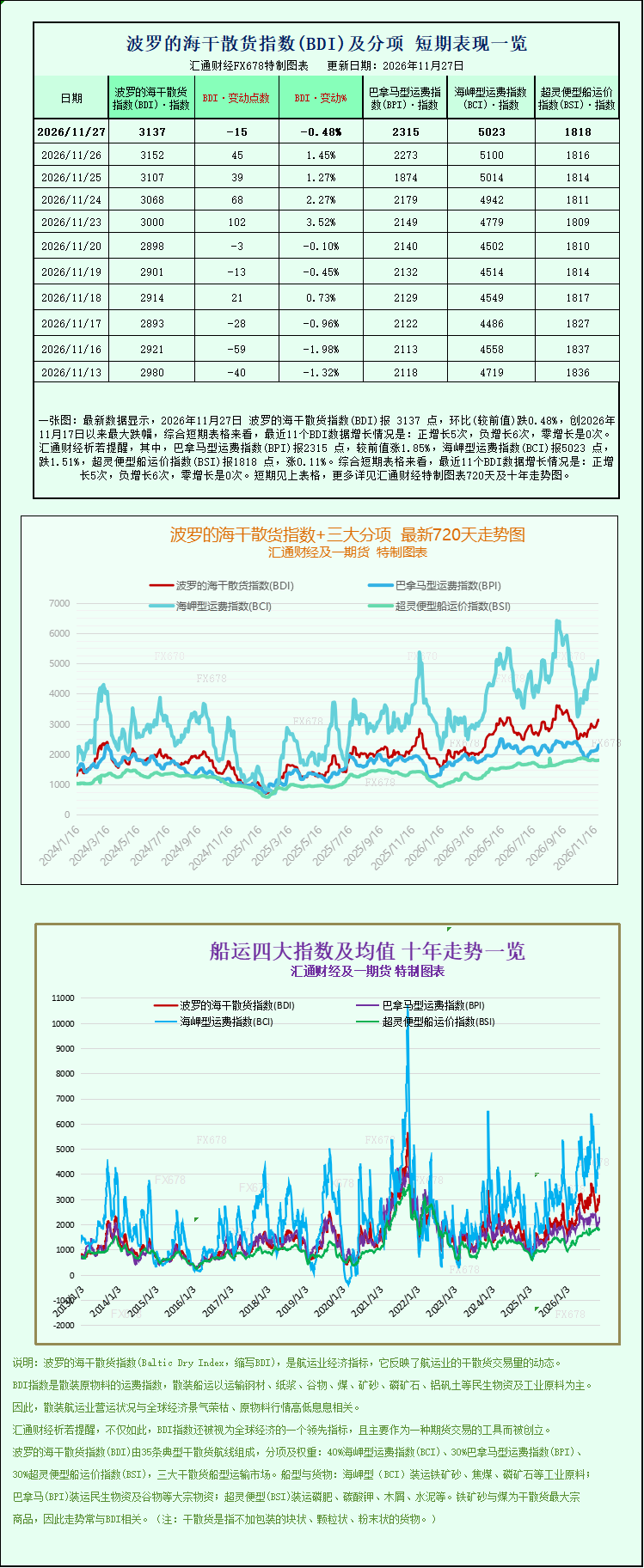 Market sentiment was generally negative. The Baltic Dry Index (BDI), the core composite index reflecting dry bulk shipping rates, declined slightly on Friday, mainly dragged down by weaker freight rates in the Capesize segment. However, looking at the overall performance for the week, the index still recorded an increase, indicating that the dry bulk shipping market as a whole has not completely fallen into a downward trend, with significant divergence in performance across different vessel types. The Baltic Dry Index (BDI), which aggregates shipping quotes for Capesize, Panamax, and Supramax vessels, fell 15 points on Friday, a drop of 0.48%, closing at 3137 points. Despite the day's decline, the index still rose 4.6% for the week, indicating that the upward momentum in freight rates was strong in the early part of the week, and Friday's correction was merely a temporary pullback. The overall market maintained a relatively strong weekly trend. Looking at the specific vessel types, the market showed significant divergence, with the largest segment, Capesize vessels, being the main factor dragging down the overall market. The Capesize Index (BCI) fell sharply by 77 points, or 1.51%, to close at 5023. Despite this significant single-day pullback, the index still saw a weekly gain of 5.1%. Capesize vessels primarily transport large dry bulk commodities like iron ore and coal, typically with a deadweight tonnage of around 150,000 tons, making them the mainstay of ocean-going bulk raw material trade. The average daily earnings per vessel declined by $692 to $42,055. The decline in freight rates was largely driven by volatility in the iron ore market. Iron ore prices had initially been under pressure, but subsequent policy signals from the Chinese government to increase market support boosted investor confidence, leading to a partial recovery in prices and a slight decline. These favorable policies mitigated the downward pressure on the freight market, preventing a deeper drop in Capesize freight rates. Iron ore is the core cargo for Capesize vessels. Demand expectations and policy guidance in the Chinese market directly influence freight rates for this vessel type. Expectations of policy support also maintain market anticipation for future iron ore trade volumes. In contrast to the weakening of Capesize vessels, the Panamax sector continued its upward trend. The Panamax Index (BPI) rose 42 points to 2315 points, a weekly increase of 7.7%, making it the best-performing vessel category this week. Panamax vessels have a deadweight tonnage concentrated between 60,000 and 70,000 tons and mainly transport bulk commodities such as coal and grain, widely used in transoceanic grain trade and regional coal transportation. The average daily earnings for this vessel type increased by $378 to $20,834. The Panamax market strengthened, driven by two factors: increased global grain trade activity and stable grain export shipments from South and North America; and continued strong regional coal shipping demand, supporting robust charter demand for this vessel type. This contrasts sharply with the Capesize market, which was affected by short-term fluctuations in iron ore prices. The smaller Supramax market remained relatively stable, with the Supramax Index (BSI) rising slightly by 2 points, or 0.1%, to close at 1818 points, a weekly increase of 0.5%. These smaller dry bulk vessels primarily serve short-haul regional shipping trade, with diversified routes and a wide range of cargoes. They are less affected by fluctuations in any single commodity, and their freight rate volatility is significantly lower than that of larger ocean-going vessels. Overall, the market maintained a steady, slightly increasing trend this week, without significant volatility, demonstrating strong resilience. In conclusion, Friday's decline in the Baltic Dry Index is a temporary adjustment, not a trend reversal. The pullback in freight rates for large Capesize vessels was mainly due to profit-taking after the rapid rise in the previous period. Expectations of policy support for the iron ore market provided a floor for the market. Panamax vessels maintained their strength thanks to grain and coal cargoes, while small and medium-sized Supramax vessels remained stable. This divergence in performance among different vessel types reflects the current structural characteristics of the global dry bulk shipping market: large vessels are highly dependent on demand for heavy industrial raw materials such as iron ore, leading to significant price fluctuations; medium and small vessels benefit from diversified cargo types, resulting in more stable performance. The future market trend will be closely monitored in conjunction with actual iron ore arrivals, the pace of global grain exports, and changes in global commodity trade. If actual iron ore trade recovers in line with policy expectations, Capesize freight rates are expected to stabilize; if grain and coal exports continue to increase, Panamax vessels will maintain their strong performance. Overall, the dry bulk shipping market is likely to maintain a segmented pattern in the short term. Daily index fluctuations do not fully represent the overall market trend; continuous monitoring of cargo and freight rate changes for each vessel type is necessary.
- Risk Warning and Disclaimer
- The market involves risk, and trading may not be suitable for all investors. This article is for reference only and does not constitute personal investment advice, nor does it take into account certain users’ specific investment objectives, financial situation, or other needs. Any investment decisions made based on this information are at your own risk.