Three-week losing streak ends! Renewed tensions in the Middle East trigger a dramatic reversal in oil prices.
2026-11-28 12:08:33
This week, the international crude oil market experienced a period of dramatic volatility, initially declining before rebounding. On Monday (November 23), oil prices plummeted, hitting a three-month low, with the market initially dominated by news of increased supply. In the following days, attacks on oil tankers and refineries in the Middle East erupted, rapidly escalating shipping risks in the Strait of Hormuz and driving a sustained rebound in oil prices, ultimately helping Brent crude record its first weekly gain since November. Throughout the week, the tug-of-war between geopolitical risk premiums and expectations of oversupply became the dominant theme. 
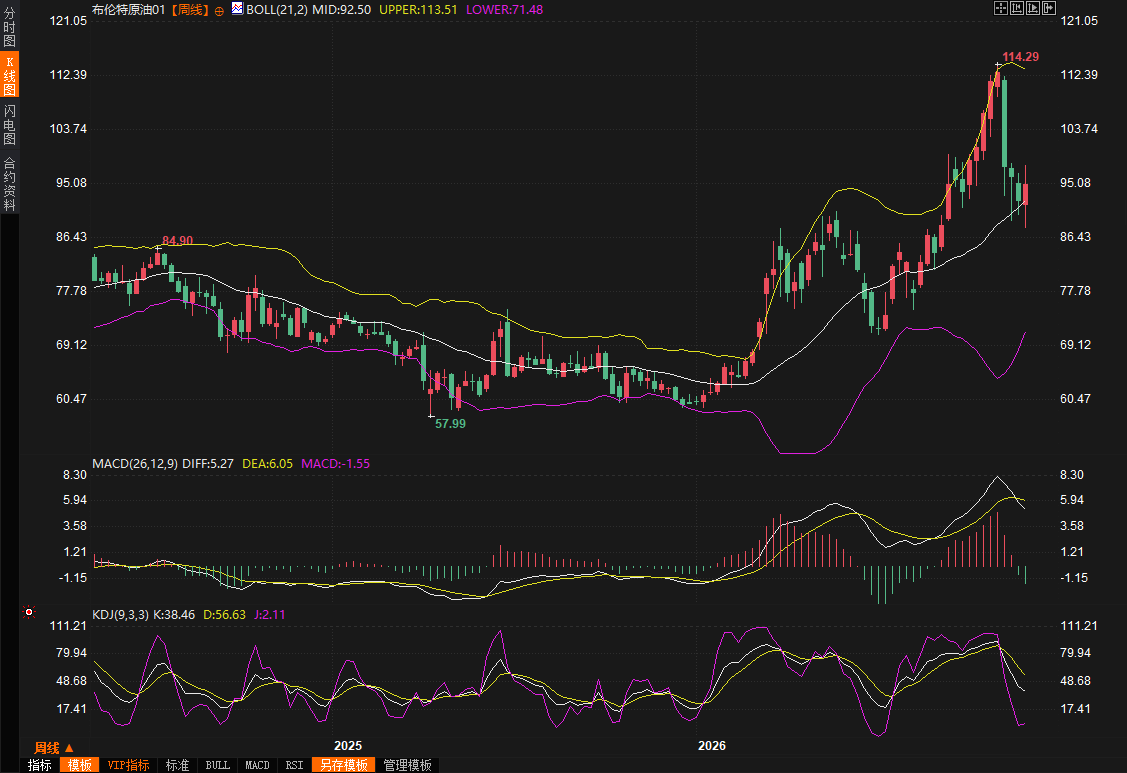 (Brent crude oil weekly chart, source: FX678)
Monday's plunge: Increased supply outweighs geopolitical concerns
Market sentiment was clearly bearish at the start of the week. Brent crude futures closed down $3.20, or 3.46%, at $89.37 a barrel on Monday; U.S. crude futures fell $3.24, or 3.88%, to $80.17. Brent hit its lowest closing price since August 31, while U.S. crude reached its lowest level since August 10. The immediate trigger for the decline was signals of improvement on the supply side. The chairman of Libya's National Oil Corporation confirmed that the Sharara pipeline had reopened, and crude oil had begun flowing into storage tanks at the Zawiya Akakus facility. Meanwhile, the market widely expects continued increases in production in the Middle East (excluding Iran), and expansion in U.S.-led supply in the Americas. JPMorgan Chase even explicitly stated that, due to oversupply, crude oil futures prices could fall to the $70 range per barrel in the first half of 2027. Analysts generally believe that previous concerns about attacks on Middle Eastern shipping and refineries have been offset by stronger expectations of increased supply. Chris Beauchamp, chief market analyst at IG, pointed out that signs of oversupply are becoming increasingly apparent, while the likelihood of Trump launching another military strike seems to be decreasing over time. Monday's sharp drop was essentially a concentrated pricing in of the "supply easing" narrative by the market.Geopolitical risks are rapidly returning: Hormuz and Saudi facilities are facing immediate crises.
However, the bearish dominance did not last long. Starting Tuesday, Middle East geopolitical risks resurfaced at a faster pace, gradually overshadowing concerns about oversupply. On Tuesday, the UK's Maritime Trade Action Group reported that three ships were attacked by unidentified projectiles while transiting eastward through the Strait of Hormuz. Iran's Revolutionary Guard claimed that a container ship was attacked near Hormuz for taking an "unauthorized" route. Oil prices rose more than $2 after fluctuations, with Brent crude at $91.40 and US crude at $82.05. Although prices hit lower levels during the session, the news of the attacks ultimately supported a rebound at the close. On Wednesday, the Houthi rebels in Yemen claimed responsibility for attacks on Saudi Arabia's largest oil refinery, Rastanura, and the Riyadh financial district. The complex housing this refinery is also a major export terminal for Saudi crude oil, and the news directly ignited market concerns about unexpected supply disruptions. Brent crude surged $3.21, or 3.5%, to close at $94.61; U.S. crude rose $1.63 to $83.68. Analysts pointed out that geopolitical risk premiums are rising significantly, and some traders are closing short positions ahead of the U.S. Thanksgiving holiday. On Thursday, the risks escalated further. Iran's Revolutionary Guard stated that two oil tankers exploded and caught fire after hitting mines near the Strait of Hormuz, one of which was a supertanker carrying over 2 million barrels of crude oil. Meanwhile, the Houthi attack on Saudi Arabia's Rastanura continued to reverberate. Brent crude settled at $96.57. Rory Johnston, founder of Commodity Context, stated that although global oil supply may be slightly oversupplied in October, traffic in the Strait of Hormuz is slowing, inventories are low, and approximately 15% of global supply faces "known and imminent risks." With Brent falling below $90, the market was already oversold, and a tightening of supply again was only a matter of time. On Friday, the Saudi Energy Ministry confirmed that a projectile struck Saudi Aramco's Jazan refinery, killing one worker and temporarily halting some production. This is the latest blow to a critical Saudi facility in a short period. Brent crude oil fell slightly by $1.13 on Friday (November 27) to close at $95.44, but still rose about 3% for the week, successfully ending a three-week losing streak and recording its first weekly gain since November. US crude oil performed relatively weakly for the week due to the Thanksgiving holiday. (Brent crude oil weekly chart, source: FX678)Multiple signals from supply and demand intertwined
Beyond the Middle East main theme, other supply disruptions this week warrant attention. Ukraine continued its attacks on Russian energy infrastructure, damaging processing units at Lukoil's Perm refinery, and repeatedly hitting oil terminals and storage tanks in Tatarstan. Russian exports via major Baltic and Black Sea oil terminals faced increasing delays due to severe weather and drone attacks. Thailand's Bangchak refinery shut down all production units due to a fire, and a refinery in southern Russia was also severely damaged in a drone attack. These events combined further heightened market sensitivity to supply disruptions. Meanwhile, structural concerns about oversupply persisted. Deutsche Bank noted that global observed liquid fuel inventories rose in October, implying a daily oversupply of approximately 1.7 million barrels. Growing evidence suggests the global market is rebalancing towards oversupply, although some setbacks may slow this process. Data from the U.S. Energy Information Administration showed that U.S. crude oil inventories increased by 1.1 million barrels in the week ending November 20. Surveys also indicated expectations of further inventory increases. China and India are expected to import record amounts of Russian crude oil this year, partially filling supply gaps related to Iran. Temporary waivers of US sanctions on Russian oil have further expanded buyer options, but continued attacks on Ukraine are limiting the actual available supply.With the OPEC+ meeting approaching, policy uncertainty remains.
This weekend, OPEC+ ministers will hold a series of meetings to decide on production policies for 2027. The market is largely focused on whether the alliance will extend its current production targets at least into the first quarter of 2027. Reports indicate that the UAE is no longer bound by OPEC+ policies, Iraq is seeking to increase its oil production capacity assessment, and Kazakhstan has similar demands. These internal differences of interest pose challenges to how the alliance will balance production. The Iraqi oil minister stated before the meeting that the country is negotiating with OPEC on raising its production ceiling. Other reports suggest that the US government encouraged Venezuela and Iraq to consider leaving OPEC earlier this year. These external factors have increased the uncertainty of the meeting and, to some extent, limited a significant rise in oil prices.Summary and Outlook
In summary, the oil market experienced a rapid shift this week from a "supply easing-dominated" environment to a "strong return of geopolitical risks." Monday's plunge reflected the market's pricing in oversupply, while the subsequent rebound fully reflected the risk premium brought about by the attacks on the Strait of Hormuz and Saudi energy infrastructure. Brent crude ultimately achieved a weekly gain, indicating that given the current limited inventory and real threats to key shipping routes, the market's tolerance for supply disruptions remains low. Looking ahead, two forces will continue to fiercely contend: on one hand, the ongoing and potential escalation of Middle East geopolitics; on the other hand, the expected supply growth in 2027 and the direction of OPEC+ policy. If shipping in the Strait of Hormuz is further disrupted, or if infrastructure in oil-producing countries like Saudi Arabia suffers further substantial damage, oil prices still have room to break upwards; conversely, if geopolitical risks temporarily ease while signals of oversupply become clearer, the pressure that previously pushed prices below $90 may reappear. Short-term volatility is expected to intensify, and investors need to closely monitor the latest developments in the Middle East and the outcome of Sunday's OPEC+ meeting.- Risk Warning and Disclaimer
- The market involves risk, and trading may not be suitable for all investors. This article is for reference only and does not constitute personal investment advice, nor does it take into account certain users’ specific investment objectives, financial situation, or other needs. Any investment decisions made based on this information are at your own risk.