Rapidly weakening demand and peace talks weaken the short-term outlook for oil prices.
2025-11-21 21:45:05
On Friday (November 21) during the European session, bearish sentiment dominated the market, with attention turning to the next major downside targets: the major bottom of $55.96 formed on October 20 and the major bottom of $55.30 formed on May 5.

Whether a short-term rebound can materialize depends on whether buyers can reclaim the previous levels of $58.43 and $59.96. If this range is broken, the 50-day moving average at $60.81 will become the next major resistance level—unless the overall fundamentals improve, this level could trigger renewed selling interest.
Geopolitical negotiations put pressure on oil price outlook
New geopolitical developments are impacting the oil market: the US is pushing for a peace framework between Russia and Ukraine, a move traders believe could lead to increased oil supply in the future.
The possibility of a diplomatic breakthrough pushed the prices of the two major crude oil benchmarks down by more than 2% on the day, with the cumulative decline for the week widening to about 4%, erasing all of last week's gains.
As the United States pushes for peace talks, sanctions against Russian oil producers Rosneft and Lukoil have officially taken effect. While the market had already priced in potential supply tightening, the possibility of Russia-Ukraine negotiations has diminished that expectation.
Ukrainian President Volodymyr Zelenskyy confirmed his readiness to cooperate with the United States on a potential peace plan, further dampening bullish market sentiment.
Uncertainty surrounding Russian sanctions casts a shadow over oil price forecasts.
Analysts warn that a high degree of uncertainty remains regarding the conclusion of any peace agreement. ANZ Bank points out that Ukraine's repeated rejections of Russia's demands have made the negotiation timeline difficult to predict.
Meanwhile, traders are skeptical about the effectiveness of the latest round of U.S. sanctions against Rosneft and Lukoil, which has been allowed to delay the divestiture of its international portfolio until December 13.
Jim Reid of Deutsche Bank said that the combination of the negotiation process and the new sanctions has alleviated market concerns about supply risks to some extent, but the market is still uncertain about the actual impact of the sanctions.
A stronger dollar coupled with a shift in expectations regarding Federal Reserve policy further weighed on crude oil prices.
A stronger dollar is another source of pressure on the oil market. With traders lowering their expectations for a Fed rate cut next month, the dollar is poised for its strongest weekly performance in over a month.
The CME FedWatch Tool shows that the probability of a December rate cut has dropped sharply to 35% from about 90% a month ago. A stronger dollar typically dampens the buying interest of non-US investors in crude oil, further reinforcing the downward trend of the day.
Market Forecast: Short-term bearish sentiment remains unchanged.
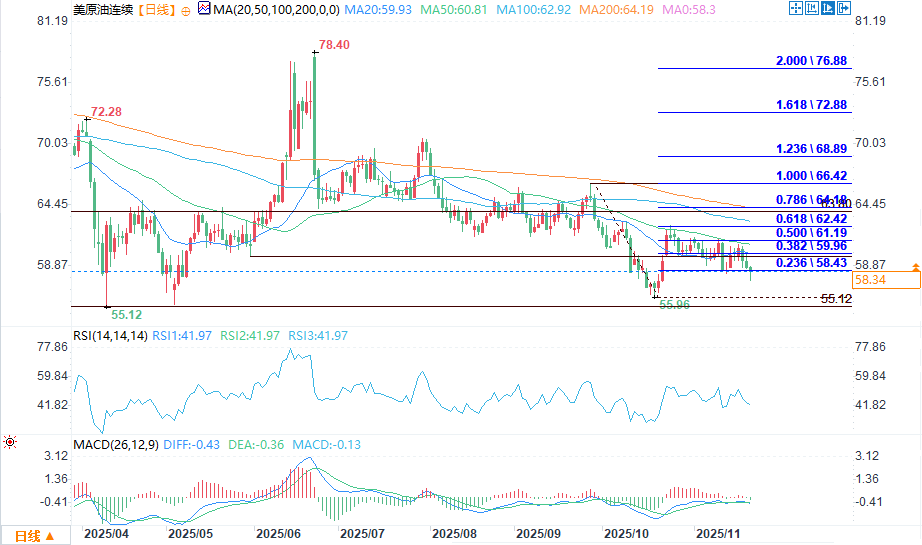
(WTI crude oil daily chart source: FX678)
WTI futures have now fallen below the 61.8% Fibonacci retracement level and last week's low. Coupled with geopolitical developments and a shift in overall risk sentiment towards the negative, the short-term outlook for oil prices remains bearish.
Unless buyers retake $58.43 and $59.96 and launch an attack on the 50-day moving average at $60.81, the market appears poised to test the major bottom range of $55.96 and $55.30.
At 21:43 Beijing time, WTI crude oil futures were trading at $58.31 per barrel, down 1.17%.
Whether a short-term rebound can materialize depends on whether buyers can reclaim the previous levels of $58.43 and $59.96. If this range is broken, the 50-day moving average at $60.81 will become the next major resistance level—unless the overall fundamentals improve, this level could trigger renewed selling interest.
Geopolitical negotiations put pressure on oil price outlook
New geopolitical developments are impacting the oil market: the US is pushing for a peace framework between Russia and Ukraine, a move traders believe could lead to increased oil supply in the future.
The possibility of a diplomatic breakthrough pushed the prices of the two major crude oil benchmarks down by more than 2% on the day, with the cumulative decline for the week widening to about 4%, erasing all of last week's gains.
As the United States pushes for peace talks, sanctions against Russian oil producers Rosneft and Lukoil have officially taken effect. While the market had already priced in potential supply tightening, the possibility of Russia-Ukraine negotiations has diminished that expectation.
Ukrainian President Volodymyr Zelenskyy confirmed his readiness to cooperate with the United States on a potential peace plan, further dampening bullish market sentiment.
Uncertainty surrounding Russian sanctions casts a shadow over oil price forecasts.
Analysts warn that a high degree of uncertainty remains regarding the conclusion of any peace agreement. ANZ Bank points out that Ukraine's repeated rejections of Russia's demands have made the negotiation timeline difficult to predict.
Meanwhile, traders are skeptical about the effectiveness of the latest round of U.S. sanctions against Rosneft and Lukoil, which has been allowed to delay the divestiture of its international portfolio until December 13.
Jim Reid of Deutsche Bank said that the combination of the negotiation process and the new sanctions has alleviated market concerns about supply risks to some extent, but the market is still uncertain about the actual impact of the sanctions.
A stronger dollar coupled with a shift in expectations regarding Federal Reserve policy further weighed on crude oil prices.
A stronger dollar is another source of pressure on the oil market. With traders lowering their expectations for a Fed rate cut next month, the dollar is poised for its strongest weekly performance in over a month.
The CME FedWatch Tool shows that the probability of a December rate cut has dropped sharply to 35% from about 90% a month ago. A stronger dollar typically dampens the buying interest of non-US investors in crude oil, further reinforcing the downward trend of the day.
Market Forecast: Short-term bearish sentiment remains unchanged.
(WTI crude oil daily chart source: FX678)
WTI futures have now fallen below the 61.8% Fibonacci retracement level and last week's low. Coupled with geopolitical developments and a shift in overall risk sentiment towards the negative, the short-term outlook for oil prices remains bearish.
Unless buyers retake $58.43 and $59.96 and launch an attack on the 50-day moving average at $60.81, the market appears poised to test the major bottom range of $55.96 and $55.30.
At 21:43 Beijing time, WTI crude oil futures were trading at $58.31 per barrel, down 1.17%.
- Risk Warning and Disclaimer
- The market involves risk, and trading may not be suitable for all investors. This article is for reference only and does not constitute personal investment advice, nor does it take into account certain users’ specific investment objectives, financial situation, or other needs. Any investment decisions made based on this information are at your own risk.