The Bank of Japan and the Federal Reserve have parted ways! Amid this policy divergence, the USD/JPY exchange rate has rebounded slightly.
2025-12-12 13:58:29
The US dollar rebounded against the Japanese yen in Asian trading on Friday (December 12), rising by about 0.10%, but the upside appeared limited. Market concerns centered on Japanese Prime Minister Sanae Takaichi's massive spending plans and the deteriorating fiscal situation due to slowing economic growth.
Furthermore, the generally risk-averse environment has diminished the yen's safe-haven appeal. However, rising market expectations that the Bank of Japan may raise interest rates as early as next week could curb aggressive short positions in the yen.

Investors may also choose to wait and see, awaiting the Bank of Japan's policy meeting on December 18-19, which will provide new key guidance for the yen's trajectory.
On the other hand, the dollar index hovered near its seven-week low of 98.13 reached on Thursday, as market expectations for further interest rate cuts by the Federal Reserve strengthened. This divergence from the market's hawkish expectations of the Bank of Japan will support the low-yielding yen and limit the potential upside for the dollar/yen pair.
Asian stocks rose in early trading on Friday, following overnight gains in U.S. stocks, which diminished the appeal of traditional safe-haven assets. Furthermore, continued market concerns about the state of Japan's public finances due to Prime Minister Sanae Takashi's reflationary policies put continued pressure on the yen.
The Japanese corporate goods price index released on Wednesday showed that inflation remains above historical levels, confirming the hawkish views expressed by Bank of Japan Governor Kazuo Ueda earlier this week—that the likelihood of the Bank of Japan's benchmark economic and price forecasts being realized is gradually increasing.
This provides a basis for the Bank of Japan to further normalize its policy. Ahead of the highly anticipated Bank of Japan policy meeting on December 18-19, traders may avoid aggressively shorting the yen. Furthermore, widespread bearish sentiment towards the US dollar will also limit the substantial upside potential for the USD/JPY exchange rate.
The Federal Reserve announced a 25-basis-point rate cut as expected after concluding its two-day policy meeting on Wednesday, and projected only one more rate cut in 2026. However, investors still expect two more rate cuts in 2026 following dovish comments from Fed Chairman Powell.
In a press conference following the meeting, Powell stated that there are significant downside risks to the U.S. labor market, and the Federal Reserve does not want its policies to stifle job creation. This kept the dollar index near its seven-week low of 98.13 reached on Thursday, which is expected to put downward pressure on the dollar against the yen.
Traders are currently focused on speeches by key members of the Federal Open Market Committee, which could provide guidance for later trading in the absence of relevant U.S. economic data. However, market focus will remain on next week's highly anticipated Bank of Japan monetary policy meeting.
From a technical analysis perspective, on the upside, the overnight high (156.16) may constitute the near-term resistance level for USD/JPY. A successful break above this level could trigger a new round of short covering, pushing the pair to test the weekly high near 157.00. Subsequent buying would create conditions for the pair to test the medium-term resistance level of 157.45, and could potentially further challenge the high of 157.89 reached in November.
On the downside, the first support level is at 155.00. If this level is breached, USD/JPY may accelerate its decline and retest the monthly low near 154.34 reached last Friday. The psychological level of 154.00 will then form key support; if this level is broken, the exchange rate may slide further towards the important support level near 153.60, and ultimately potentially fall below 152.00.
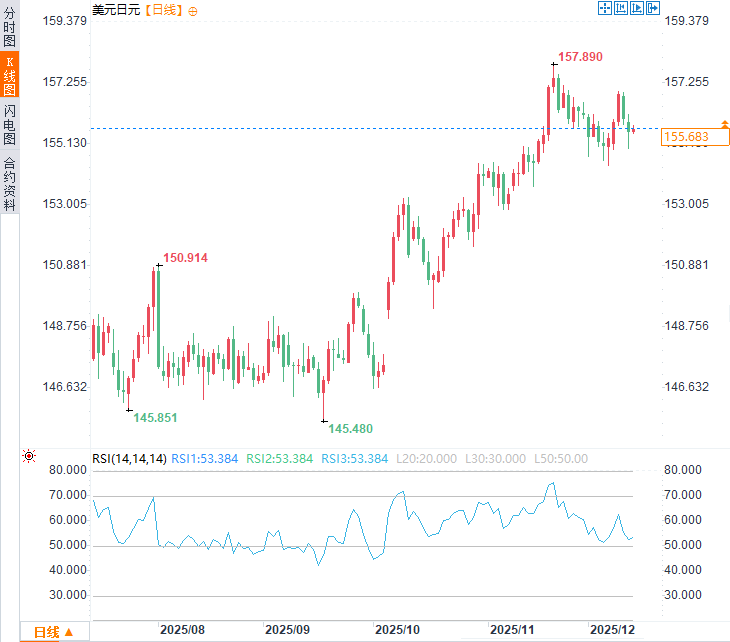
(USD/JPY daily chart, source: FX678)
At 13:57 Beijing time, the US dollar was trading at 155.70/71 against the Japanese yen.
Furthermore, the generally risk-averse environment has diminished the yen's safe-haven appeal. However, rising market expectations that the Bank of Japan may raise interest rates as early as next week could curb aggressive short positions in the yen.
Investors may also choose to wait and see, awaiting the Bank of Japan's policy meeting on December 18-19, which will provide new key guidance for the yen's trajectory.
On the other hand, the dollar index hovered near its seven-week low of 98.13 reached on Thursday, as market expectations for further interest rate cuts by the Federal Reserve strengthened. This divergence from the market's hawkish expectations of the Bank of Japan will support the low-yielding yen and limit the potential upside for the dollar/yen pair.
The yen was pressured by both risk appetite and fiscal concerns.
Asian stocks rose in early trading on Friday, following overnight gains in U.S. stocks, which diminished the appeal of traditional safe-haven assets. Furthermore, continued market concerns about the state of Japan's public finances due to Prime Minister Sanae Takashi's reflationary policies put continued pressure on the yen.
The Japanese corporate goods price index released on Wednesday showed that inflation remains above historical levels, confirming the hawkish views expressed by Bank of Japan Governor Kazuo Ueda earlier this week—that the likelihood of the Bank of Japan's benchmark economic and price forecasts being realized is gradually increasing.
This provides a basis for the Bank of Japan to further normalize its policy. Ahead of the highly anticipated Bank of Japan policy meeting on December 18-19, traders may avoid aggressively shorting the yen. Furthermore, widespread bearish sentiment towards the US dollar will also limit the substantial upside potential for the USD/JPY exchange rate.
The Federal Reserve announced a 25-basis-point rate cut as expected after concluding its two-day policy meeting on Wednesday, and projected only one more rate cut in 2026. However, investors still expect two more rate cuts in 2026 following dovish comments from Fed Chairman Powell.
In a press conference following the meeting, Powell stated that there are significant downside risks to the U.S. labor market, and the Federal Reserve does not want its policies to stifle job creation. This kept the dollar index near its seven-week low of 98.13 reached on Thursday, which is expected to put downward pressure on the dollar against the yen.
Traders are currently focused on speeches by key members of the Federal Open Market Committee, which could provide guidance for later trading in the absence of relevant U.S. economic data. However, market focus will remain on next week's highly anticipated Bank of Japan monetary policy meeting.
USD/JPY bulls need to wait for a decisive break above the 156.00 level.
From a technical analysis perspective, on the upside, the overnight high (156.16) may constitute the near-term resistance level for USD/JPY. A successful break above this level could trigger a new round of short covering, pushing the pair to test the weekly high near 157.00. Subsequent buying would create conditions for the pair to test the medium-term resistance level of 157.45, and could potentially further challenge the high of 157.89 reached in November.
On the downside, the first support level is at 155.00. If this level is breached, USD/JPY may accelerate its decline and retest the monthly low near 154.34 reached last Friday. The psychological level of 154.00 will then form key support; if this level is broken, the exchange rate may slide further towards the important support level near 153.60, and ultimately potentially fall below 152.00.
(USD/JPY daily chart, source: FX678)
At 13:57 Beijing time, the US dollar was trading at 155.70/71 against the Japanese yen.
- Risk Warning and Disclaimer
- The market involves risk, and trading may not be suitable for all investors. This article is for reference only and does not constitute personal investment advice, nor does it take into account certain users’ specific investment objectives, financial situation, or other needs. Any investment decisions made based on this information are at your own risk.