December 16th Financial Breakfast: Profit-taking by investors limited gold price gains; investors await non-farm payroll data; oversupply expectations weighed on oil prices.
2025-12-16 07:21:43
On Tuesday (December 16, Beijing time) in early Asian trading, spot gold was trading around $4,307 per ounce. Gold prices narrowed their gains on Monday, influenced by signs of easing geopolitical tensions and profit-taking by some investors, as the market awaited the release of non-farm payroll data. US crude oil was trading around $56.63 per barrel. Oil prices continued their decline on Monday, mainly pressured by strong market expectations of a global oil supply glut in 2026 and the impact of progress in negotiations with Ukraine.


U.S. stocks closed lower across the board on Monday as investors awaited several key economic data releases this week and assessed policy signals regarding the nominee for Federal Reserve chairman and speeches by officials.
At the close, the Dow Jones Industrial Average fell 0.09%, the S&P 500 fell 0.16%, and the Nasdaq Composite fell 0.59%. The market lacked clear direction, and investors remained cautious ahead of the release of October and November nonfarm payrolls, retail sales, business activity, and inflation reports.
CNBC reported on Monday, citing sources familiar with the matter, that some within Trump's inner circle oppose appointing White House economic advisor Hassett as the next Federal Reserve chairman. Meanwhile, New York Fed President Williams stated that last week's rate cut puts policy in a favorable position, while Fed Governor Milan questioned the representativeness of current inflation data.
In terms of sectors, 8 out of 11 sectors in the S&P 500 rose, with healthcare leading the gains; the information technology sector fell, with ServiceNow plunging 11.5% due to merger news.
In terms of individual stocks, Tesla rose 3.5% after Musk said the company is testing driverless taxis; iRobot plummeted 72.7% after the company filed for bankruptcy protection.
Gold prices pared gains on Monday as signs of easing geopolitical tensions emerged. Spot gold closed at $4,304.91 an ounce, up 0.11% on the day, a significant pullback from the more than 1% gain earlier in the session.
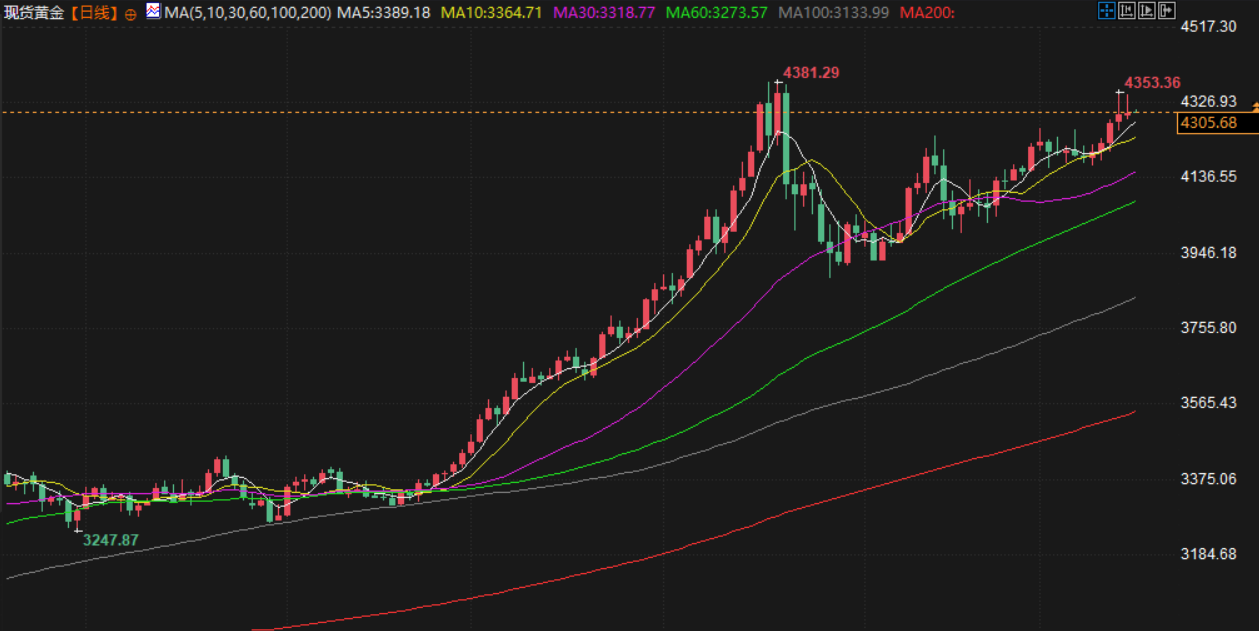
Analysts pointed out that the decline in gold prices was mainly due to the market's reaction to news of progress in talks between the US and Ukrainian President Zelensky, which weakened gold's safe-haven appeal. At the same time, some investors chose to take profits after the recent rise, which also put pressure on gold prices.
The market is currently closely watching the US non-farm payrolls and retail sales data to be released on Tuesday to assess the Federal Reserve's future monetary policy path. According to the CME FedWatch tool, the market expects a 78% probability of a rate cut in January 2026.
Other precious metals performed strongly: spot silver rose 2.6% to settle at $63.61 an ounce, near its record high reached last Friday; platinum rose 2.5% to $1,788.55 an ounce, a new high since September 2011; and palladium rose nearly 5% to settle at $1,560.25 an ounce, a two-month high. Nornickel, the world's largest palladium producer, predicts a potential 200,000-ounce supply deficit in the palladium market this year.
Oil prices continued their decline on Monday, primarily pressured by strong market expectations of a global oil supply glut in 2026. While escalating tensions between the US and Venezuela hampered oil exports, this localized supply disruption failed to offset the negative macroeconomic factors.
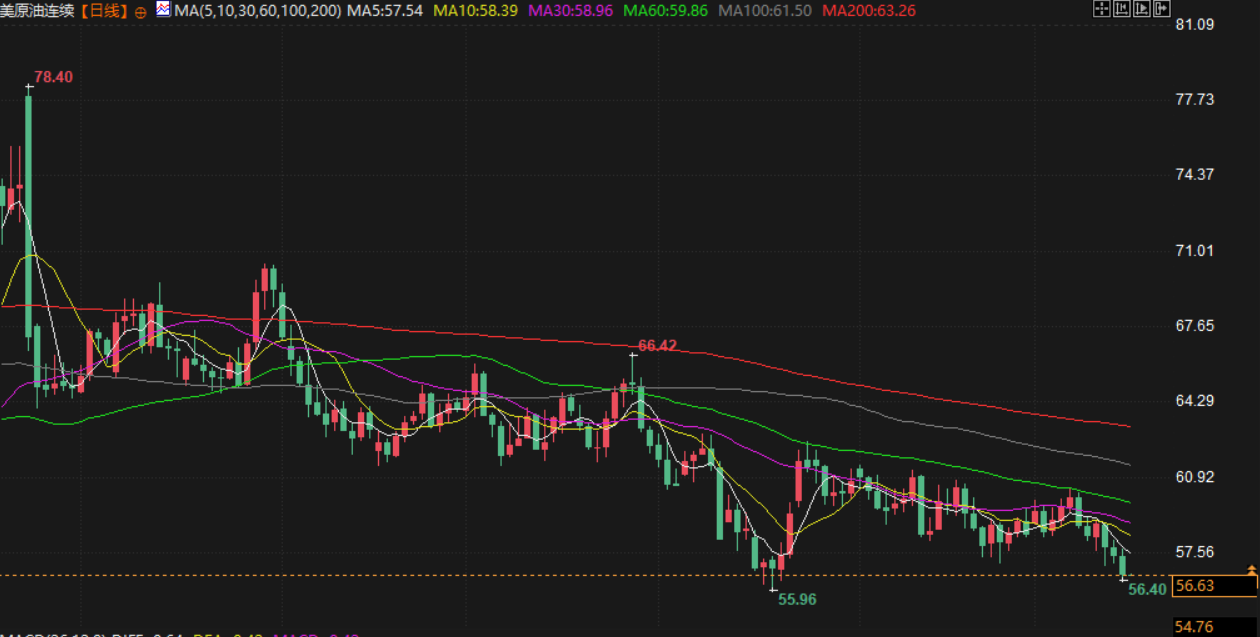
Brent crude futures settled down 0.92% at $60.56 a barrel, while U.S. crude futures fell 1.08% to $56.82 a barrel.
The core reason for the decline in oil prices is that the market widely expects a global oil surplus next year, and geopolitical risk premiums have subsided. Ukrainian President Zelenskyy recently demonstrated negotiating flexibility in his talks with the United States, proposing to abandon his bid for NATO membership. This progress in the talks has eased concerns about potential disruptions to crude oil supplies.
Meanwhile, supply disruptions caused by escalating US sanctions against Venezuela provided some support to the market. Venezuelan oil exports have plummeted since the US seized an oil tanker and imposed new sanctions last week. Analysts point out that without this event, the price drop might have been even more significant.
The dollar index dipped slightly by 0.09% on Monday, while the dollar weakened against the yen, as markets braced for a week packed with central bank decisions and a series of key U.S. economic data releases that could provide important clues about the Federal Reserve's interest rate path next year.
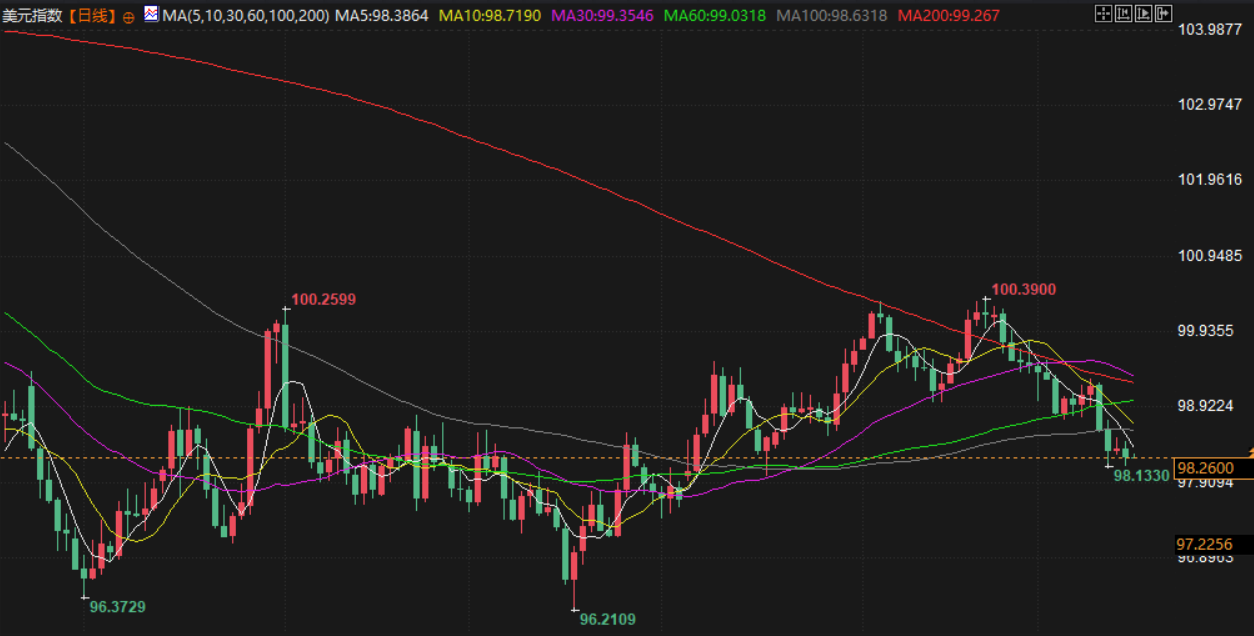
The dollar fell 0.31% against the yen to 155.345 at the close. The market widely expects the Bank of Japan to announce an interest rate hike at its meeting this Friday, an expectation that provided support for the yen. Meanwhile, traders are also awaiting the US November non-farm payroll report on Tuesday and inflation data on Thursday to assess the health of the US economy. Analysts at institutions such as Goldman Sachs have now shifted their expectations to a December rate hike by the Bank of Japan, noting that its policy guidance will be key to influencing the yen's future direction.
Among other major currencies, the pound fell slightly by 0.12% to $1.33645, as the market anticipated a possible interest rate cut by the Bank of England this week, but the decision was considered very delicate and dependent on the latest data; the euro rose slightly by 0.06% to $1.174775.
Zelensky: Territorial issues are particularly thorny in the US-Ukraine negotiations
Ukrainian President Volodymyr Zelenskyy stated on the 15th that the territorial issue was particularly thorny in the negotiations between Ukraine and the United States in Berlin, with differing positions remaining between the parties. Speaking to reporters alongside German Chancellor Merz that day, Zelenskyy said the issues facing the Ukraine-US negotiations were very complex, especially the territorial issue, where the parties held differing positions. However, he emphasized that it was important that Ukraine had the opportunity to articulate its position, and that this issue should be resolved fairly. He said that the two sides would continue negotiations.
Europe has proposed forming a "multinational force" to support Ukraine.
On the evening of the 15th local time, leaders of Germany, France, the United Kingdom, Italy, Poland, Finland, Norway, Sweden, the Netherlands, and EU institutions issued a joint statement announcing the formation of a "multinational force" to support Ukraine. The statement said that "this force will assist Ukraine in rebuilding its armed forces, ensuring the security of Ukrainian airspace, and enhancing maritime security; related operations will also include military operations conducted within Ukraine."
Zelensky: Berlin talks were productive, but the US and Ukraine have different positions on the territorial issue.
On March 15th local time, Ukrainian President Volodymyr Zelenskyy stated at the closing ceremony of the Germany-Ukraine Business Forum in Berlin, Germany, that the negotiations with US representatives in Berlin on ending the Russia-Ukraine conflict were fruitful. Zelenskyy also commented on one of the key issues in the negotiations, the territorial issue, stating that the US and Ukraine have different positions on the matter. However, Zelenskyy also indicated that much progress could be made in the coming days. Regarding the effectiveness of the US-Ukraine talks, Zelenskyy said, "Our negotiations like this are always difficult, to be honest. But this negotiation was fruitful, and many, many details were discussed. It is important that peace be achieved in a dignified manner. This is very important to us." (CCTV News)
The Central Bank of Argentina will reform its exchange rate band system in 2026.
The Central Bank of Argentina announced in a statement released Monday that it will adjust its currency exchange rate band mechanism starting January 1, 2026, and will adjust the band according to the pace of monthly inflation. The statement also said the central bank will implement a foreign exchange reserve accumulation program starting next month. Under the baseline scenario, the program could accumulate $10 billion in foreign exchange reserves by 2026; depending on whether the increase in currency demand reaches 1% of GDP, the purchase scale could rise to $17 billion.
WTO: Global value chains are showing resilience and are undergoing accelerated restructuring.
On March 15th local time, the World Trade Organization (WTO) released its "Global Value Chains Development Report 2025" in Geneva, Switzerland. The report points out that despite constraints from geopolitical tensions, financial uncertainty, and climate pressures, global value chains have generally remained resilient and continue to restructure. WTO Director-General Iweala stated that globalization has not ended, with global value chains accounting for 46.3% of global trade in 2023. The report argues that value chains are being restructured through multiple dimensions, including regional adjustments, digitalization and automation, industrial policies, and green investment. However, rising trade costs and financing shortages continue to pose challenges to peripheral economies. (CCTV News)
The EU announced new sanctions against parties associated with Russia's "shadow fleet".
The European Council issued two announcements on the 15th, announcing a new round of sanctions against Russia's "shadow fleet" activities and its "hybrid threat." The announcements stated that the EU added five individuals and four entities to its sanctions, alleging they support Russia's "shadow fleet" and its value chain operations. The EU stated that these individuals have direct or indirect ties to Rosneft and Lukoil. These individuals control vessels used to transport Russian crude oil or petroleum products, evading oversight by concealing the true origin of the oil and employing "unusual and high-risk" shipping practices. (Xinhua)
Milan: The Federal Reserve's policy stance has imposed unnecessary restrictive effects on the economy.
Federal Reserve Governor Stephen Milan reiterated that the Fed's policy stance has imposed unnecessary constraints on the economy, based on its optimistic assessment of inflation trends and warning signs from the labor market. Milan stated that housing inflation is expected to gradually decline as rent increases return to normal levels following the surge during the COVID-19 pandemic. He believes that core services inflation, excluding housing, food, and energy, is unlikely to face upward pressure due to the cooling labor market. Milan noted that some drivers of services inflation (such as portfolio management fees) are actually statistical biases, not changes in prices truly felt by consumers.
By 2025, my country's non-fossil energy consumption will exceed the target of 20%.
Wang Hongzhi, director of the National Energy Administration, stated at the 2026 National Energy Work Conference held on the 15th that my country's green and low-carbon energy transformation will accelerate in 2025, with the proportion of non-fossil energy consumption exceeding the target of 20%. Furthermore, energy investment is showing strong growth, moving towards green and new technologies; new energy sources are achieving higher-quality leapfrog development; major hydropower and nuclear power projects are under accelerated construction; the construction of new power systems is progressing steadily; and new steps are being taken in the clean and efficient utilization of fossil energy. (Xinhua News Agency)
my country's first mass-production bio-methanol project went into operation today.
On December 16, according to CIMC Group, my country's first mass-production bio-methanol project was fully operational and officially put into production. This marks the completion of my country's strategic extension from hydrogen energy to advanced liquid fuels in the field of clean fuels, providing a practical and feasible deep decarbonization solution for the global shipping industry.
Key Focus Today
stock market
U.S. stocks closed lower across the board on Monday as investors awaited several key economic data releases this week and assessed policy signals regarding the nominee for Federal Reserve chairman and speeches by officials.
At the close, the Dow Jones Industrial Average fell 0.09%, the S&P 500 fell 0.16%, and the Nasdaq Composite fell 0.59%. The market lacked clear direction, and investors remained cautious ahead of the release of October and November nonfarm payrolls, retail sales, business activity, and inflation reports.
CNBC reported on Monday, citing sources familiar with the matter, that some within Trump's inner circle oppose appointing White House economic advisor Hassett as the next Federal Reserve chairman. Meanwhile, New York Fed President Williams stated that last week's rate cut puts policy in a favorable position, while Fed Governor Milan questioned the representativeness of current inflation data.
In terms of sectors, 8 out of 11 sectors in the S&P 500 rose, with healthcare leading the gains; the information technology sector fell, with ServiceNow plunging 11.5% due to merger news.
In terms of individual stocks, Tesla rose 3.5% after Musk said the company is testing driverless taxis; iRobot plummeted 72.7% after the company filed for bankruptcy protection.
Gold Market
Gold prices pared gains on Monday as signs of easing geopolitical tensions emerged. Spot gold closed at $4,304.91 an ounce, up 0.11% on the day, a significant pullback from the more than 1% gain earlier in the session.
Analysts pointed out that the decline in gold prices was mainly due to the market's reaction to news of progress in talks between the US and Ukrainian President Zelensky, which weakened gold's safe-haven appeal. At the same time, some investors chose to take profits after the recent rise, which also put pressure on gold prices.
The market is currently closely watching the US non-farm payrolls and retail sales data to be released on Tuesday to assess the Federal Reserve's future monetary policy path. According to the CME FedWatch tool, the market expects a 78% probability of a rate cut in January 2026.
Other precious metals performed strongly: spot silver rose 2.6% to settle at $63.61 an ounce, near its record high reached last Friday; platinum rose 2.5% to $1,788.55 an ounce, a new high since September 2011; and palladium rose nearly 5% to settle at $1,560.25 an ounce, a two-month high. Nornickel, the world's largest palladium producer, predicts a potential 200,000-ounce supply deficit in the palladium market this year.
oil market
Oil prices continued their decline on Monday, primarily pressured by strong market expectations of a global oil supply glut in 2026. While escalating tensions between the US and Venezuela hampered oil exports, this localized supply disruption failed to offset the negative macroeconomic factors.
Brent crude futures settled down 0.92% at $60.56 a barrel, while U.S. crude futures fell 1.08% to $56.82 a barrel.
The core reason for the decline in oil prices is that the market widely expects a global oil surplus next year, and geopolitical risk premiums have subsided. Ukrainian President Zelenskyy recently demonstrated negotiating flexibility in his talks with the United States, proposing to abandon his bid for NATO membership. This progress in the talks has eased concerns about potential disruptions to crude oil supplies.
Meanwhile, supply disruptions caused by escalating US sanctions against Venezuela provided some support to the market. Venezuelan oil exports have plummeted since the US seized an oil tanker and imposed new sanctions last week. Analysts point out that without this event, the price drop might have been even more significant.
Foreign exchange market
The dollar index dipped slightly by 0.09% on Monday, while the dollar weakened against the yen, as markets braced for a week packed with central bank decisions and a series of key U.S. economic data releases that could provide important clues about the Federal Reserve's interest rate path next year.
The dollar fell 0.31% against the yen to 155.345 at the close. The market widely expects the Bank of Japan to announce an interest rate hike at its meeting this Friday, an expectation that provided support for the yen. Meanwhile, traders are also awaiting the US November non-farm payroll report on Tuesday and inflation data on Thursday to assess the health of the US economy. Analysts at institutions such as Goldman Sachs have now shifted their expectations to a December rate hike by the Bank of Japan, noting that its policy guidance will be key to influencing the yen's future direction.
Among other major currencies, the pound fell slightly by 0.12% to $1.33645, as the market anticipated a possible interest rate cut by the Bank of England this week, but the decision was considered very delicate and dependent on the latest data; the euro rose slightly by 0.06% to $1.174775.
International News
Zelensky: Territorial issues are particularly thorny in the US-Ukraine negotiations
Ukrainian President Volodymyr Zelenskyy stated on the 15th that the territorial issue was particularly thorny in the negotiations between Ukraine and the United States in Berlin, with differing positions remaining between the parties. Speaking to reporters alongside German Chancellor Merz that day, Zelenskyy said the issues facing the Ukraine-US negotiations were very complex, especially the territorial issue, where the parties held differing positions. However, he emphasized that it was important that Ukraine had the opportunity to articulate its position, and that this issue should be resolved fairly. He said that the two sides would continue negotiations.
Europe has proposed forming a "multinational force" to support Ukraine.
On the evening of the 15th local time, leaders of Germany, France, the United Kingdom, Italy, Poland, Finland, Norway, Sweden, the Netherlands, and EU institutions issued a joint statement announcing the formation of a "multinational force" to support Ukraine. The statement said that "this force will assist Ukraine in rebuilding its armed forces, ensuring the security of Ukrainian airspace, and enhancing maritime security; related operations will also include military operations conducted within Ukraine."
Zelensky: Berlin talks were productive, but the US and Ukraine have different positions on the territorial issue.
On March 15th local time, Ukrainian President Volodymyr Zelenskyy stated at the closing ceremony of the Germany-Ukraine Business Forum in Berlin, Germany, that the negotiations with US representatives in Berlin on ending the Russia-Ukraine conflict were fruitful. Zelenskyy also commented on one of the key issues in the negotiations, the territorial issue, stating that the US and Ukraine have different positions on the matter. However, Zelenskyy also indicated that much progress could be made in the coming days. Regarding the effectiveness of the US-Ukraine talks, Zelenskyy said, "Our negotiations like this are always difficult, to be honest. But this negotiation was fruitful, and many, many details were discussed. It is important that peace be achieved in a dignified manner. This is very important to us." (CCTV News)
The Central Bank of Argentina will reform its exchange rate band system in 2026.
The Central Bank of Argentina announced in a statement released Monday that it will adjust its currency exchange rate band mechanism starting January 1, 2026, and will adjust the band according to the pace of monthly inflation. The statement also said the central bank will implement a foreign exchange reserve accumulation program starting next month. Under the baseline scenario, the program could accumulate $10 billion in foreign exchange reserves by 2026; depending on whether the increase in currency demand reaches 1% of GDP, the purchase scale could rise to $17 billion.
WTO: Global value chains are showing resilience and are undergoing accelerated restructuring.
On March 15th local time, the World Trade Organization (WTO) released its "Global Value Chains Development Report 2025" in Geneva, Switzerland. The report points out that despite constraints from geopolitical tensions, financial uncertainty, and climate pressures, global value chains have generally remained resilient and continue to restructure. WTO Director-General Iweala stated that globalization has not ended, with global value chains accounting for 46.3% of global trade in 2023. The report argues that value chains are being restructured through multiple dimensions, including regional adjustments, digitalization and automation, industrial policies, and green investment. However, rising trade costs and financing shortages continue to pose challenges to peripheral economies. (CCTV News)
The EU announced new sanctions against parties associated with Russia's "shadow fleet".
The European Council issued two announcements on the 15th, announcing a new round of sanctions against Russia's "shadow fleet" activities and its "hybrid threat." The announcements stated that the EU added five individuals and four entities to its sanctions, alleging they support Russia's "shadow fleet" and its value chain operations. The EU stated that these individuals have direct or indirect ties to Rosneft and Lukoil. These individuals control vessels used to transport Russian crude oil or petroleum products, evading oversight by concealing the true origin of the oil and employing "unusual and high-risk" shipping practices. (Xinhua)
Milan: The Federal Reserve's policy stance has imposed unnecessary restrictive effects on the economy.
Federal Reserve Governor Stephen Milan reiterated that the Fed's policy stance has imposed unnecessary constraints on the economy, based on its optimistic assessment of inflation trends and warning signs from the labor market. Milan stated that housing inflation is expected to gradually decline as rent increases return to normal levels following the surge during the COVID-19 pandemic. He believes that core services inflation, excluding housing, food, and energy, is unlikely to face upward pressure due to the cooling labor market. Milan noted that some drivers of services inflation (such as portfolio management fees) are actually statistical biases, not changes in prices truly felt by consumers.
Domestic News
By 2025, my country's non-fossil energy consumption will exceed the target of 20%.
Wang Hongzhi, director of the National Energy Administration, stated at the 2026 National Energy Work Conference held on the 15th that my country's green and low-carbon energy transformation will accelerate in 2025, with the proportion of non-fossil energy consumption exceeding the target of 20%. Furthermore, energy investment is showing strong growth, moving towards green and new technologies; new energy sources are achieving higher-quality leapfrog development; major hydropower and nuclear power projects are under accelerated construction; the construction of new power systems is progressing steadily; and new steps are being taken in the clean and efficient utilization of fossil energy. (Xinhua News Agency)
my country's first mass-production bio-methanol project went into operation today.
On December 16, according to CIMC Group, my country's first mass-production bio-methanol project was fully operational and officially put into production. This marks the completion of my country's strategic extension from hydrogen energy to advanced liquid fuels in the field of clean fuels, providing a practical and feasible deep decarbonization solution for the global shipping industry.
- Risk Warning and Disclaimer
- The market involves risk, and trading may not be suitable for all investors. This article is for reference only and does not constitute personal investment advice, nor does it take into account certain users’ specific investment objectives, financial situation, or other needs. Any investment decisions made based on this information are at your own risk.