Non-farm payrolls may trigger a dollar rebound, but asset risks remain as the US Treasury yields steepen.
2025-12-16 17:55:29
Despite the implementation of interest rate cuts and the drop in short-term interest rates to multi-year lows, the 10-year US Treasury yield remains stubbornly high, while the 30-year Treasury yield hit a recent high.
The steepening of the yield curve is a phenomenon where the Federal Reserve's Reserve Management Purchase Program (RMP) directly lowers short-term interest rates by purchasing short-term Treasury bonds, but fails to lead to a corresponding decline in long-term interest rates; instead, it pushes the yield curve to steepen.
This divergence between policy and the market will cause US Treasury yields to exhibit a bear steepening characteristic, which will have a significant impact on asset classes such as the US dollar, gold, and equities.
Most traders initially focused on the pace of interest rate cuts, but overlooked the potential power of the Fed's balance sheet adjustment. The RMP program essentially expands the balance sheet by increasing its holdings of short-term U.S. Treasury securities (with a maturity of less than one year) by $40 billion per month. Its core objective is to alleviate liquidity pressures in the money market, rather than quantitative easing (QE) like in 2020.
This technical operation had an immediate impact on short-term U.S. Treasury transactions: as of October, the Federal Reserve's reserve balance had fallen to a near three-year low of $2.8 trillion, and the implementation of the RMP directly injected incremental liquidity, pushing the secured overnight funding rate (SOFR) down rapidly from 3.9% to a near three-year low of 3.67%.
For US Treasury bond trading, short-term Treasury bills have stable demand support due to the Federal Reserve's regular purchases, and short-term yields have continued to decline, making them a "safety cushion" in low-risk transactions.
Deutsche Bank explicitly pointed out that the RMP is the first substantial expansion of the Federal Reserve's balance sheet since the balance sheet reduction in 2022, and this move provides far more support to the short end of the US Treasury bond market than the interest rate cut itself.
JPMorgan Chase further emphasized in its trading strategy report that the monthly purchase of $40 billion in short-term U.S. Treasury bonds is the core driver of loose market liquidity and the strengthening of short-term U.S. Treasuries.
This situation, where the Federal Reserve lowers short-term bond yields but long-term yields still rise, is a characteristic of a bearish steepening of the yield curve. Rising long-term yields are negative for long-duration assets such as gold, growth stocks, and technology stocks.
Unlike short-term US Treasury yields, which have declined with easing liquidity, 10-year US Treasury yields have remained high. This divergence is the core pain point in current US Treasury trading, and it reveals three important trading logics:
The market generally expects short-term interest rates to continue to decline, but inflation uncertainty, high fiscal deficits and duration risks have driven the term premium to rise sharply, completely offsetting the easing effect brought about by interest rate cuts.
Investors' demand for higher compensation for long-term lending is not a "confrontation" with the Federal Reserve, but rather a pure price discovery—the high inflation shock of the 2020s has made long-term bond buyers no longer unconditionally believe that inflation will remain low indefinitely, making a reset of the risk premium inevitable.
The "supply pressure" of medium- and long-term US Treasury bonds is that the US Treasury continues to issue bonds across all maturities, and the issuance of medium- and long-term notes and bonds remains substantial to cover government spending needs. Although issuance has shifted towards shorter-term bonds over the past year, long-term supply has not disappeared, and market absorption pressure persists, limiting the downside potential of long-term US Treasury yields.
The Fed's policy signals represent a "delicate balance." The dot plot clearly signals "gradual rate cuts, not a return to zero interest rates," a stark contrast to the easing policies implemented after the global financial crisis. This more data-driven, moderate approach has deterred long-term US Treasury investors from overly betting on a significant decline in yields, keeping the pricing anchor relatively high.
However, Bank of America’s baseline scenario provides clear trading guidance: if the Fed’s RMP reaches $380 billion in 2026, the 10-year Treasury yield is expected to fall by 20-30 basis points. This means that there is no lack of opportunities in long-term Treasury bonds, but rather that we need to wait for the continued transmission of liquidity easing, the easing of supply pressure, or the signal of a decline in the term premium. Buying on rallies becomes the core strategy.
The structural divergence in the US Treasury market directly impacts the trading logic of the US dollar, creating a game-theoretic pattern of "short-term easing suppression and long-term high-level support."
In the short term, the liquidity easing brought about by the RMP program, coupled with the implementation of interest rate cuts, has directly weakened the interest rate advantage of the US dollar.
The decline in short-term interest rates has reduced the attractiveness of the US dollar against high-yield currencies, and market funds tend to flow to riskier assets with higher returns. The US dollar index faces short-term pressure and volatility.
However, in the long run, the high yield on 10-year US Treasury bonds has provided key support for the US dollar.
As a global asset pricing anchor, the relative advantage of the 10-year US Treasury yield continues to attract global capital inflows, especially given that other major economies are also maintaining loose monetary policies. The "safe haven" attribute and interest rate advantage of the US dollar have not completely disappeared.
In addition, the Federal Reserve's cautious attitude towards inflation and the fundamentals of "slowing but not collapsing" economic growth make it difficult for the dollar to experience a trend of depreciation, and a volatile but slightly stronger trend will remain the main theme in the long term.
In summary, the US Treasury market is currently in a typical "bear steepening" phase, with the core contradiction being the interplay between the Federal Reserve's easing expectations suppressing short-term interest rates and the market's concerns about long-term inflation and fiscal health pushing up long-term interest rates.
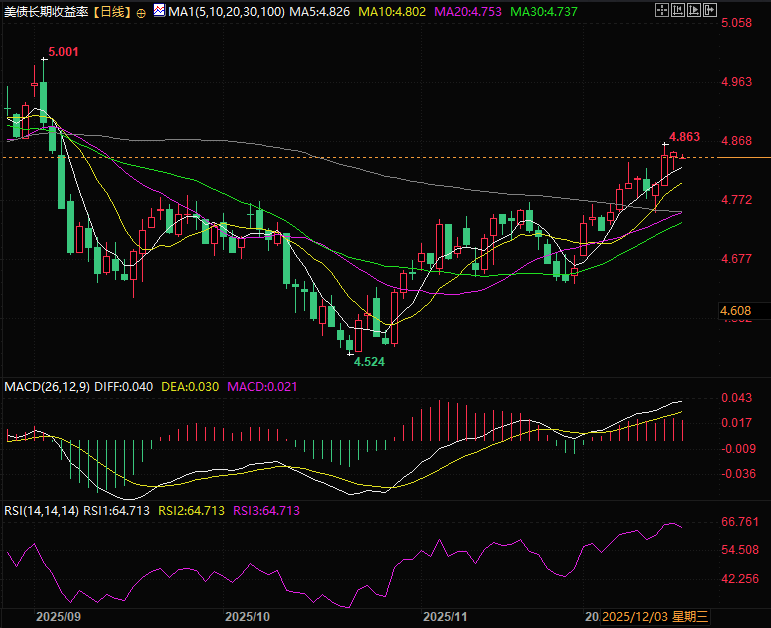
The US dollar index is under short-term pressure due to the Federal Reserve's interest rate cuts and the downward pull of short-term interest rates from the RMP on long-term interest rates. However, with the rebound of long-term US Treasury yields, the US dollar index is expected to rebound.
This steep bear market pattern favors pro-cyclical commodities, financial stocks, cyclical stocks, and short-term government bonds; while long-term safe-haven assets (long-term government bonds, gold) and growth stocks and technology stocks will be under pressure.
The US dollar index has reached the lower end of its trading range and may experience a final dip in anticipation of tonight's non-farm payroll data before rebounding. Support lies at 98.13. A break below 98.13 could create a safety net for the subsequent rebound, making it a relatively worthwhile entry point. Simultaneously, close attention should be paid to the US 10-year Treasury yield, as this could be a signal of a potential dollar index rebound.

(US Dollar Index Daily Chart)
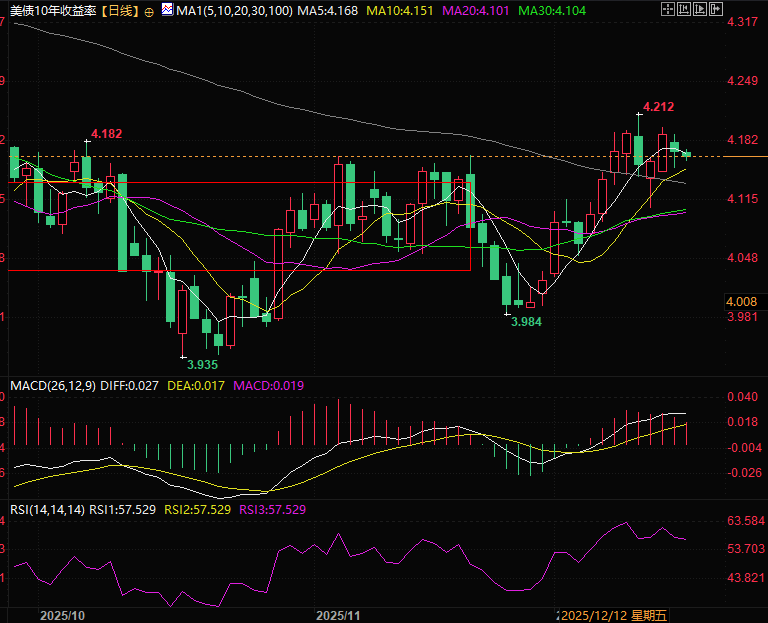
(Daily chart of the yield on the 10-year US Treasury note, source: FX678)
At 17:51 Beijing time, the US dollar index is currently at 98.15.
The steepening of the yield curve is a phenomenon where the Federal Reserve's Reserve Management Purchase Program (RMP) directly lowers short-term interest rates by purchasing short-term Treasury bonds, but fails to lead to a corresponding decline in long-term interest rates; instead, it pushes the yield curve to steepen.
This divergence between policy and the market will cause US Treasury yields to exhibit a bear steepening characteristic, which will have a significant impact on asset classes such as the US dollar, gold, and equities.
The RMP program: A reassurance for short-term US Treasury liquidity.
Most traders initially focused on the pace of interest rate cuts, but overlooked the potential power of the Fed's balance sheet adjustment. The RMP program essentially expands the balance sheet by increasing its holdings of short-term U.S. Treasury securities (with a maturity of less than one year) by $40 billion per month. Its core objective is to alleviate liquidity pressures in the money market, rather than quantitative easing (QE) like in 2020.
This technical operation had an immediate impact on short-term U.S. Treasury transactions: as of October, the Federal Reserve's reserve balance had fallen to a near three-year low of $2.8 trillion, and the implementation of the RMP directly injected incremental liquidity, pushing the secured overnight funding rate (SOFR) down rapidly from 3.9% to a near three-year low of 3.67%.
For US Treasury bond trading, short-term Treasury bills have stable demand support due to the Federal Reserve's regular purchases, and short-term yields have continued to decline, making them a "safety cushion" in low-risk transactions.
Deutsche Bank explicitly pointed out that the RMP is the first substantial expansion of the Federal Reserve's balance sheet since the balance sheet reduction in 2022, and this move provides far more support to the short end of the US Treasury bond market than the interest rate cut itself.
JPMorgan Chase further emphasized in its trading strategy report that the monthly purchase of $40 billion in short-term U.S. Treasury bonds is the core driver of loose market liquidity and the strengthening of short-term U.S. Treasuries.
This situation, where the Federal Reserve lowers short-term bond yields but long-term yields still rise, is a characteristic of a bearish steepening of the yield curve. Rising long-term yields are negative for long-duration assets such as gold, growth stocks, and technology stocks.
The mystery of high long-term US Treasury yields: three core contradictions that need to be resolved in trading.
Unlike short-term US Treasury yields, which have declined with easing liquidity, 10-year US Treasury yields have remained high. This divergence is the core pain point in current US Treasury trading, and it reveals three important trading logics:
The market generally expects short-term interest rates to continue to decline, but inflation uncertainty, high fiscal deficits and duration risks have driven the term premium to rise sharply, completely offsetting the easing effect brought about by interest rate cuts.
Investors' demand for higher compensation for long-term lending is not a "confrontation" with the Federal Reserve, but rather a pure price discovery—the high inflation shock of the 2020s has made long-term bond buyers no longer unconditionally believe that inflation will remain low indefinitely, making a reset of the risk premium inevitable.
The "supply pressure" of medium- and long-term US Treasury bonds is that the US Treasury continues to issue bonds across all maturities, and the issuance of medium- and long-term notes and bonds remains substantial to cover government spending needs. Although issuance has shifted towards shorter-term bonds over the past year, long-term supply has not disappeared, and market absorption pressure persists, limiting the downside potential of long-term US Treasury yields.
The Fed's policy signals represent a "delicate balance." The dot plot clearly signals "gradual rate cuts, not a return to zero interest rates," a stark contrast to the easing policies implemented after the global financial crisis. This more data-driven, moderate approach has deterred long-term US Treasury investors from overly betting on a significant decline in yields, keeping the pricing anchor relatively high.
However, Bank of America’s baseline scenario provides clear trading guidance: if the Fed’s RMP reaches $380 billion in 2026, the 10-year Treasury yield is expected to fall by 20-30 basis points. This means that there is no lack of opportunities in long-term Treasury bonds, but rather that we need to wait for the continued transmission of liquidity easing, the easing of supply pressure, or the signal of a decline in the term premium. Buying on rallies becomes the core strategy.
Transmission to the US Dollar: A Battle Between Short-Term Pressure and Long-Term Support
The structural divergence in the US Treasury market directly impacts the trading logic of the US dollar, creating a game-theoretic pattern of "short-term easing suppression and long-term high-level support."
In the short term, the liquidity easing brought about by the RMP program, coupled with the implementation of interest rate cuts, has directly weakened the interest rate advantage of the US dollar.
The decline in short-term interest rates has reduced the attractiveness of the US dollar against high-yield currencies, and market funds tend to flow to riskier assets with higher returns. The US dollar index faces short-term pressure and volatility.
However, in the long run, the high yield on 10-year US Treasury bonds has provided key support for the US dollar.
As a global asset pricing anchor, the relative advantage of the 10-year US Treasury yield continues to attract global capital inflows, especially given that other major economies are also maintaining loose monetary policies. The "safe haven" attribute and interest rate advantage of the US dollar have not completely disappeared.
In addition, the Federal Reserve's cautious attitude towards inflation and the fundamentals of "slowing but not collapsing" economic growth make it difficult for the dollar to experience a trend of depreciation, and a volatile but slightly stronger trend will remain the main theme in the long term.
Summary and Technical Analysis:
In summary, the US Treasury market is currently in a typical "bear steepening" phase, with the core contradiction being the interplay between the Federal Reserve's easing expectations suppressing short-term interest rates and the market's concerns about long-term inflation and fiscal health pushing up long-term interest rates.
The US dollar index is under short-term pressure due to the Federal Reserve's interest rate cuts and the downward pull of short-term interest rates from the RMP on long-term interest rates. However, with the rebound of long-term US Treasury yields, the US dollar index is expected to rebound.
This steep bear market pattern favors pro-cyclical commodities, financial stocks, cyclical stocks, and short-term government bonds; while long-term safe-haven assets (long-term government bonds, gold) and growth stocks and technology stocks will be under pressure.
The US dollar index has reached the lower end of its trading range and may experience a final dip in anticipation of tonight's non-farm payroll data before rebounding. Support lies at 98.13. A break below 98.13 could create a safety net for the subsequent rebound, making it a relatively worthwhile entry point. Simultaneously, close attention should be paid to the US 10-year Treasury yield, as this could be a signal of a potential dollar index rebound.
(US Dollar Index Daily Chart)
(Daily chart of the yield on the 10-year US Treasury note, source: FX678)
At 17:51 Beijing time, the US dollar index is currently at 98.15.
- Risk Warning and Disclaimer
- The market involves risk, and trading may not be suitable for all investors. This article is for reference only and does not constitute personal investment advice, nor does it take into account certain users’ specific investment objectives, financial situation, or other needs. Any investment decisions made based on this information are at your own risk.