December 18th Financial Breakfast: Gold prices held firm at $4330, silver surged nearly 4%, and oil prices jumped nearly 3%, driven by expectations of interest rate cuts and geopolitical tensions.
2025-12-18 07:29:43
On Thursday (December 18, Beijing time) in early Asian trading, spot gold was trading around $4,337 per ounce. The precious metals market generally rallied on Wednesday, with gold prices surging as much as 1% intraday. Spot silver prices soared nearly 4%, breaking the $66 per ounce mark for the first time, reaching a record high of $66.86 intraday, benefiting from weak US jobs data that fueled expectations of a Federal Reserve rate cut and escalating tensions between the US and Venezuela. US crude oil was trading around $56.78 per barrel. Oil prices rose nearly 3% on Wednesday, with the Trump administration's latest actions against Venezuela exacerbating global political tensions and providing short-term support for oil prices.

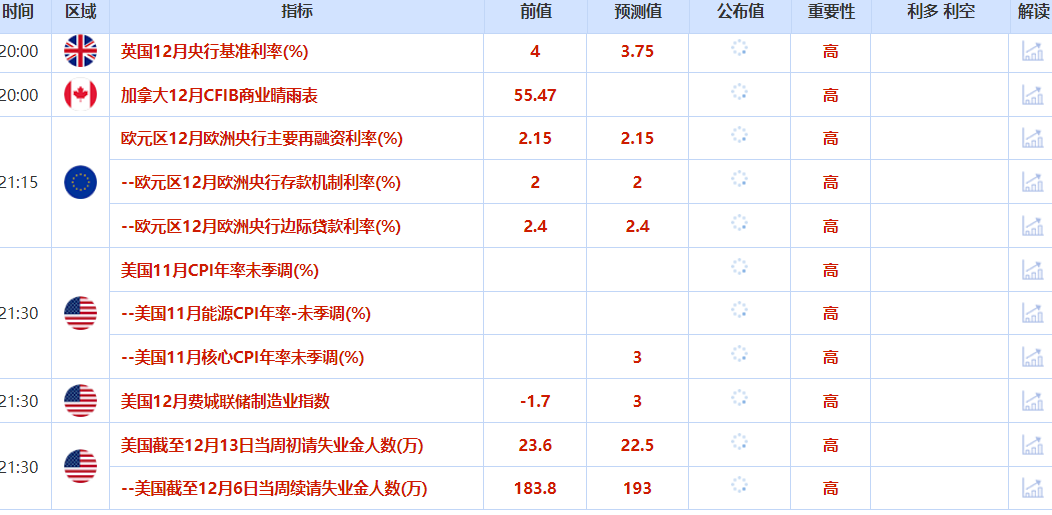
The Ministry of Commerce held a press conference where a spokesperson introduced key recent work in the commercial sector and answered questions from reporters.
Major U.S. stock indexes closed lower across the board on Wednesday, with the S&P 500 and Nasdaq Composite both falling to their lowest levels in three weeks. Continued concerns about the sustainability of massive funding in the artificial intelligence sector weighed heavily on the technology sector.
Stocks related to artificial intelligence generally came under pressure. Oracle's shares plunged 5.4%, mainly due to reports that a key data center partner did not support its next multi-billion dollar data center construction plan. Nvidia, the leading AI chipmaker, fell 3.8%, and Broadcom plummeted 4.5%, dragging down the Philadelphia Semiconductor Index by 3.9%. Additionally, reports that Amazon is in talks to invest approximately $10 billion in OpenAI caused its shares to fall slightly by 0.6%.
Baird investment strategist Ross Mayfield noted, "Anxiety surrounding AI deals is intensifying. The core issues are the sheer size of capital expenditures, the cyclical nature of some investments, and whether these investments will generate sustainable returns in the future." Alphabet, Google's parent company, also fell 3.2% amid reports that it is partnering with Meta to weaken Nvidia's dominance in AI software.
In other sectors, the media industry saw significant changes. Warner Bros. Discovery's board of directors rejected Paramount Skydance's over $100 billion acquisition offer, instead favoring Netflix's acquisition proposal. As a result, Warner Bros. and Paramount's stock prices fell by 2.4% and 5.4%, respectively, while Netflix's stock price rose slightly by 0.2%.
Energy stocks were among the few bright spots, following the rise in international oil prices. This followed US President Trump's order to "block" all oil tankers entering and leaving sanctioned Venezuela. Market sentiment was also somewhat soothed, with Federal Reserve Governor Waller stating that the Fed still has room to cut interest rates given the weak job market. The market is currently closely watching US consumer inflation data to be released on Thursday for clues about the future direction of monetary policy.
Precious metals markets rallied broadly on Wednesday, fueled by weak U.S. jobs data that raised expectations of a Federal Reserve rate cut and escalating tensions between the U.S. and Venezuela. Spot silver prices surged nearly 4%, breaking the $66 mark for the first time and hitting an intraday record high of $66.86. Gold prices also rose, with spot gold closing up 0.7%, after surging more than 1% at one point during the session.
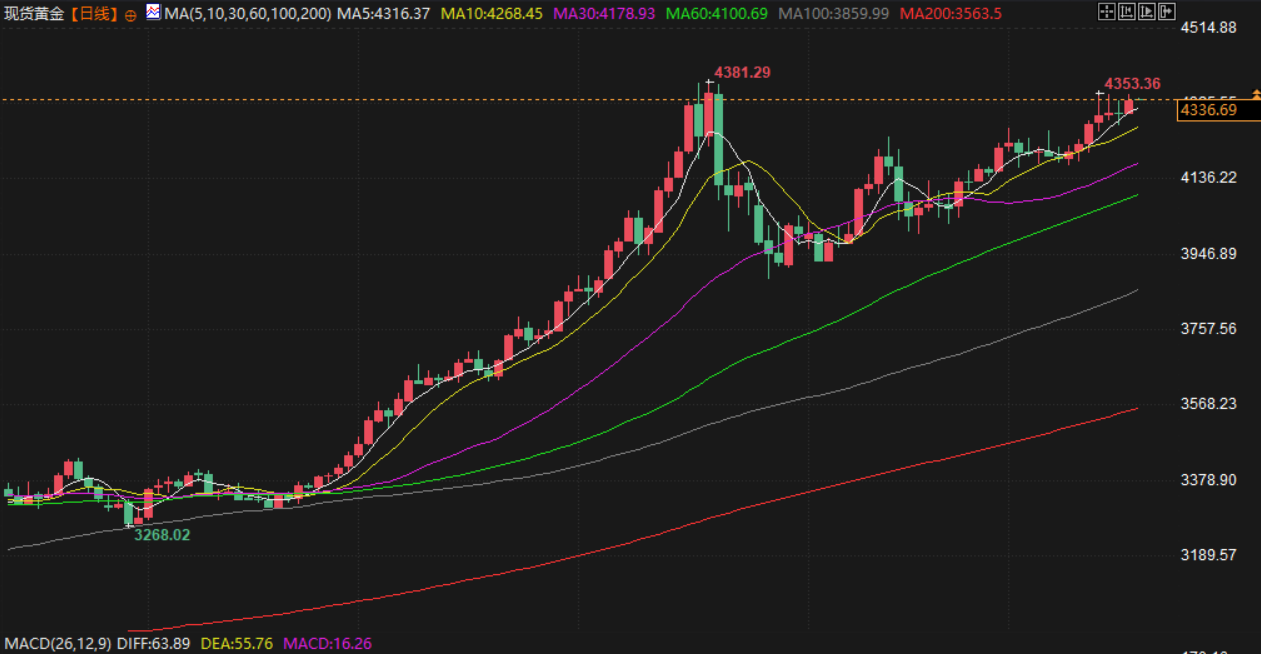
Market analysts believe that silver's strong rally is driving the entire precious metals sector. Marex analyst Edward Meir points out that some funds are rotating from gold to silver, platinum, and palladium, and believes that $70 is a reasonable short-term target for silver. Meanwhile, platinum has also hit its highest point in over 17 years.
The U.S. unemployment rate rose to 4.6% in November, the highest since September 2021, according to data released Tuesday, despite stronger-than-expected job growth. Weakness in the labor market strengthened market expectations for a Federal Reserve rate cut, boosting precious metal assets. Furthermore, President Trump's order to "block" sanctioned oil tankers entering and leaving Venezuela escalated geopolitical tensions, further stimulating safe-haven demand.
Markets are closely watching the U.S. CPI and PCE inflation data to be released later this week for further clues about the Federal Reserve's policy path.
Oil prices rose nearly 3% on Wednesday, mainly driven by geopolitical tensions. US President Trump ordered a "blockade" of all sanctioned oil tankers entering and leaving Venezuela, raising concerns about Venezuelan crude supplies and partially easing market anxieties about a global supply glut.
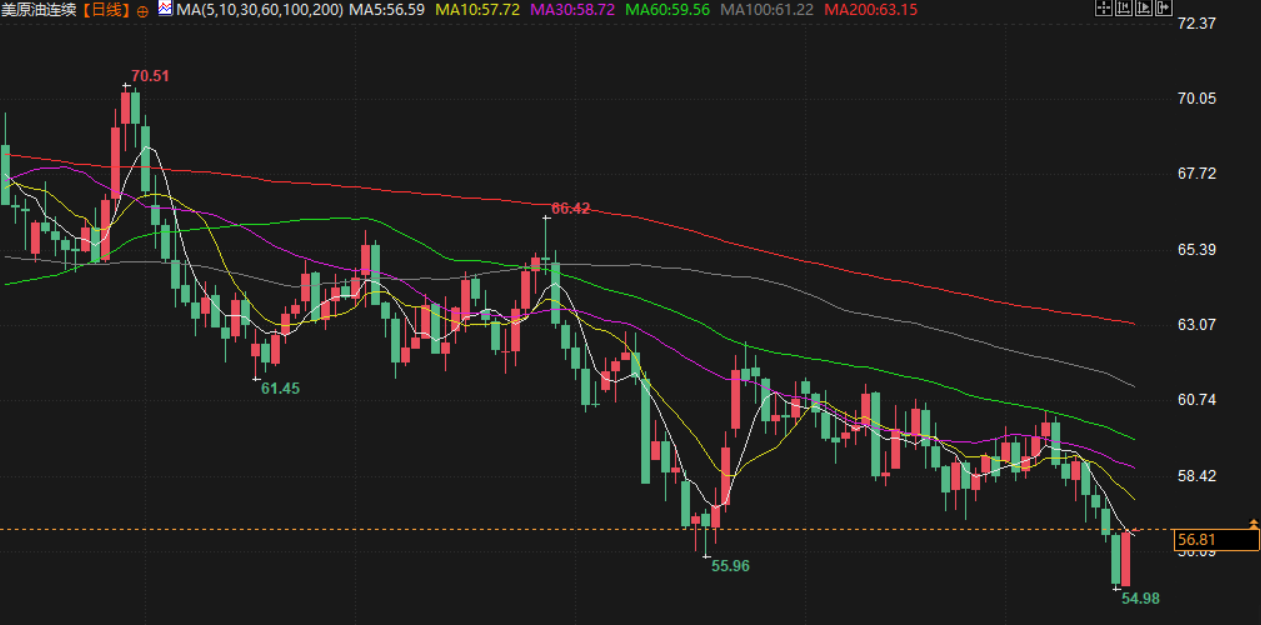
At the close of trading, Brent crude rose 2.97% to settle at $60.58 a barrel, while WTI crude rose 2.85% to settle at $56.74 a barrel. The Trump administration's latest actions against Venezuela escalated global political tensions, providing short-term support for oil prices.
Despite the market volatility triggered by the news, many energy analysts remain skeptical about its substantial impact. A Kpler analysis report points out that this measure alone is insufficient to tighten the global supply-demand balance or drive a sustained rise in oil prices, as Venezuelan crude oil accounts for only about 1% of global supply, and some transportation routes may circumvent sanctions.
Data from the U.S. Energy Information Administration (EIA) showed that U.S. gasoline and distillate fuel inventories rose more than expected last week, limiting further increases in crude oil prices.
Oil prices have been under continued pressure recently, mainly due to weak global demand and expectations that Russia may lift sanctions and release supply following a peace agreement. The sustainability of this geopolitical rebound remains to be seen.
Wednesday saw a key divergence in the foreign exchange market. The pound fell 0.34% against the dollar to 1.3375, retreating from a two-month high. This move was directly caused by a surprisingly significant slowdown in UK inflation data.
The Consumer Price Index (CPI) fell sharply to 3.2% year-on-year in November from 3.6% in October, the lowest level since March. This data dispelled market doubts about whether the Bank of England would take action at its meeting on Thursday, with interest rate futures markets showing traders almost entirely pricing in a 25-basis-point rate cut.
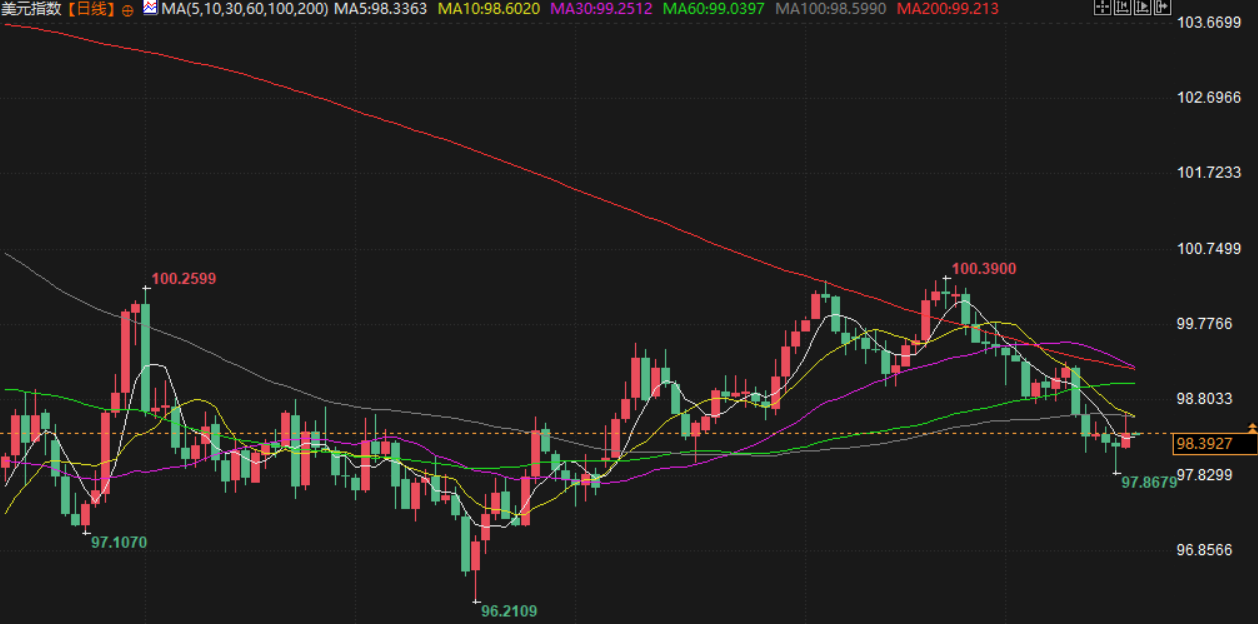
Meanwhile, the dollar index rose 0.16% to 98.37. The dollar's rebound was partly due to its status as a safe-haven asset, as traders became cautious ahead of several major global central banks' interest rate decisions. The market widely expects the European Central Bank to keep interest rates unchanged, while the Bank of Japan is likely to announce a rate hike on Friday, with expectations that it will raise rates to their highest level in 30 years.
The internal disagreements among Federal Reserve officials have also become a focus of the market. Governor Waller suggested that the Fed still has room to cut interest rates given signs of a weak job market. Atlanta Fed President Bostic, however, holds the opposite view, believing last week's rate cut was unreasonable and predicting no further policy easing until 2026.
Looking ahead, traders' attention has turned to a number of upcoming data releases and policy decisions, including Thursday's US CPI data, the Bank of England and European Central Bank interest rate decisions, and Friday's Bank of Japan meeting, all of which could trigger a new round of market volatility.
The United States is preparing to impose a new round of sanctions on Russia following Putin's rejection of the Russia-Ukraine peace agreement.
The United States is preparing a new round of sanctions against Russia's energy sector to increase pressure on Moscow, according to sources familiar with the matter. These sanctions come after Russian President Vladimir Putin rejected a peace agreement with Ukraine. Sources indicate the U.S. is considering several options, including targeting vessels used to transport Russian crude oil in what is known as a "shadow tanker fleet," and traders facilitating related transactions. Some sources say the new measures could be announced as early as this week. Sources revealed that U.S. Treasury Secretary Scott Bessenter discussed the plans earlier this week when he met with ambassadors from European countries. He later posted on social media platform X: "President Trump is a peace president, and I reiterate that under his leadership, the United States will continue to focus on ending the conflict between Russia and Ukraine." Sources cautioned that the final decision rests with Trump. "It is the responsibility of each agency to prepare different options for the president to implement," the White House said in a statement. "The president has not yet made a new decision on sanctions." According to Interfax, Kremlin spokesman Dmitry Peskov told reporters on Wednesday that the Kremlin is aware that some U.S. officials are considering plans to impose new sanctions on Russia. "Clearly, any sanctions would be detrimental to the process of rebuilding relations between the two countries," he said. (CCTV)
Zelensky called on the EU to reach an agreement on using frozen Russian assets to aid Ukraine.
In a video address on the evening of the 17th, Ukrainian President Zelensky appealed to European leaders, hoping that the EU summit scheduled for the 18th and 19th could reach an agreement on using frozen Russian assets to aid Ukraine.
Trump considers pressuring defense contractors to cut stock buybacks
The Trump administration is considering an executive order to pressure defense contractors to reduce stock buybacks and dividend payments, and instead allocate more funds to infrastructure construction and weapons production. According to a source familiar with the matter, the proposed executive order would mandate that companies link executive compensation to overall performance in the delivery of specific equipment. The wording of the executive order may prompt the Pentagon to review how to implement these requirements on defense companies, and its enforceability remains unclear. This move represents an unconventional intervention by the US government in corporate affairs.
Venezuela's largest oil refinery restarts production
Venezuela's largest oil refinery, the Amuay refinery, has restarted production after a power outage. This facility, a key component of PDVSA's Paraguana refining center, has a daily capacity of 645,000 barrels, and its operational stability is crucial to Venezuela's domestic fuel supply and oil exports.
The US Senate passed a $901 billion defense authorization bill.
On March 17 local time, the U.S. Senate passed a $901 billion national defense authorization bill with 77 votes in favor and 20 against. The bill will then be sent to the White House for the U.S. President's signature. (CCTV News)
The Trump administration has invoked emergency powers for the third time and is now trying to keep Washington state coal-fired power plants running.
The U.S. government has ordered a Washington state coal-fired power plant to continue operating beyond its scheduled decommissioning date, citing concerns about potential power outages in the region. The Department of Energy's order requires TransAlta to keep the last unit at its Centralia power station operational after its planned decommissioning at the end of this year. The Trump administration has repeatedly invoked emergency powers to keep this coal-fired plant and two other fossil fuel power plants running beyond their scheduled decommissioning dates, a move that has drawn criticism from environmental groups.
Federal Reserve Governor Waller wants to cut interest rates but says there's no need to rush.
Federal Reserve Governor Christopher Waller supports further interest rate cuts to bring rates back to neutral levels, while also saying policymakers don't need to rush. Waller said Wednesday that in a scenario where inflation continues to slow until 2026, current monetary policy rates are up to 100 basis points above the neutral rate. The neutral rate is the level at which the Fed neither stifles growth nor pushes up inflation. "Because inflation is still high, we can take it slow—there's no need to rush into rate cuts," Waller said on the CNBC forum. "We can take it step by step, lowering the policy rate towards the neutral level." This was Waller's first statement since the Fed cut rates for the third consecutive time last week.
Venezuela's national oil company: Crude oil and petroleum product export operations are proceeding normally.
On the 17th local time, Venezuela's state-owned oil company, PDVSA, issued a statement announcing that Venezuela's crude oil and petroleum product exports are proceeding normally. The statement said that oil tankers associated with PDVSA continue to navigate with full technical support and operational safeguards, legally exercising their freedom of navigation rights. The rights to freedom of navigation and free trade are widely recognized and protected under international law. PDVSA reiterated its determination to defend the energy sovereignty of the Bolivarian Republic of Venezuela, fulfill its legitimate commercial commitments, and protect maritime operations, and reaffirmed its commitment to always acting in accordance with the principles of the Constitution, international maritime law, and the UN Charter. (CCTV News)
European Clearing Bank responds to being placed on negative watch list
On December 16, international rating agency Fitch Ratings placed the European Clearing Bank's credit rating on negative watch, citing the EU's plan to provide "compensation loans" to Ukraine using frozen Russian assets, a move that could exacerbate the bank's legal and liquidity risks. In response, the European Clearing Bank stated on December 17 that Fitch's adjustment indicates the EU's related loan plans urgently need clarification. The EU recently announced an "indefinite freeze" of Russian assets within the EU and plans to finalize specific details at the EU summit on December 18-19. Following the full escalation of the Russia-Ukraine conflict in February 2022, Western countries froze approximately $300 billion in Russian overseas assets. Of this, the EU froze approximately €210 billion worth of assets held by the Russian central bank. About 90% of the frozen Russian assets within the EU are controlled by the Brussels-based European Clearing Bank. (CCTV International News)
A new member has been added to the Earth's mineral family. The newly discovered mineral in my country has been officially named Jinxiu Mine.
On the 17th, it was learned from the China Geological Survey of the Ministry of Natural Resources that, after review and voting by the Professional Committee on Nomenclature and Classification of New Minerals of the International Mineralogical Union, the new mineral discovered and applied for by researchers from the Chinese Academy of Geological Sciences—nickel-bismuth-antimony-arsenic sulfide—has been officially approved, and its Chinese name has been determined as Jinxiu Mine. (CCTV News)
my country's first set of strong vibration accelerometer calibration devices with an error of no more than 0.02% has been approved.
The State Administration for Market Regulation recently approved the establishment of the nation's first strong-motion accelerometer calibration device at the First Monitoring Center of the China Earthquake Administration, providing strong metrological support for the accurate monitoring of the "pulse of the earth." (CCTV News)
Ministry of Industry and Information Technology: Promoting breakthroughs across the entire supply chain, including complete instruments and meters, components and parts, software and standards, materials and consumables.
On December 16, Li Lecheng, Minister of Industry and Information Technology, chaired the 13th Roundtable Meeting for Small and Medium-sized Enterprises (SMEs). The meeting focused on vigorously cultivating and developing high-quality enterprises in the instrumentation field and enhancing the self-reliance and controllability of the industrial chain, listening to presentations and suggestions from enterprises. Li Lecheng pointed out that the Ministry of Industry and Information Technology will thoroughly implement the spirit of the Fourth Plenary Session of the 20th CPC Central Committee and the Central Economic Work Conference, implement the decisions and deployments of the CPC Central Committee and the State Council, accelerate the planning of key tasks for the 15th Five-Year Plan, support the integration of research, education, and industry, strengthen basic research accumulation and key common technology breakthroughs, and promote breakthroughs across the entire industrial chain of instrumentation, including complete machines, components and parts, software and standards, materials and consumables. The Ministry will improve the pilot-scale testing and certification system, cultivate and build a number of performance evaluation and testing certification platforms, and enhance service capabilities in pilot-scale testing and certification, standards and metrology, inspection and testing, and certification and accreditation. The Ministry will accelerate market application, promote the iterative upgrading of high-end products in application, and form real productivity. The Ministry will further leverage the role of enterprises as the main drivers of innovation, encourage increased R&D investment, strengthen upstream and downstream collaboration in the industrial chain, and cultivate a number of leading enterprises and specialized, refined, and innovative enterprises.
Key Focus Today
The Ministry of Commerce held a press conference where a spokesperson introduced key recent work in the commercial sector and answered questions from reporters.
stock market
Major U.S. stock indexes closed lower across the board on Wednesday, with the S&P 500 and Nasdaq Composite both falling to their lowest levels in three weeks. Continued concerns about the sustainability of massive funding in the artificial intelligence sector weighed heavily on the technology sector.
Stocks related to artificial intelligence generally came under pressure. Oracle's shares plunged 5.4%, mainly due to reports that a key data center partner did not support its next multi-billion dollar data center construction plan. Nvidia, the leading AI chipmaker, fell 3.8%, and Broadcom plummeted 4.5%, dragging down the Philadelphia Semiconductor Index by 3.9%. Additionally, reports that Amazon is in talks to invest approximately $10 billion in OpenAI caused its shares to fall slightly by 0.6%.
Baird investment strategist Ross Mayfield noted, "Anxiety surrounding AI deals is intensifying. The core issues are the sheer size of capital expenditures, the cyclical nature of some investments, and whether these investments will generate sustainable returns in the future." Alphabet, Google's parent company, also fell 3.2% amid reports that it is partnering with Meta to weaken Nvidia's dominance in AI software.
In other sectors, the media industry saw significant changes. Warner Bros. Discovery's board of directors rejected Paramount Skydance's over $100 billion acquisition offer, instead favoring Netflix's acquisition proposal. As a result, Warner Bros. and Paramount's stock prices fell by 2.4% and 5.4%, respectively, while Netflix's stock price rose slightly by 0.2%.
Energy stocks were among the few bright spots, following the rise in international oil prices. This followed US President Trump's order to "block" all oil tankers entering and leaving sanctioned Venezuela. Market sentiment was also somewhat soothed, with Federal Reserve Governor Waller stating that the Fed still has room to cut interest rates given the weak job market. The market is currently closely watching US consumer inflation data to be released on Thursday for clues about the future direction of monetary policy.
Gold Market
Precious metals markets rallied broadly on Wednesday, fueled by weak U.S. jobs data that raised expectations of a Federal Reserve rate cut and escalating tensions between the U.S. and Venezuela. Spot silver prices surged nearly 4%, breaking the $66 mark for the first time and hitting an intraday record high of $66.86. Gold prices also rose, with spot gold closing up 0.7%, after surging more than 1% at one point during the session.
Market analysts believe that silver's strong rally is driving the entire precious metals sector. Marex analyst Edward Meir points out that some funds are rotating from gold to silver, platinum, and palladium, and believes that $70 is a reasonable short-term target for silver. Meanwhile, platinum has also hit its highest point in over 17 years.
The U.S. unemployment rate rose to 4.6% in November, the highest since September 2021, according to data released Tuesday, despite stronger-than-expected job growth. Weakness in the labor market strengthened market expectations for a Federal Reserve rate cut, boosting precious metal assets. Furthermore, President Trump's order to "block" sanctioned oil tankers entering and leaving Venezuela escalated geopolitical tensions, further stimulating safe-haven demand.
Markets are closely watching the U.S. CPI and PCE inflation data to be released later this week for further clues about the Federal Reserve's policy path.
oil market
Oil prices rose nearly 3% on Wednesday, mainly driven by geopolitical tensions. US President Trump ordered a "blockade" of all sanctioned oil tankers entering and leaving Venezuela, raising concerns about Venezuelan crude supplies and partially easing market anxieties about a global supply glut.
At the close of trading, Brent crude rose 2.97% to settle at $60.58 a barrel, while WTI crude rose 2.85% to settle at $56.74 a barrel. The Trump administration's latest actions against Venezuela escalated global political tensions, providing short-term support for oil prices.
Despite the market volatility triggered by the news, many energy analysts remain skeptical about its substantial impact. A Kpler analysis report points out that this measure alone is insufficient to tighten the global supply-demand balance or drive a sustained rise in oil prices, as Venezuelan crude oil accounts for only about 1% of global supply, and some transportation routes may circumvent sanctions.
Data from the U.S. Energy Information Administration (EIA) showed that U.S. gasoline and distillate fuel inventories rose more than expected last week, limiting further increases in crude oil prices.
Oil prices have been under continued pressure recently, mainly due to weak global demand and expectations that Russia may lift sanctions and release supply following a peace agreement. The sustainability of this geopolitical rebound remains to be seen.
Foreign exchange market
Wednesday saw a key divergence in the foreign exchange market. The pound fell 0.34% against the dollar to 1.3375, retreating from a two-month high. This move was directly caused by a surprisingly significant slowdown in UK inflation data.
The Consumer Price Index (CPI) fell sharply to 3.2% year-on-year in November from 3.6% in October, the lowest level since March. This data dispelled market doubts about whether the Bank of England would take action at its meeting on Thursday, with interest rate futures markets showing traders almost entirely pricing in a 25-basis-point rate cut.
Meanwhile, the dollar index rose 0.16% to 98.37. The dollar's rebound was partly due to its status as a safe-haven asset, as traders became cautious ahead of several major global central banks' interest rate decisions. The market widely expects the European Central Bank to keep interest rates unchanged, while the Bank of Japan is likely to announce a rate hike on Friday, with expectations that it will raise rates to their highest level in 30 years.
The internal disagreements among Federal Reserve officials have also become a focus of the market. Governor Waller suggested that the Fed still has room to cut interest rates given signs of a weak job market. Atlanta Fed President Bostic, however, holds the opposite view, believing last week's rate cut was unreasonable and predicting no further policy easing until 2026.
Looking ahead, traders' attention has turned to a number of upcoming data releases and policy decisions, including Thursday's US CPI data, the Bank of England and European Central Bank interest rate decisions, and Friday's Bank of Japan meeting, all of which could trigger a new round of market volatility.
International News
The United States is preparing to impose a new round of sanctions on Russia following Putin's rejection of the Russia-Ukraine peace agreement.
The United States is preparing a new round of sanctions against Russia's energy sector to increase pressure on Moscow, according to sources familiar with the matter. These sanctions come after Russian President Vladimir Putin rejected a peace agreement with Ukraine. Sources indicate the U.S. is considering several options, including targeting vessels used to transport Russian crude oil in what is known as a "shadow tanker fleet," and traders facilitating related transactions. Some sources say the new measures could be announced as early as this week. Sources revealed that U.S. Treasury Secretary Scott Bessenter discussed the plans earlier this week when he met with ambassadors from European countries. He later posted on social media platform X: "President Trump is a peace president, and I reiterate that under his leadership, the United States will continue to focus on ending the conflict between Russia and Ukraine." Sources cautioned that the final decision rests with Trump. "It is the responsibility of each agency to prepare different options for the president to implement," the White House said in a statement. "The president has not yet made a new decision on sanctions." According to Interfax, Kremlin spokesman Dmitry Peskov told reporters on Wednesday that the Kremlin is aware that some U.S. officials are considering plans to impose new sanctions on Russia. "Clearly, any sanctions would be detrimental to the process of rebuilding relations between the two countries," he said. (CCTV)
Zelensky called on the EU to reach an agreement on using frozen Russian assets to aid Ukraine.
In a video address on the evening of the 17th, Ukrainian President Zelensky appealed to European leaders, hoping that the EU summit scheduled for the 18th and 19th could reach an agreement on using frozen Russian assets to aid Ukraine.
Trump considers pressuring defense contractors to cut stock buybacks
The Trump administration is considering an executive order to pressure defense contractors to reduce stock buybacks and dividend payments, and instead allocate more funds to infrastructure construction and weapons production. According to a source familiar with the matter, the proposed executive order would mandate that companies link executive compensation to overall performance in the delivery of specific equipment. The wording of the executive order may prompt the Pentagon to review how to implement these requirements on defense companies, and its enforceability remains unclear. This move represents an unconventional intervention by the US government in corporate affairs.
Venezuela's largest oil refinery restarts production
Venezuela's largest oil refinery, the Amuay refinery, has restarted production after a power outage. This facility, a key component of PDVSA's Paraguana refining center, has a daily capacity of 645,000 barrels, and its operational stability is crucial to Venezuela's domestic fuel supply and oil exports.
The US Senate passed a $901 billion defense authorization bill.
On March 17 local time, the U.S. Senate passed a $901 billion national defense authorization bill with 77 votes in favor and 20 against. The bill will then be sent to the White House for the U.S. President's signature. (CCTV News)
The Trump administration has invoked emergency powers for the third time and is now trying to keep Washington state coal-fired power plants running.
The U.S. government has ordered a Washington state coal-fired power plant to continue operating beyond its scheduled decommissioning date, citing concerns about potential power outages in the region. The Department of Energy's order requires TransAlta to keep the last unit at its Centralia power station operational after its planned decommissioning at the end of this year. The Trump administration has repeatedly invoked emergency powers to keep this coal-fired plant and two other fossil fuel power plants running beyond their scheduled decommissioning dates, a move that has drawn criticism from environmental groups.
Federal Reserve Governor Waller wants to cut interest rates but says there's no need to rush.
Federal Reserve Governor Christopher Waller supports further interest rate cuts to bring rates back to neutral levels, while also saying policymakers don't need to rush. Waller said Wednesday that in a scenario where inflation continues to slow until 2026, current monetary policy rates are up to 100 basis points above the neutral rate. The neutral rate is the level at which the Fed neither stifles growth nor pushes up inflation. "Because inflation is still high, we can take it slow—there's no need to rush into rate cuts," Waller said on the CNBC forum. "We can take it step by step, lowering the policy rate towards the neutral level." This was Waller's first statement since the Fed cut rates for the third consecutive time last week.
Venezuela's national oil company: Crude oil and petroleum product export operations are proceeding normally.
On the 17th local time, Venezuela's state-owned oil company, PDVSA, issued a statement announcing that Venezuela's crude oil and petroleum product exports are proceeding normally. The statement said that oil tankers associated with PDVSA continue to navigate with full technical support and operational safeguards, legally exercising their freedom of navigation rights. The rights to freedom of navigation and free trade are widely recognized and protected under international law. PDVSA reiterated its determination to defend the energy sovereignty of the Bolivarian Republic of Venezuela, fulfill its legitimate commercial commitments, and protect maritime operations, and reaffirmed its commitment to always acting in accordance with the principles of the Constitution, international maritime law, and the UN Charter. (CCTV News)
European Clearing Bank responds to being placed on negative watch list
On December 16, international rating agency Fitch Ratings placed the European Clearing Bank's credit rating on negative watch, citing the EU's plan to provide "compensation loans" to Ukraine using frozen Russian assets, a move that could exacerbate the bank's legal and liquidity risks. In response, the European Clearing Bank stated on December 17 that Fitch's adjustment indicates the EU's related loan plans urgently need clarification. The EU recently announced an "indefinite freeze" of Russian assets within the EU and plans to finalize specific details at the EU summit on December 18-19. Following the full escalation of the Russia-Ukraine conflict in February 2022, Western countries froze approximately $300 billion in Russian overseas assets. Of this, the EU froze approximately €210 billion worth of assets held by the Russian central bank. About 90% of the frozen Russian assets within the EU are controlled by the Brussels-based European Clearing Bank. (CCTV International News)
Domestic News
A new member has been added to the Earth's mineral family. The newly discovered mineral in my country has been officially named Jinxiu Mine.
On the 17th, it was learned from the China Geological Survey of the Ministry of Natural Resources that, after review and voting by the Professional Committee on Nomenclature and Classification of New Minerals of the International Mineralogical Union, the new mineral discovered and applied for by researchers from the Chinese Academy of Geological Sciences—nickel-bismuth-antimony-arsenic sulfide—has been officially approved, and its Chinese name has been determined as Jinxiu Mine. (CCTV News)
my country's first set of strong vibration accelerometer calibration devices with an error of no more than 0.02% has been approved.
The State Administration for Market Regulation recently approved the establishment of the nation's first strong-motion accelerometer calibration device at the First Monitoring Center of the China Earthquake Administration, providing strong metrological support for the accurate monitoring of the "pulse of the earth." (CCTV News)
Ministry of Industry and Information Technology: Promoting breakthroughs across the entire supply chain, including complete instruments and meters, components and parts, software and standards, materials and consumables.
On December 16, Li Lecheng, Minister of Industry and Information Technology, chaired the 13th Roundtable Meeting for Small and Medium-sized Enterprises (SMEs). The meeting focused on vigorously cultivating and developing high-quality enterprises in the instrumentation field and enhancing the self-reliance and controllability of the industrial chain, listening to presentations and suggestions from enterprises. Li Lecheng pointed out that the Ministry of Industry and Information Technology will thoroughly implement the spirit of the Fourth Plenary Session of the 20th CPC Central Committee and the Central Economic Work Conference, implement the decisions and deployments of the CPC Central Committee and the State Council, accelerate the planning of key tasks for the 15th Five-Year Plan, support the integration of research, education, and industry, strengthen basic research accumulation and key common technology breakthroughs, and promote breakthroughs across the entire industrial chain of instrumentation, including complete machines, components and parts, software and standards, materials and consumables. The Ministry will improve the pilot-scale testing and certification system, cultivate and build a number of performance evaluation and testing certification platforms, and enhance service capabilities in pilot-scale testing and certification, standards and metrology, inspection and testing, and certification and accreditation. The Ministry will accelerate market application, promote the iterative upgrading of high-end products in application, and form real productivity. The Ministry will further leverage the role of enterprises as the main drivers of innovation, encourage increased R&D investment, strengthen upstream and downstream collaboration in the industrial chain, and cultivate a number of leading enterprises and specialized, refined, and innovative enterprises.
- Risk Warning and Disclaimer
- The market involves risk, and trading may not be suitable for all investors. This article is for reference only and does not constitute personal investment advice, nor does it take into account certain users’ specific investment objectives, financial situation, or other needs. Any investment decisions made based on this information are at your own risk.